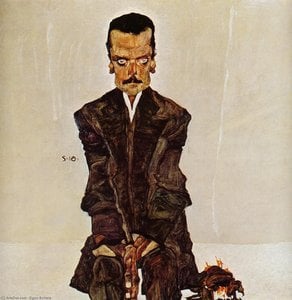
Lilly Steiner avtorja Egon Ščile, ročno slikano oljno platno v reprodukciji mojstra
Predogled v realnem okolju Predogled v AR Preklop na tiskanine Preklop na digitalno sliko Pošlji
Podrobnosti o delu Priročnik Dodaj v priljubljene Prenesi sliko Podobni izdelki Rentgenski posnetek Predvajaj diaporama Vprašanja in odgovori Prenosna prezentacija Statistika

Lilly Steiner Ročno slikano reprodukcijo oljne barve

Egon Schiele (1890-1918) was an Austrian Expressionist painter renowned for his psychologically charged portraits and drawings, notably featuring nude figures. Influenced profoundly by Gustav Klimt and marked by personal hardship—including the loss of his father to syphilis—Schiele developed a unique artistic vision focused on themes of mortality, vulnerability, and eroticism.

Raziskujte intenzivne ekspresionistične umetnosti Egon Schieleja (1890-1918): izrazite portrete, psihološke teme in edinstvene črte. Odkrijte reprodukcije že danes!

Ročno izdelana oljna reprodukcija

Ročno slikano olje na platnu v vaši izbiri velikosti in okvirja, izdelano po naročilu naših umetnikov. ( Preklop na tiskanine Preklop na digitalno sliko)

Corner sample of the P118B picture frame: izoblit polistiren, 5 cm wide and 3 cm thick
P118B €10
Corner sample of the P118H picture frame: izoblit polistiren, 5 cm wide and 3 cm thick
P118H €10
Corner sample of the P118W picture frame: izoblit polistiren, 5 cm wide and 3 cm thick
P118W €10
Corner sample of the P438Z picture frame: izoblit polistiren, 5.5 cm wide and 3.5 cm thick
P438Z €10
Corner sample of the P508JH picture frame: izoblit polistiren, 7 cm wide and 3.5 cm thick
P508JH €12
Corner sample of the P508YH picture frame: izoblit polistiren, 7 cm wide and 3.5 cm thick
P508YH €12
Corner sample of the P805H picture frame: izoblit polistiren, 5 cm wide and 3.5 cm thick
P805H €10
Corner sample of the P805Z picture frame: izoblit polistiren, 5 cm wide and 3.5 cm thick
P805Z €10
Corner sample of the P919BZ picture frame: izoblit polistiren, 7 cm wide and 3.5 cm thick
P919BZ €10
Corner sample of the P919G picture frame: izoblit polistiren, 7 cm wide and 3.5 cm thick
P919G €10
Corner sample of the P919XJ picture frame: izoblit polistiren, 7 cm wide and 3.5 cm thick
P919XJ €10
Corner sample of the P959ZH picture frame: izoblit polistiren, 5 cm wide and 3 cm thick
P959ZH €10
Corner sample of the P968JZ picture frame: izoblit polistiren, 6 cm wide and 4 cm thick
P968JZ €12
Corner sample of the W106C picture frame: masivno drevo, 5 cm wide and 3 cm thick
W106C €8
Corner sample of the W218G picture frame: masivno drevo, 5 cm wide and 3 cm thick
W218G €10
Corner sample of the W218JH picture frame: masivno drevo, 5 cm wide and 3 cm thick
W218JH €8
Corner sample of the W218Y picture frame: masivno drevo, 5 cm wide and 3 cm thick
W218Y €10
Corner sample of the W307PJ picture frame: masivno drevo, 6 cm wide and 3 cm thick
W307PJ €10
Corner sample of the W316G picture frame: masivno drevo, 6 cm wide and 3 cm thick
W316G €10
Corner sample of the W316PJ picture frame: masivno drevo, 6 cm wide and 3 cm thick
W316PJ €8
Corner sample of the W316Y picture frame: masivno drevo, 6 cm wide and 3 cm thick
W316Y €10
Corner sample of the W398PJ picture frame: masivno drevo, 5 cm wide and 3 cm thick
W398PJ €8
Corner sample of the W4111J picture frame: masivno drevo, 6.5 cm wide and 3.5 cm thick
W4111J €10
Corner sample of the W500HY picture frame: masivno drevo, 7 cm wide and 5 cm thick
W500HY €15
Corner sample of the W500JH picture frame: masivno drevo, 7 cm wide and 5 cm thick
W500JH €15
Corner sample of the W692G picture frame: masivno drevo, 8 cm wide and 4 cm thick
W692G €12
Corner sample of the W849H picture frame: masivno drevo, 5 cm wide and 3 cm thick
W849H €8
Corner sample of the W940BG picture frame: masivno drevo, 7.5 cm wide and 4.5 cm thick
W940BG €15
Corner sample of the W953PJ picture frame: masivno drevo, 6 cm wide and 3.5 cm thick
W953PJ €8

Standardna velikost
po meri
CM
INCH

Izberite eno od naših vnaprej določenih velikosti, ki ustrezajo prvotnim proporcijam umetničkega dela.

širina
višina

Vnesite širino in višino, ki jih potrebujete, da se slika prilega vašemu okviru ali steni. Ker je delo ročno slikano, lahko umetnik pri različnih oblikih slik pri robovih doda malo več barve ali pa jih malo odreže — izberite sami. Pred začetkom slikanja vam pošljemo digitalni predogled za potrditev. Slika, prikazana na tej strani, ni končni rezultat — le predogled prikazuje dejansko podobo.

Primeri možnih sprememb: Zamenjava obraza s fotografijo stranke; Dodajanje hišnega ljubljenčka (npr. zamenjava mačke s psom); Vključitev skritega sporočila v ozadje; Sprememba pokrajine ali elementov v ozadju.
Po oddaji naročila bo ekipa WahooArt.com stranki po e-pošti poslala navodila in predogled digitalnega predogleda.

Mednarodna dostava () v 3/4 tednih namesto običajnih 5 tednov. (10 november). Brez kompromisov pri kakovosti.

Brezplačna ekspresna dostava po vsem svetu
Visokokakovostno laneno platno
Popolno zavarovanje pošiljke
Garancija povračila carine in uvoznih davkov
Garancija popolnega barvnega ujemanja
100-dnevna politika vračil (le v primeru okvar)
Garancija 100% povračila denarja
Popust pri večjem naročilu

Skupna cena

€ 266

Lilly Steiner

Tehnik reprodukcije

Velikost reprodukcije

-

Skupna cena

€ 266

Ključni podatki

  • Medium: Black crayon on paper
  • Movement: Expressionism
  • Title: Lilly Steiner
  • Artistic style: Austrian Expressionist
  • Artist: Egon Schiele

Umetniški kviz

Pri vsakem vprašanju je na voljo le eden pravilen odgovor.

Vprašanje 1:
What artistic movement is Egon Schiele’s ‘Lilly Steiner’ primarily associated with?
Vprašanje 2:
The predominant element in the artwork's composition is:
Vprašanje 3:
What technique did Schiele employ to create texture and depth?
Vprašanje 4:
The painting’s color palette utilizes:
Vprašanje 5:
What is the overall mood conveyed by ‘Lilly Steiner’?

Lilly Steiner: A Study in Expressionist Vulnerability

Egon Schiele’s “Lilly Steiner,” completed in 1918, stands as a haunting testament to the artist's signature style—a masterful blend of psychological intensity and gestural linework that captures the essence of Expressionism. This black crayon sketch depicts two figures: a portrait of Lilly Steiner herself and a smaller figure nestled beneath her gaze, creating an intimate tableau imbued with palpable emotion.

The composition prioritizes verticality, positioning Steiner’s head and shoulders slightly off-center—a deliberate asymmetry that contributes to the artwork's dynamism. Below her, a diminutive form occupies the lower portion of the image, subtly overlapping Steiner’s torso, fostering an unspoken connection between the two subjects. Schiele eschews traditional perspective, flattening the scene and simplifying spatial relationships, reflecting a stylistic choice rooted in conveying inner turmoil rather than realistic representation.

Dominating the artwork is the pervasive use of black ink on white paper—a stark contrast that amplifies the linework’s expressive quality. Lines aren't smooth or uniform; instead, they surge with jagged edges and intersecting contours, mirroring Schiele’s preoccupation with capturing raw emotion. Particularly striking are the intricate lines delineating Steiner’s hair, which writhe and twist in a manner characteristic of Schiele’s technique—a deliberate distortion intended to convey psychological depth.

Organic shapes prevail, mirroring the natural curves of human anatomy. There's no geometric rigidity; instead, forms flow seamlessly across the surface, reflecting Schiele’s belief that art should communicate feeling directly. Texture is suggested through varying densities of linework—darker areas appear richer and more textured than lighter passages—underscoring Schiele’s commitment to tactile representation.

The artwork evokes a profound sense of introspection and vulnerability. Steiner's gaze directs upward, conveying melancholy and contemplation—a visual embodiment of Schiele’s exploration of human emotion. The smaller figure beneath her embodies repose or perhaps resignation, furthering the painting’s contemplative mood. “Lilly Steiner” isn’t merely a depiction of two individuals; it’s an invitation to contemplate themes of mortality, intimacy, and psychological complexity—themes that resonate powerfully within Schiele's broader oeuvre.

Schiele’s work aligns perfectly with Expressionism, prioritizing subjective experience over objective observation. He achieved this remarkable feat through a technique characterized by spontaneous linework and unwavering focus on conveying inner feelings. The meticulous rendering of Steiner’s hair—a deliberate distortion—serves as a microcosm of Schiele's broader artistic vision.

This artwork exemplifies the Expressionist movement's commitment to portraying emotion with uncompromising honesty. Its enduring appeal lies in its ability to capture the essence of human vulnerability and psychological depth—qualities that continue to fascinate art historians and collectors alike.

Vprašanja in odgovori

Kdo je ustvaril "Lilly Steiner"?

Avtor dela "Lilly Steiner" je Egon Ščile. Del je katalogiran pod imenom Egon Ščile.

Kje lahko prenesem "Lilly Steiner" avtorja Egon Ščile?

Digitalno sliko za "Lilly Steiner" lahko prenesete na strani Prenos digitalne slike, kjer je na voljo možnost prenos digitalne slike visoke ločljivosti.

V kateri umetniški smer pripadajo "Lilly Steiner" avtorja Egon Ščile?

"Lilly Steiner" je del umetniškega sloga Expressionism, ki predstavlja umetniško tradicijo, v katero je delo vključeno.


Biografija umetnika

Egon Schiele: Austrian Expressionist Painter

Austrian art has since acquired legendary status in interdisciplinary cultural studies. Histories of modern Austrian art generally begin with the architectural boom that swept Vienna in the second half of the nineteenth century. During this period of strong economic growth, the Emperor Franz Josef constructed a necklace of public edifices along the broad Ringstrasse that encircles Vienna’s inner city, prompting artists to flock to the capital from all over to compete for decorative mural commissions. The most renowned painter of the era was Hans Makart, but the young Gustav Klimt also earned his reputation executing commissions on the interior walls of structures such as theaters and museums. The favored style combined a sort of blowsy eroticism with a firm grip on classical and historical allegory. Starting from his masterpiece *The Kiss*, Klimt gradually moved away from the accepted formula, however, evolving a personal symbolism that was less conventionally readable as well as more overtly sexual. This combination proved devastating so far as the tasted of staid Vienna were concerned: Klimt was banished from the ranks of public muralists, and henceforth had to seek support solely from well-heeled private patrons.

Early Life & Influences

Egon Schiele was born in Tulln an der Donau – a picturesque region with vineyards, onion-domed towers and Baroque monasteries. Yet this idyllic setting is hardly reflected in his work.
Instead, many of his landscapes appear melancholic, sometimes sombre. Perhaps he was processing the early death of his father from syphilis and the subsequent loss of his sister Elvira.
Raised initially by his mother and then under the somewhat controlling guardianship of his uncle Leopold Czihaczek, Schiele’s childhood lacked conventional stability but fostered a fiercely independent spirit. Even as a boy, he displayed an intense fascination with trains—a motif that subtly reappeared in later paintings—and a burgeoning talent for drawing, though this was initially met with disapproval from his father who saw it as a distraction from more practical pursuits. The early death of his sister Elvira also cast a long shadow over the young artist’s psyche. These formative experiences instilled within him a sensitivity and an emotional rawness that would become hallmarks of his artistic expression, a constant grappling with themes of life, death, and the human condition.

Vienna Secession & Artistic Breakthrough

Schiele's formal artistic training began at the Kunstgewerbeschule (School of Arts and Crafts) in Vienna, but he quickly found itself stifled by its conservative approach. He transferred to the Akademie der bildenden Künste (Academy of Fine Arts), only to become further disillusioned with its rigid academic traditions. This dissatisfaction led him to abandon formal training altogether, choosing instead to forge his own path, a testament to his unwavering artistic conviction.
The influence of Gustav Klimt was pivotal during these early years; Schiele admired Klimt’s decorative style and exploration of symbolism, even receiving mentorship from the established artist.
He co-founded the Neues Wiener Kunstgruppe (New Viennese Art Group) in 1909, aligning himself with other progressive artists who challenged the prevailing artistic norms. His distinctive style features elongated figures, contorted poses, and expressive lines that convey a sense of unease and emotional intensity.

Style Characteristics & Recurring Themes

Schiele’s art is immediately recognizable for its raw honesty and psychological depth.
He fearlessly confronted themes often considered taboo – sexuality, death, anxiety, isolation – with an unflinching gaze.
His distinctive style features elongated figures, contorted poses, and expressive lines that convey a sense of unease and emotional intensity. The human form, particularly the nude, became his primary subject, not as an object of idealized beauty but as a vessel for exploring the complexities of human experience.
Schiele didn’t shy away from depicting himself in unflattering or vulnerable poses, revealing a profound level of self-awareness and introspection.

Legacy & Recognition

Despite facing censorship and legal challenges – including a brief imprisonment for allegedly corrupting minors with his art – Schiele gained recognition within Vienna’s avant-garde circles.
His work challenged the conventions of the time, provoking both admiration and outrage.
By the time of his untimely death during the Spanish flu pandemic in 1918 at the age of twenty-eight, he had established himself as a leading figure in Austrian Expressionism. Significant works such as *Self-Portrait with Physalis*, *Couple Embracing*, and *Field Landscape (Kreuzberg near Krumau)* stand as testaments to his artistic genius.
His influence on subsequent generations of artists is undeniable, particularly those interested in exploring psychological themes and challenging conventional artistic norms.

Egon Ščile

Egon Ščile

1890 - 1918 , Avstrija

Hitri podatki

  • Artistic Movement Or Style: Expresionismo
  • Artists Who Influenced This Artist: ['Gustav Klimt']
  • Date Of Birth: 12 giugno 1890
  • Date Of Death: 31 octubre 1918
  • Full Name: Egon Schiele
  • Nationality: Austriaco
  • Notable Artworks:
    • Autoritratto con Physalis
    • Giovane coppia
    • Paesaggio campo (Kreuzberg)
  • Place Of Birth: Tulln an der Donau, Austria
Raziščite umetniška dela, razvrščena po temah, slogih in značilnostih.