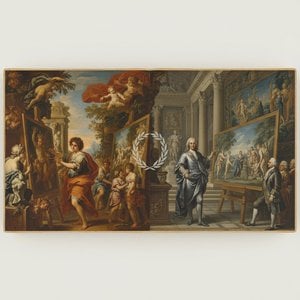
The Architect of Baroque Splendor
Claude Gillot (1673–1722) remains a luminous figure in the tapestry of late Baroque France, an artist whose versatile hand touched nearly every facet of the visual culture of his era. Born in the historic town of Langres, north of Dijon, Gillot’s early creative impulses were nurtured by his father before he ventured to Paris to refine his craft. His artistic journey was far from linear; he was a true polymath of the arts, moving with ease between the delicate precision of printmaking, the structural demands of metalworking, and the grand-scale imagination required for theatrical design. This multidisciplinary foundation allowed him to approach the canvas not merely as a surface for pigment, and but as a stage where light, movement, and drama could converge.
The trajectory of Gillot’s career was profoundly shaped by his apprenticeship under the legendary Jean Watteau around 1703. From Watteau, he absorbed the ethereal qualities of the emerging fête champêtre style—a genre characterized by pastoral elegance and aristocratic leisure. Yet, while he inherited this delicate sensibility, Gillot infused it with a unique vigor derived from his work in the Parisian theater. His extensive collaborations with playwrights and composers to design elaborate sets and costumes for operas and comedies instilled in him a mastery of visual storytelling. He understood how to direct the viewer's eye through composition, using the theatricality of costume and scenery to breathe life into mythological and contemporary narratives alike.
A Mastery of Myth and Motion
Gillot’s ascent within the prestigious Académie Royale de peinture et de sculpture in 1715 marked a definitive moment in his professional life, signaling his recognition as a master of monumental composition. His breakthrough was anchored by works that celebrated the grandeur of classical antiquity through a contemporary lens. In masterpieces such as “Feast of Pan” and “Feast of Bacchus,” Gillot demonstrated an extraordinary ability to blend the divine with the terrestrial. These canvases were not merely depictions of myth; they were sensory experiences, where the lushness of the landscape met the exuberant energy of mythological revelry.
His technique was characterized by a sophisticated use of color and form that could shift from the soft, dreamlike textures reminiscent of his mentor to a more robust, dramatic Baroque intensity. This versatility allowed him to capture the very essence of the commedia dell’arte, bringing the wit and character of masked performers to life with a sense of spontaneous motion. Through his engravings and paintings, he documented the social graces and theatrical whimsies of the French court, creating a visual record that was as much about the spirit of the age as it was about the subjects themselves.
Legacy of the Rococo Prelude
As the art world began to transition from the heavy grandeur of the Baroque toward the lighter, more intimate aesthetics of the Rococo, Gillot’s influence remained foundational. He served as a vital bridge between generations, influencing later masters such as Lancret by refining the vocabulary of pastoral scenes and theatrical character studies. His ability to marry the structural discipline of classical painting with the whimsical charm of the stage helped define the aesthetic sensibilities of the early 18th century.
Today, the significance of Claude Gillot lies in his role as a creator of atmosphere. Whether through the intricate lines of a print or the sweeping vistas of a mythological feast, his work continues to evoke the vibrant, theatrical pulse of pre-revolutionary France. He remains an artist whose legacy is found not just in individual masterpieces, but in the very way we perceive the intersection of art, theater, and the beautiful artifice of life.



 Predogled
 Kupi ročno naslikano sliko
 Pošlji
 Deli
Deli
 Podrobnosti o delu

 Prenesi
 Podobni izdelki
 Rentgenski posnetek
 Predvajaj diaporama
 Statistika


 Razviljaj več






































 Možnost stekla je na voljo le za velikosti pod 110 cm