A Surreal Symphony of Faces: Deconstructing Reality with Andy Warhol
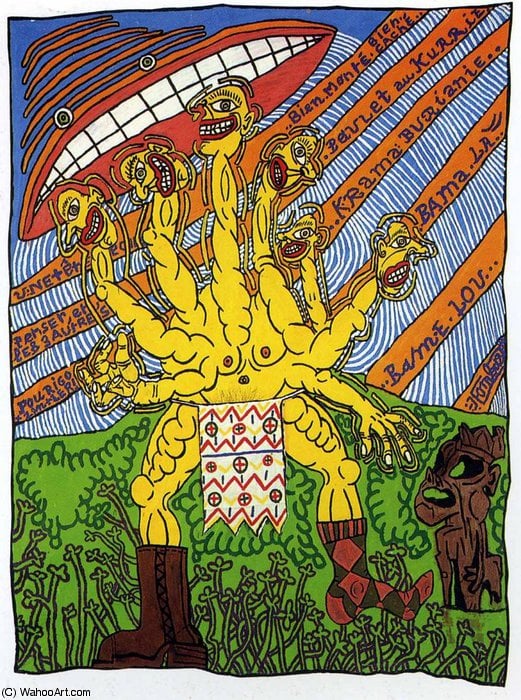
Andy Warhol’s “untitled (5729)” is not merely a painting; it's an immersive experience, a kaleidoscopic plunge into the anxieties and fascinations of American culture in the mid-1960s. This arresting image, dominated by a colossal, almost monstrous yellow creature adorned with a multitude of mouths, immediately commands attention – a visual embodiment of excess and the overwhelming bombardment of imagery that defined the era. The sheer scale of the central figure, coupled with its unsettling multiplicity of faces, speaks to Warhol’s core concern: how we perceive reality in an age saturated by mass media and celebrity culture. The painting's vibrant palette—a riot of yellows, greens, reds, blues, and oranges—further amplifies this sense of sensory overload, mirroring the frenetic energy of New York City at that time.
Warhol’s technique is instantly recognizable – a masterful application of silkscreen printing. This method, borrowed from commercial advertising, lends an uncanny smoothness to the surfaces, flattening perspective and stripping away any illusion of depth. The deliberate lack of brushstrokes contributes to the painting's detached, almost clinical quality, reflecting Warhol’s desire to remove the artist’s hand and elevate the image itself to a position of importance. The repetition inherent in silkscreening – each mouth meticulously replicated – underscores the themes of mass production and the blurring of individual identity that were central to his artistic vision.
Echoes of Nouvelle Figuration and Narrative
To fully appreciate “untitled (5729),” it’s crucial to consider its place within the broader context of 1960s art. Warhol was deeply influenced by Gilles Aillaud, a key figure in the French movement known as Nouvelle Figuration. Aillaud's work, characterized by powerful depictions of zoo animals – lions, monkeys, elephants – often imbued with symbolic weight and philosophical commentary, explored themes of human nature, power, and vulnerability. Warhol adopted this approach, translating Aillaud’s evocative imagery into the realm of American pop culture. The creature in “untitled (5729)” can be interpreted as a distorted reflection of humanity itself—a being overwhelmed by its own desires, anxieties, and the relentless demands of the external world.
Furthermore, the inclusion of the smaller figures in the background – including a solitary individual near the bottom right corner – hints at a narrative element. These figures, seemingly oblivious to the colossal creature dominating the scene, represent the everyday lives of individuals caught within this larger cultural landscape. They are witnesses to the spectacle, perhaps even participants in its unsettling drama. This layering of perspectives—the monumental and the mundane—is characteristic of Narrative Figuration, another movement that sought to capture contemporary life through symbolic imagery.
Symbolism and the American Psyche
The multitude of mouths on the creature’s body is undoubtedly the painting's most striking feature. Each mouth represents a voice, an opinion, a demand – a constant barrage of information vying for attention. It speaks to the anxieties surrounding communication in a rapidly changing society, where individuals are increasingly exposed to competing narratives and fragmented identities. The smiling face, despite the overwhelming number of mouths, suggests a paradoxical sense of optimism or perhaps a desperate attempt to maintain composure amidst chaos.
The yellow color itself carries significant symbolic weight. Yellow is often associated with happiness, energy, and even danger – a potent combination that reflects the complex emotional landscape of the 1960s. It’s a color that simultaneously attracts and repels, mirroring the allure and unease inherent in Warhol's work. The overall composition evokes a sense of movement and dynamism, as if the creature is perpetually shifting and transforming—a visual representation of the instability and uncertainty of the era.
A Legacy of Pop Art and Reproduction
“untitled (5729)” stands as a quintessential example of Andy Warhol’s artistic genius. It's a work that continues to resonate with viewers today, prompting reflection on the nature of identity, media saturation, and the American psyche. WahooArt offers meticulously crafted hand-painted reproductions of this iconic piece, allowing you to bring its captivating imagery into your own space. These reproductions capture not only the visual details but also the emotional depth and symbolic richness of Warhol’s original work, providing a tangible connection to one of the 20th century's most influential artists.