The Harmony of Al-Mizan: The Artistic Vision of Ahmad Sami Angawi
In the heart of Jeddah, where the ancient rhythms of the Hejaz region meet the pulse of modern Saudi Arabia, the work of Ahmad Sami Angawi emerges as a profound meditation on equilibrium. Born in 1981, Angawi has cultivated a creative practice that does not merely observe tradition but breathes new life into it through a sophisticated dialogue between the past and the present. His artistic journey is defined by a rare duality; he possesses the technical precision of an industrial designer and the soulful reverence of a master of traditional arts. This unique intellectual foundation, forged at the Pratt Institute in New York and refined at The Prince's School of Traditional Arts in London, allows him to navigate the complexities of contemporary aesthetics while remaining deeply anchored in his cultural roots.
Angawi’s work is profoundly shaped by the concept of Al-Mizan, or balance. This Islamic principle serves as both a spiritual compass and a structural blueprint for his compositions. To Angawi, balance is not a static state but a dynamic pursuit of harmony between light and shadow, geometry and organic form, and heritage and innovation. His explorations are heavily influenced by the colorful diversity of the Hejaz region and his Moroccan lineage, drawing inspiration from the intricate architectural details that define Western Saudi Arabia. Through his eyes, the historical patterns of his ancestors are transformed into a living language capable of speaking to a global, modern audience.
A Tapestry of Mediums and the Legacy of Mangour
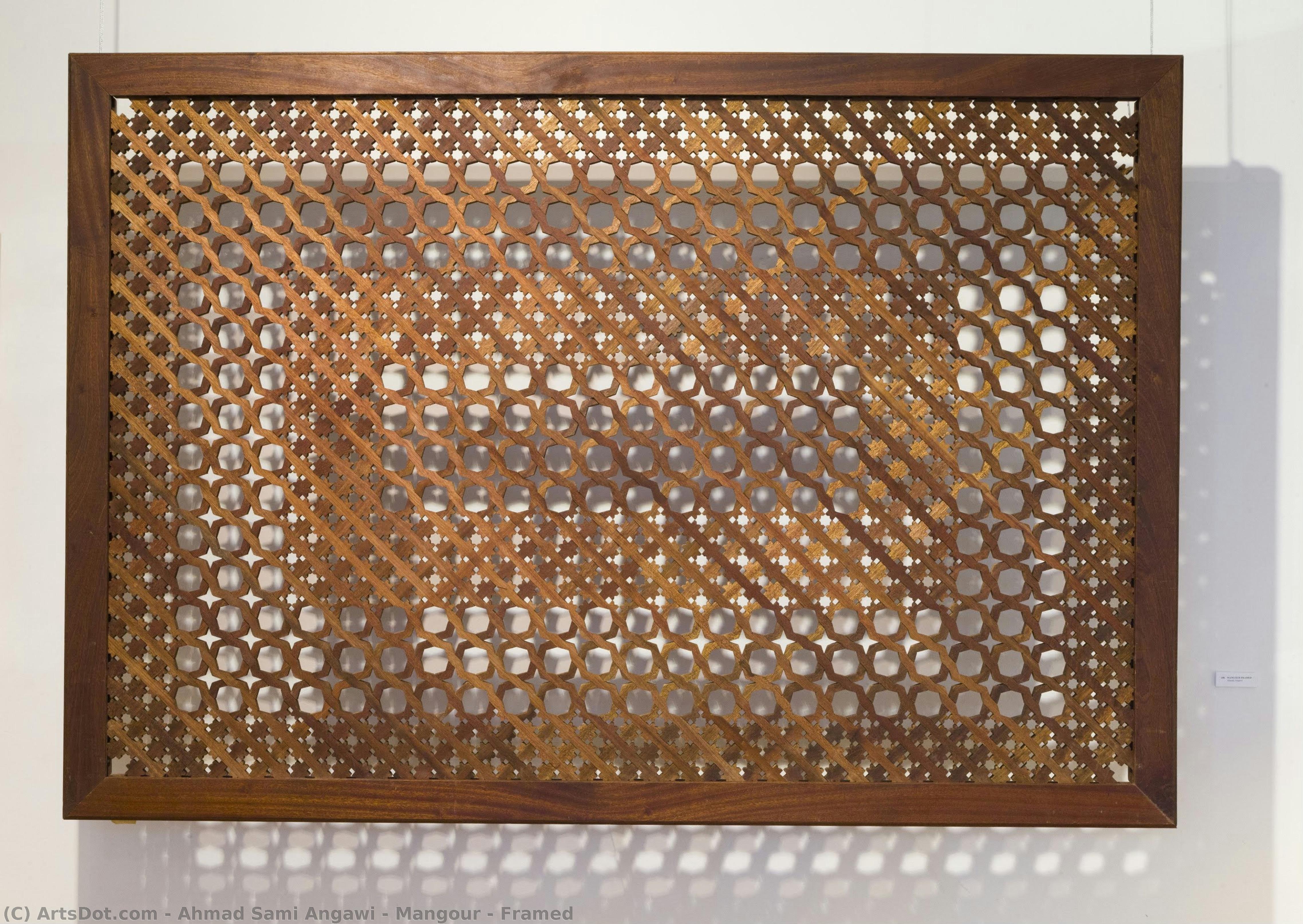
The breadth of Angawi’s multidisciplinary practice is nothing short of extraordinary, spanning sculptural installations, textiles, and graphic design. He approaches each medium as an opportunity to investigate the human condition and our relationship with the environment. One of his most celebrated achievements lies in his reimagining of Mangour—the traditional wooden lattice screens used in Hejazi architecture to regulate light and airflow. In his hands, these screens transcend their functional origins to become mesmerizing works of art. By manipulating intricate geometric patterns and vibrant color palettes, Angativ creates immersive environments where the interplay of sunlight and shadow evokes a sense of timelessness.
His commitment to the preservation of artisanal skills is further evidenced by his entrepreneurial spirit. Through platforms such as Design Studio Shai and Zawiya 97, Angawi has created vital spaces for collaborative creativity. These initiatives are dedicated to the concept of a "living tradition," ensuring that ancient techniques are not relegated to museums but are instead integrated into contemporary design projects. His work with the Albukhary Foundation Gallery of Islamic World stands as a testament to this mission, showcasing how traditional motifs can be scaled into monumental installations that transform architectural spaces into profound cultural experiences.
Ultimately, the significance of Ahmad Sami Angawi lies in his ability to bridge disparate worlds. His art serves as a vital link between:
- The Ancestral and the Avant-Garde: Utilizing ancient geometric wisdom to inform modern sculptural forms.
- The Local and the Universal: Taking the specific architectural vernacular of Jeddah and presenting it through a lens of global contemporary design.
- Structure and Spirit: Using the rigid mathematics of Islamic pattern-making to evoke deep, emotional responses to light and space.
As he continues to push the boundaries of his practice, Angawi remains a pivotal figure in the Saudi art landscape, reminding us that true innovation is most powerful when it honors the foundations upon which it is built.


 Kupi ročno naslikano sliko
 Pošlji
 Deli
Deli
 Podrobnosti o delu

 Prenesi
 Podobni izdelki
 Predvajaj diaporama
 Statistika


 Razviljaj več






































 Možnost stekla je na voljo le za velikosti pod 110 cm


