A Life Rooted in the Swiss Landscape
Adolf Dietrich, born in 1877 and passing away in 1957, was a quietly significant figure in 20th-century Swiss art. Though not widely known internationally during his lifetime, he has since been recognized as a leading exponent of Naïve art, deeply connected to the traditions of New Objectivity. His life unfolded largely within the serene setting of Berlingen, Switzerland, on Lake Constance, and this geographical anchoring profoundly shaped both the subject matter and spirit of his work. Dietrich wasn’t an artist who sought out bustling urban scenes or avant-garde experimentation; instead, he turned inward, meticulously documenting the rhythms of rural existence with a unique blend of precision and heartfelt simplicity. He was, in essence, a chronicler of a disappearing world—a world of farmers, orchards, and the quiet dignity of everyday labor. His artistic journey wasn’t one of dramatic shifts or stylistic revolutions but rather a consistent refinement of his vision, a deepening engagement with the visual language of his surroundings.
The Painterly Language of Simplicity
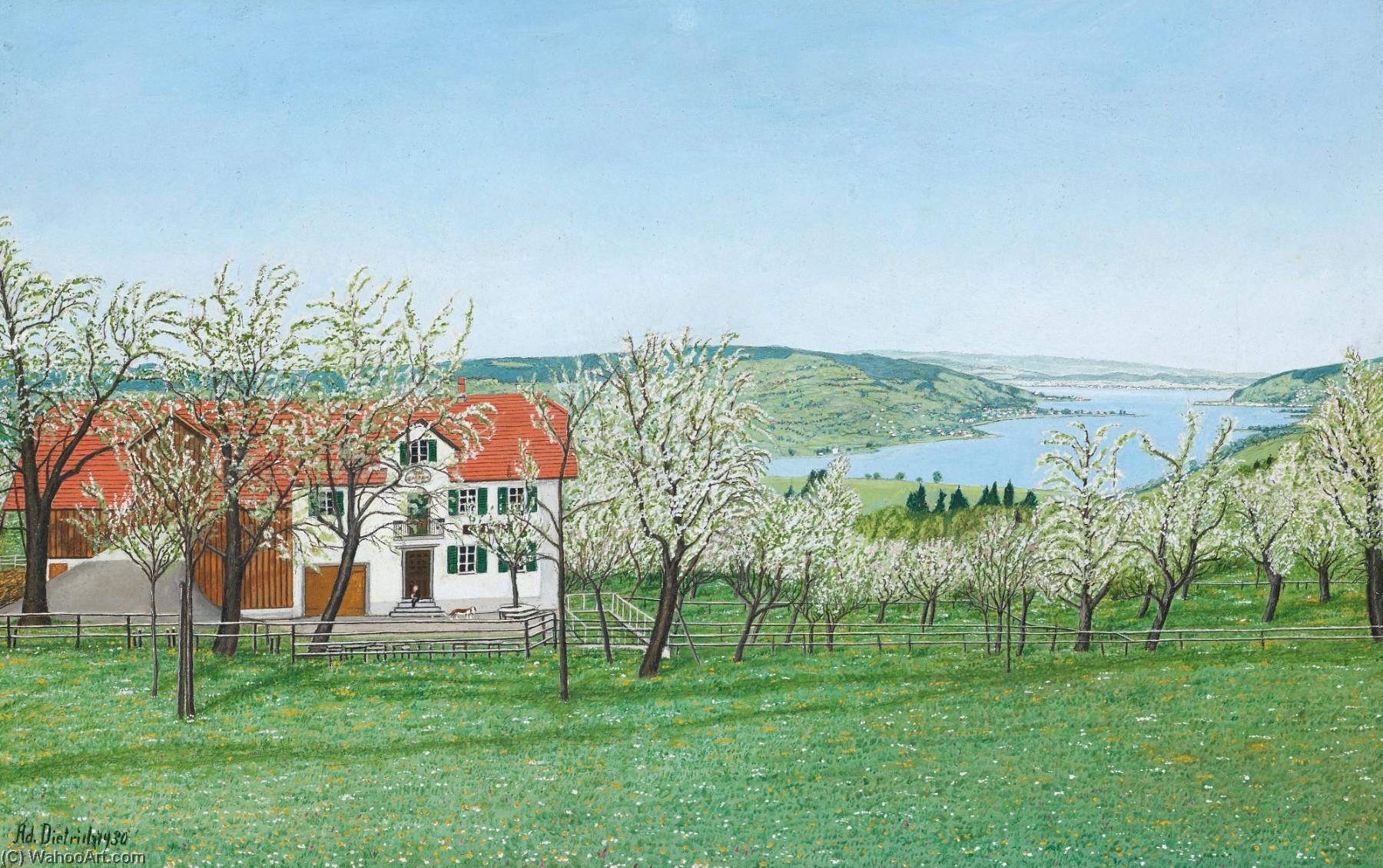
Dietrich's paintings are immediately recognizable for their distinctive style. He eschewed academic conventions in favor of a deliberately naive approach—a term that shouldn’t be mistaken for lack of skill, but rather an intentional rejection of illusionistic depth and perspective. His forms are solid and clearly defined, often outlined with dark contours, reminiscent of folk art traditions and children's drawings. Colors are vibrant yet grounded, reflecting the natural hues of the Swiss countryside: the rich greens of meadows, the warm ochres of barns, the deep blues of the lake. He possessed an extraordinary eye for detail, rendering each leaf, flower, and cobblestone with painstaking accuracy. However, this meticulousness wasn’t employed to create a photographic realism; instead, it served to emphasize the inherent beauty and order within the natural world.
His compositions are often characterized by a flattened perspective and a sense of stillness, inviting viewers to linger and contemplate the quiet poetry of his scenes. He frequently depicted still lifes—arrangements of fruit, vegetables, and household objects—that radiate a sense of abundance and contentment.
Influences and Artistic Development
While Dietrich’s style is often categorized as Naïve, it wasn't born in isolation. The artistic climate of the early 20th century, particularly the rise of New Objectivity (Neue Sachlichkeit) in Germany, exerted a subtle influence on his work. This movement emphasized clarity, realism, and a rejection of emotional excess—qualities that resonate strongly with Dietrich’s paintings. However, he diverged from the often-critical or satirical tone of many New Objectivity artists, choosing instead to celebrate the beauty and dignity of rural life.
His primary influence, however, stemmed from the folk art traditions of Switzerland, particularly the decorative painting found on furniture and houses in his region. He absorbed the bold colors, simplified forms, and directness of expression that characterized these vernacular styles. Over time, Dietrich’s work evolved from a more purely descriptive approach to one that incorporated elements of symbolism and personal narrative. While he rarely depicted dramatic events, his paintings often convey a sense of underlying emotion—a quiet joy in the simple pleasures of life or a subtle melancholy for a world undergoing change.
Themes and Recurring Motifs
Several themes recur throughout Dietrich’s oeuvre. Rural landscapes are central to his work, depicting scenes of farming, harvesting, and village life. He frequently painted orchards laden with fruit, vineyards basking in the sun, and fields dotted with wildflowers. These landscapes aren't merely representations of physical places; they are imbued with a sense of nostalgia and reverence for the natural world. Still lifes also occupy a prominent place in his paintings—arrangements of fruits, vegetables, flowers, and household objects that radiate a sense of abundance and contentment.
- The depiction of daily life: Dietrich’s scenes often feature ordinary people engaged in everyday activities – tending gardens, washing clothes, or simply enjoying a meal.
- Celebration of the seasons: He captured the changing rhythms of nature with meticulous detail, from the blossoming of spring to the harvest of autumn.
- The importance of community: His paintings often depict scenes of social gathering and communal labor, highlighting the bonds that connect people to their land and each other.
Historical Significance and Legacy
Adolf Dietrich’s historical significance lies in his ability to capture the essence of a disappearing way of life. His paintings offer a poignant glimpse into the rural Switzerland of the early 20th century—a world that was rapidly changing under the pressures of modernization and industrialization. While he wasn't actively engaged in political or social commentary, his work implicitly celebrates the values of simplicity, community, and connection to nature. In recent years, there has been a growing appreciation for Dietrich’s unique artistic vision. His paintings are now recognized as important examples of Naïve art and valuable documents of Swiss cultural history. He stands as a testament to the power of quiet observation—a reminder that beauty can be found in the most ordinary of places and that even the simplest subjects can be imbued with profound meaning. His work continues to resonate with viewers today, offering a sense of peace, nostalgia, and a renewed appreciation for the rhythms of the natural world.


 Predogled
 Preklop na tiskanine
 Pošlji
 Deli
Deli
 Podrobnosti o delu

 Prenesi
 Podobni izdelki
 Rentgenski posnetek
 Predvajaj diaporama
 Statistika
 Razviljaj več


