Early Life, Family and Training
Born on February 14, 1902, in Klosterneuburg, Austria, Max Frey entered a world where the brush was a familiar tool. He was the grandson of the academic painter Maximilian Frey, a man whose legacy provided a quiet foundation for the boy's own burgeoning interests. Though he was born into a merchant family, the pull of the arts was a persistent presence in his early years. Before he could fully commit to the canvas, he followed the practical path expected of his lineage, completing a commercial apprenticeship within the family business.
The spark of his true vocation was nurtured by Karl Ludwig Strauch, a drawing teacher who possessed a keen eye for exceptional talent. It was through Strauch's guidance that Max Frey first began to understand the discipline required of a professional artist. This early instruction laid the groundwork for a formal education that would eventually take him to the heart of the imperial capital. Despite the practical demands of his family's trade, the call of creative study proved too strong to ignore.
Between 1918 and 1923, he sought his true calling at the Kunstgewerbeschule in Vienna. Under the tutelage of Professor Adolf Boehm, he refined his technical skills and began to shape the hand that would later touch so many different mediums. This period of study in Vienna transformed the apprentice of a merchant into a dedicated student of form and line, setting the stage for a life spent translating the world onto surface and stone.
Artistic Style and Versatile Career
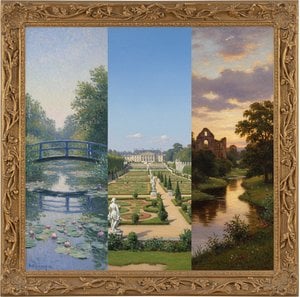
Frey possessed a hand that could navigate both the broad strokes of emotion and the fine precision of detail. His early works leaned heavily into an expressive manner, yet as the years passed, a gentle accuracy began to settle into his brushwork. He was a painter of landscapes and portraits, often using the human figure to breathe a sense of natural liveliness into his scenes. Whether he was capturing the quietude of the countryside or the presence of a sitter, the people in his compositions provided a vital, living pulse to the environment around them.
His talents were not confined to the canvas alone, as he moved through many different spheres of design with ease. He was a man of many crafts, finding work as a book illustrator and a poster designer. His vision extended to the smallest of objects, such as stamps, and to the grander scale of stage design, where he contributed to the productions at the Raimundtheater. He also applied his skill to the creation of patterns for tapestries, proving that his artistic eye could adapt to any medium he chose to touch.
Major Commissions and Professional Honors
His talent for graphic design and large-scale visual arrangements led to significant opportunities across Europe. Between 1925 and 1926, he was tasked with creating the exhibition graphics for the Austrian Pavilion at the GeSoLei exhibition in Düsseldorf. This ability to translate artistic vision into public displays continued as he moved into more international spheres. In 1934, he collaborated with Franz von Zülow to prepare the "Austria" exhibition in London, a project that helped bring his specific aesthetic sensibilities to a broader audience.
The recognition of his skill was not merely a matter of public visibility but was met with formal accolades from the highest artistic circles. The year 1934 proved particularly fruitful, as he was awarded the State Prize for Works of Fine Arts. As his career progressed and his reputation solidified, he continued to receive honors that reflected his standing among his peers. In 1947, he was presented with the Small Golden Medal of the Professional Association of Fine Artists Austria, a distinction that marked his continued relevance in the Austrian art scene.
The later stages of his professional life were marked by the highest levels of institutional respect. He was granted the title of Professor in 1949, a recognition of his mastery and his contributions to the field. Furthermore, he received the Large Golden Honor Medal from the Künstlerhaus, cementing his legacy within the established artistic community of his homeland.
Later Years and Death
In the years following the mid-century shifts in Europe, Frey’s life remained deeply intertwined with the creative circles of Vienna. He shared his life with Margarete "Grete" Plischke, whom he had married on August 22, 1925. Together, they maintained a presence in the artistic community, often working alongside family and friends in shared spaces. His influence extended beyond the canvas and into the instruction of the next generation of creators. From 1946, he dedicated himself to teaching at the Graphische Bundes Lehr- und Versuchsanstalt Wien, passing on his technical skill and eye for detail to his students.
The vitality of his creative output eventually met the limits of the body. He faced a struggle with lung cancer, a hardship that marked his final years. He passed away in Vienna in 1955. His departure left behind a body of work that reflected a life spent observing the nuances of the human form and the natural world with a steady, practiced hand.
Otázky a odpovede
Môžem si prehliadať diela umelca Max Frey podľa kľúčových slov?
Diela umelca Max Frey si môžete preskúmať podľa kľúčových slov na jeho stránke Podľa kľúčových slov. Každé kľúčové slovo spája súvisiace diela do tematických celkov.
V akom meste a v ktorej krajine sa narodil/a Max Frey?
Max Frey sa narodil v meste Klosterneuburg v krajine Austria.
Koľko umelých diel od Max Frey si môžete v katalógu prehliadnuť?
Na stránke Všetky diela umelcov si môžete prelistovať 1 dielo diel od umelca Max Frey.
Môžem si prehliadnuť diela umelca Max Frey podľa farebnej palety?
Diela umelca Max Frey si môžete prehliadnuť podľa farebnej palety na jeho stránke Podľa palety farieb.