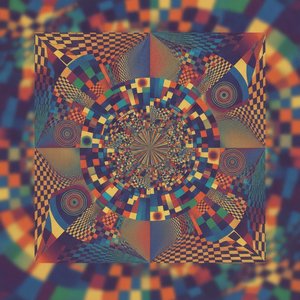
Vertche II: Exploring the Universe Within a Square
Victor Vasarely’s “Vertche II” stands as a cornerstone of Op Art, a movement that revolutionized visual perception in the mid-20th century. Created around 1978, this striking serigraph captures the essence of geometric abstraction—a deliberate departure from representational art towards an exploration of pure form and optical illusion.
The artwork’s dominant palette consists of vibrant blues and deep purples, skillfully juxtaposed to generate a dynamic visual experience. At first glance, it appears as a simple arrangement of squares and triangles; however, closer examination reveals a complex interplay of shapes that create an unsettling yet mesmerizing depth effect. Vasarely wasn't merely depicting geometric forms; he was actively manipulating the viewer’s eye—challenging conventional notions of space and perspective.
Vasarely’s Geometric System: A Quest for Order Amidst Chaos
Born Károly Vaszary in Pécs, Croatia, in 1906, Victor Vasarely embarked on a lifelong artistic journey rooted in mathematical principles. Influenced profoundly by the Bauhaus movement's emphasis on functional design and abstraction, he honed his technique at Sándor Bortnyik’s Műhely workshop.
Vasarely developed a meticulously crafted system of geometric shapes—circles, squares, triangles, rhombuses—that he believed could represent the fundamental structure of reality. He painstakingly calculated the proportions and angles of these forms to achieve maximum visual impact, striving for an equilibrium between order and dynamism. This systematic approach distinguishes Vasarely’s work from more spontaneous artistic expressions.
Op Art: Challenging Perception and Embracing Illusion
“Vertche II” exemplifies the core tenets of Op Art—Optical Art—a movement that sought to stimulate sensory perception through illusionary visual effects. Artists like Vasarely utilized techniques such as repetition, asymmetry, and color modulation to trick the eye into perceiving patterns and shapes that don’t actually exist.
The resulting images appear to shimmer, vibrate, or shift subtly depending on the viewing angle—a deliberate provocation of our visual system. This fascination with illusion wasn't merely a stylistic choice; it reflected a broader philosophical concern with how we perceive the world around us. Vasarely’s “Vertche II” remains an enduring testament to this groundbreaking artistic endeavor.
A Legacy of Bold Geometric Vision
Victor Vasarely (1906-1997) cemented his place in art history as a pioneer of Op Art and kinetic art. His influence extends far beyond the canvas, shaping design principles and inspiring artists across generations. “Vertche II,” with its masterful use of color and geometric abstraction, embodies Vasarely’s unwavering commitment to exploring the boundaries of visual experience—a legacy that continues to captivate audiences today.
Otázky a odpovede
Kde sa odporúča vystaviť dielo „Vertche II“ vo formáte Štvorcový formát?
Pre dielo „Vertche II“ od Victor Vasarely sú uvedené formát (Štvorcový formát) a odporúčaný priestor (Denná miestnosť).
Čo zobrazuje dielo "Vertche II"?
Témy predstavované v díle „Vertche II“ od Victor Vasarely zahŕňajú geometric pattern, op art, color block, abstract composition, visual illusion, minimalist design, chromatic harmony. Spolu zhrňujú predmet skladby.
Je „Vertche II“ od Victor Vasarely svetlé alebo tmavé dielo?
Vnímaná jasnosť diela „Vertche II“ od Victor Vasarely je žiarivý. Je možné ju prispôsobiť osvetleniu určeného priestoru.



 Náhľad v interiéri
 Kúpiť ručne maľovaný obraz
 Odoslať ako digitálnu kartu
 Zdieľať
 Podrobnosti o dielo
 Príručka

 Stiahnuť obraz
 Podobné položky
 RTG skúška
 Prehliadanie diapozoje
 Štatistiky
 Zobraziť viac






































 Možnosť skla je dostupná len pri rozmeroch pod 110 cm