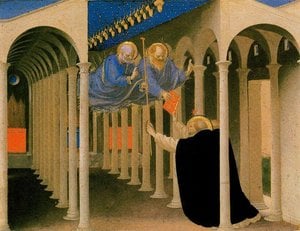
A Moment of Grace: Tiziano Vecellio’s “St Dominic”
Tiziano Vecellio's "St Dominic," painted in 1565, is more than simply a portrait; it’s a carefully constructed tableau of faith, piety, and the enduring power of spiritual leadership. Housed within the hallowed halls of the Galleria Borghese in Rome, this oil on canvas offers a profound glimpse into the Venetian master's ability to imbue a single figure with an almost palpable sense of serenity and authority. The painting’s restrained color palette – primarily cool blues and muted browns punctuated by the stark white of Dominic’s tunic – immediately establishes a mood of contemplative solemnity, drawing the viewer into the saint’s gaze.
The composition itself is remarkably simple yet profoundly effective. St. Dominic, depicted in mid-action, raises his hand as if addressing an unseen audience or perhaps pointing towards a divine revelation. This gesture, coupled with his direct and unwavering stare, creates an immediate connection with the viewer, inviting us to share in his moment of prayerful intensity. The neutral background serves not as a distraction but rather as a deliberate stage for the central figure, amplifying his presence and emphasizing the gravity of his spiritual mission.
The Venetian Titan’s Mastery: Technique and Light
Titian's signature style is vividly present in “St Dominic.” His masterful manipulation of light and shadow—a hallmark of his technique—is particularly striking. The artist employs *chiaroscuro*, a dramatic contrast between light and dark, to sculpt Dominic’s face and hands, lending them an almost sculptural quality. Notice how the illumination highlights the texture of his beard and the folds in his cloak, while simultaneously deepening the shadows around his eyes and mouth, suggesting both wisdom and humility. This careful attention to detail speaks volumes about Titian's dedication to realism and his profound understanding of human anatomy.
Furthermore, the brushwork itself is a testament to Titian’s skill. The application of paint is loose and expressive, creating a sense of movement and vitality within the figure. He avoids overly smooth surfaces, opting instead for a slightly textured finish that adds depth and richness to the image. This technique contributes significantly to the painting's overall luminosity and imbues it with an almost tactile quality.
A Historical Portrait of Faith
“St Dominic” holds significant historical weight, representing one of the last works definitively attributed to Titian during his later years. It’s a period marked by experimentation and a deepening engagement with religious themes – a shift reflected in the painting's solemnity and contemplative mood. The figure of St. Dominic himself was pivotal in establishing the Dominican Order, an influential force within the Catholic Church known for its dedication to education, social justice, and missionary work. By depicting him in this moment of quiet reflection, Titian subtly elevates his subject, portraying him not just as a historical figure but as a symbol of unwavering faith and spiritual guidance.
Symbolism and Emotional Resonance
Beyond the portrait’s immediate visual appeal, “St Dominic” is rich with symbolic meaning. The white tunic traditionally signifies purity and holiness, while the black cloak represents penance and devotion. The raised hand, as mentioned earlier, suggests a call to action – not necessarily physical, but rather a summons to spiritual enlightenment. The painting's emotional impact is profound; it evokes a sense of reverence, contemplation, and perhaps even a yearning for something beyond the material world. It’s a work that invites viewers to pause, reflect, and consider their own relationship with faith and spirituality.
A meticulously crafted oil painting reproduction of “St Dominic” by Tiziano Vecellio is available at https://WahooArt.com, offering a beautiful and enduring connection to one of the Renaissance’s greatest artistic achievements. To experience the original in all its glory, visit the Galleria Borghese in Rome.



 Náhľad
 Prepnúť na tlač
 Odoslať
 Zdieľať
 Podrobnosti o dielo

 Stiahnuť
 Podobné diela
 RTG skúška
 Prezentácia
 Štatistiky


 Zobraziť viac






































 Možnosť skla je dostupná len pri rozmeroch pod 110 cm