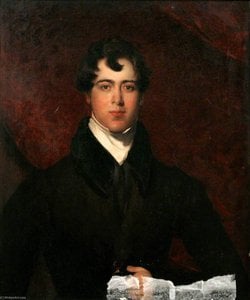
Thomas Phillips: A Master of Light and Character in 19th-Century British Portraiture
Thomas Phillips, born in Dudley, Worcestershire, in 1770, represents a fascinating confluence of artistic disciplines – initially trained as a glass painter, he ultimately ascended to become one of the most celebrated portraitists of his era. His journey from the meticulous craft of decorative glass to the grand halls of London’s Royal Academy is a testament to his innate talent and unwavering dedication. Phillips's work isn’t merely about capturing likeness; it’s an exploration of character, imbued with a remarkable sensitivity to light, color, and the subtle nuances of human expression.
His early years were shaped by his apprenticeship under Francis Eginton in Birmingham, where he honed his skills in glass-painting. This foundational experience instilled within him a profound appreciation for detail – a meticulousness that would later become a hallmark of his portraiture. The intricate patterns and vibrant hues of stained glass demanded an acute eye for color mixing and composition, providing a crucial training ground for the artist’s future endeavors. It was in 1790 that Phillips embarked on a pivotal journey to London, armed with a letter of introduction to Benjamin West, a leading figure at the Royal Academy. West's mentorship proved transformative, opening doors to employment on the painted-glass windows of St George’s Chapel at Windsor Castle – a demanding but invaluable opportunity to refine his artistic abilities within a grand architectural setting.
The Rise of a Portraitist: Style and Subject Matter
Phillips’s transition into portraiture was gradual yet deliberate. While initially undertaking landscape and historical scenes, he quickly recognized the burgeoning demand for individual portraits amongst London's elite. His style evolved rapidly, drawing upon both his glass-painting training – particularly his understanding of light and shadow – and the prevailing artistic trends of the late 18th and early 19th centuries. He possessed a rare ability to capture not just physical likeness but also something of the sitter’s inner life—their character, intellect, and even their mood. This wasn't simply replication; it was an attempt to reveal the soul behind the surface.
His early subjects were largely unknown individuals – tradesmen, servants, and members of the lower classes. However, through perseverance and a growing reputation for skill, Phillips steadily ascended the social ladder, attracting increasingly prominent figures to his studio. The portraits he produced during this period—often unsigned in the catalogues—were characterized by their understated elegance and remarkable realism. He skillfully employed subtle gradations of tone and color to create a sense of depth and atmosphere, capturing not just the appearance but also the essence of his subjects.
Royal Patronage and Academic Recognition
The year 1804 marked a turning point in Phillips’s career with his election as an associate of the Royal Academy. This prestigious recognition solidified his position within the established art world, alongside luminaries such as Thomas Lawrence and John Hoppner. Shortly thereafter, he relocated to 8 George Street, Hanover Square – a prestigious address that would serve as his home and studio for the remainder of his life. His clientele expanded dramatically during this period, encompassing members of the royal family, including the Prince of Wales (later George IV), as well as prominent figures from the aristocracy, literary circles, and scientific communities.
Amongst his most celebrated portraits are those of William Blake, a visionary poet and artist; Lord Byron, the flamboyant Romantic hero; and Sir Joseph Banks, the renowned botanist. The portrait of William Blake, now housed in the National Portrait Gallery, is particularly noteworthy for its evocative depiction of the poet’s intense gaze and spiritual depth. Phillips's ability to capture the essence of these extraordinary individuals cemented his reputation as one of the foremost portraitists of his time.
Later Years: Professorship and Legacy
In 1825, Thomas Phillips was appointed Professor of Painting at the Royal Academy, a position he held until 1832. This role afforded him the opportunity to share his artistic knowledge and techniques with aspiring artists, shaping the future of British painting. He published *Lectures on the History and Principles of Painting* in 1833, offering insights into his artistic philosophy and pedagogical approach – a testament to his enduring influence on the art world.
Phillips’s legacy extends beyond his individual works. His meticulous attention to detail, combined with his profound understanding of human psychology, established him as a master of portraiture. His paintings offer a captivating glimpse into the lives and personalities of some of Britain's most influential figures—a testament to his skill, sensitivity, and enduring artistic vision. The portraits he created continue to be admired for their beauty, realism, and the profound sense of character they convey.



 Zobraziť v interiéri
 Objednať ručne maľovanú reprodukciu
 Odoslať
 Zdieľať
 Podrobnosti
 Príručkovo

 Stiahnuť
 Podobné položky
 RTG skúška
 Prehliadanie diapo\]
 Štatistiky


 Prečítať si viac






































 Možnosť skla je dostupná len pri rozmeroch pod 110 cm