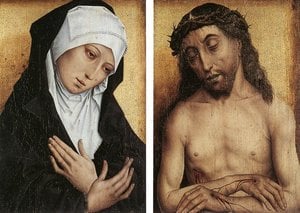
The Prince of Illuminators: The Radiant Legacy of Simon Marmion
In the golden twilight of the Middle Ages, a period where the flickering candlelight of monastic scriptoriums met the burgeoning splendor of the Burgundian court, there emerged an artist of unparalleled delicacy and prestige. Simon Marmion, a master whose brush breathed life into the parchment of history, earned the reverent title of "the prince of illuminators." Born in Amiens around 1425, Marmion was a product of a rich artistic lineage, raised in an environment where the craft of painting was woven into the very fabric of family life. With his father, Jean, and his brother, Mille, also practicing the arts, Marmion’s early development was steeped in the technical rigors of the French and Netherlandish traditions.
His career was inextricably linked to the heights of political power and the opulent tastes of the Duchy of Burgundy. As the Burgundian territories expanded in influence, so too did Marmion's reputation. His presence at the legendary Feast of the Pheasant in Lille, under the patronage of Philip the Good, signaled his ascent into the inner circles of European nobility. This was an era of profound cultural synthesis, and Marmion stood at the crossroads of two worlds. While his roots lay in the French tradition, his work increasingly embraced the innovative Flemish spirit, characterized by a burgeoning interest in atmospheric landscapes and complex compositions that would define the Early Netherlandish style.
A Master of Light and Miniature
Marmion’s true genius resided in the intimate scale of the illuminated manuscript. To look upon his miniatures is to witness a world captured in jewel-like precision. He possessed an extraordinary ability to manipulate color and light, creating scenes that felt both spiritually transcendent and tangibly real. His work on the Grandes Chroniques de France remains a pinnacle of his achievement; within its pages, one finds a breathtaking array of miniatures ranging from vibrant, sweeping battle scenes to experimental works executed in a subtle, near-grisaille technique. This versatility allowed him to navigate between the grandiosity required for royal chronicles and the quiet, contemplative stillness needed for devotional texts.
Beyond the borders of manuscripts, Marmion’s hand extended to larger altarpieces and portraits, showcasing a stylistic evolution that bridged the gap between medieval symbolism and Renaissance naturalism. While some critics have noted a certain stiffness in his figures or occasional awkwardness in proportion, these elements often contribute to the unique, rhythmic grace of his compositions. His technical command of perspective was remarkably sound for his era, providing a structural depth that allowed his landscapes to breathe, even within the confines of a small panel. This mastery of space and atmosphere helped pave the way for the more robust realism seen in later Netherlandish masters.
Enduring Influence and Historical Significance
The historical footprint of Simon Marmion is visible across the great museums of the world, from the Gemäldegalerie in Berlin to the Metropolitan Museum of Art in New York. His ability to serve the most powerful patrons of his time—including Charles the Bold and Margaret of York—ensured that his aesthetic would influence the visual language of the Burgundian court for generations. Even after his death in 1489, his legacy continued through his pupils, such as Jan Provoost, who carried forward the traditions Marmion had refined.
Marmion’s significance lies not merely in the beauty of his creations, but in his role as a cultural bridge. He captured a moment of profound transition in European art:
- The Synthesis of Styles: He successfully merged the decorative elegance of French illumination with the observational realism of the Flemish school.
- Patronage and Prestige: His work served as the visual propaganda for the most influential ducal houses in Europe, elevating the status of the artist from craftsman to courtly essentialist.
- Technical Innovation: Through his use of varied media—from brilliant pigments to delicate grisaille—he expanded the expressive potential of the miniature format.
Today, we remember Simon Marmion not just as a painter of books, but as a visionary who captured the soul of an era through the meticulous application of pigment and light.



 Náhľad v interiéri
 Prepnúť na tlač
 Odoslať ako digitálnu kartu
 Zdieľať
 Podrobnosti o dielo
 Príručka

 Stiahnuť obraz
 Podobné položky
 RTG skúška
 Prehliadanie diapozoje
 Štatistiky
 Zobraziť viac