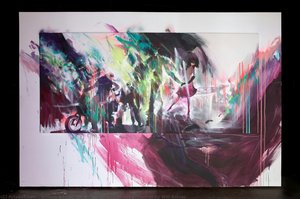
Biografia umelca
Sigmar Polke: A Life Sculpted by Displacement and the Alchemy of Perception
Sigmar Polke’s artistic journey is a profoundly moving narrative, deeply intertwined with the tumultuous currents of 20th-century history. Born in Oels (now Olesnica), Poland, in 1941, his early life was marked not by idyllic stability but by constant displacement – a series of moves driven by political upheaval and the ever-present shadow of communism. His family’s flight from East Germany to West Germany in 1953, seeking refuge from oppressive rule, instilled within him an enduring skepticism towards rigid ideologies and a fascination with the unstable nature of perception; themes that would become the very bedrock of his artistic vision. Before dedicating himself fully to painting, Polke honed his technical skills as a stained-glass worker in Düsseldorf (1959-1960), a formative apprenticeship that introduced him to the delicate interplay of light and color – an experience he would later translate into the layered complexity of his paintings. His formal studies at the Kunstakademie Düsseldorf (1961-1967) under the tutelage of influential figures like Karl Otto Götz, Gerhard Hoehme, and most significantly Joseph Beuys, provided fertile ground for his unique artistic voice to take root, one characterized by a relentless experimentation, a sharp irony, and a questioning of established norms.
The Birth of Capitalist Realism: Critique Through Appropriation
Emerging in the early 1960s, Polke quickly found himself at the forefront of a burgeoning counter-cultural movement. Alongside Gerhard Richter, Konrad Lueg, and Manfred Kuttner, he co-founded *Kapitalistischer Realismus* (Capitalist Realism). This wasn’t merely an artistic style; it was a deliberate provocation – a critical examination of both Western consumer culture and the rigid dogma of Soviet Socialist Realism. The movement's name itself was deliberately ambiguous, suggesting that both systems were equally capable of producing artificial realities. Polke’s early paintings from this period frequently appropriated imagery from advertising, comics, and popular media, presenting them with a detached irony that exposed their underlying ideological structures. He wasn’t simply rejecting capitalism; he was demonstrating its pervasive influence on perception itself – the way we see the world, the narratives it constructs. These works often featured recognizable figures and objects rendered in a deliberately bland or unsettling manner, forcing viewers to confront the artificiality of the images they were presented with. This initial foray into critical commentary established a pattern of subversive engagement that would define his career for decades to come.
From Photography to Alchemy: A Journey Through Materials
The 1970s marked a significant shift in Polke’s artistic focus, leading him to explore the world through the lens of photography. Driven by an insatiable curiosity and a desire to capture fleeting moments of beauty and absurdity, he embarked on extensive travels across continents – Afghanistan, Brazil, France, Pakistan, and the United States. However, these weren't straightforward documentary photographs; Polke subjected his images to radical chemical manipulation, altering their colors, textures, and meanings through processes like bleaching, toning, and layering. He embraced chance operations and deliberately introduced imperfections, challenging the notion of photography as an objective record of reality. This period wasn’t simply about documenting places; it was about transforming them – distorting our perceptions and revealing the subjective nature of visual experience. In the 1980s, Polke dramatically returned to painting, but not in any conventional sense. He began experimenting with a diverse range of unconventional materials – arsenic, meteor dust, turquoise, beeswax – incorporating them into his canvases alongside traditional pigments. This alchemical approach was driven by a desire to unlock hidden properties within matter and to create works that were constantly evolving, defying easy categorization. The resulting paintings became complex layered compositions, often imbued with a sense of decay or transformation, reflecting the artist’s fascination with time, memory, and the ephemeral nature of existence.
Neo-Expressionism, Historical Echoes, and Enduring Legacy
While Polke resisted being neatly categorized, his work is frequently associated with Neo-Expressionism – a movement characterized by its expressive brushwork, emotionally charged imagery, and rejection of minimalist abstraction. However, Polke’s approach was fundamentally different from that of many of his contemporaries. His paintings often engaged with historical events and perceptions thereof, frequently adopting a sardonic or critical perspective. He drew inspiration from a wide range of sources – Renaissance art, medieval iconography, advertising, and popular culture – weaving together disparate elements into complex visual narratives. The use of seemingly random imagery—a child’s drawing, a newspaper clipping, a fragment of fabric—created a sense of disorientation and ambiguity, inviting viewers to actively participate in the construction of meaning. Polke's work remains profoundly influential today, demonstrating a remarkable ability to blend technical skill with conceptual rigor, challenging conventional notions of painting and prompting us to reconsider our own perceptions of reality. His legacy lies not just in his individual artworks but also in his pioneering spirit—his willingness to experiment, to question, and to push the boundaries of artistic expression.
Key Influences and Artistic Connections
Throughout his career, Polke drew inspiration from a remarkably diverse range of artists and movements. Joseph Beuys, his teacher at the Düsseldorf Kunstakademie, profoundly shaped his exploration of unconventional materials and social commentary. The bold imagery and consumer culture critique of American *Pop Art* also resonated with him, though he filtered these influences through a distinctly German lens of skepticism and irony. Furthermore, Polke’s work engaged with the broader context of German Art Informel, an abstract expressionist movement that emphasized spontaneous gesture and material exploration. Artists like Ernst Ludwig Kirchner and Emil Nolde, pioneers of this movement, provided a crucial precedent for Polke's own experimentation with texture, color, and form. His artistic kinship with figures like Karl Otto Götz and Konrad Lüg—both fellow travelers in the early days of Capitalist Realism—further illuminates the collaborative spirit and intellectual ferment that characterized his formative years. Ultimately, Sigmar Polke transcended any single label or movement, forging a unique path that continues to inspire artists today – a testament to his profound vision and unwavering commitment to artistic innovation.



 Zobraziť v interiéri
 Prepnúť na tlač
 Odoslať
 Zdieľať
 Podrobnosti
 Príručka

 Stiahnuť
 Podobné položky
 RTG skúška
 Prehliadanie diapo\]
 Štatistiky


 Prečítať si viac






































 Možnosť skla je dostupná len pri rozmeroch pod 110 cm