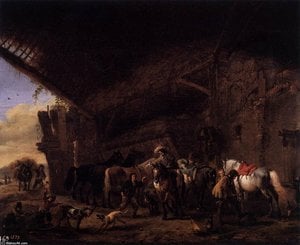
Philips Wouwerman’s “Huntsmen Setting Out”: A Dutch Golden Age Masterpiece
“Huntsmen Setting Out,” painted by Philips Wouwerman around 1665, is more than just a hunting scene; it's a meticulously crafted tableau of aristocratic leisure and the vibrant energy of the Dutch Golden Age. This oil on canvas, currently residing in the Hermitage Museum in St. Petersburg, Russia – a testament to its enduring appeal – offers a captivating glimpse into the lives of the wealthy elite and their elaborate pursuits. Wouwerman, a prolific artist known for his dynamic depictions of hunting, landscapes, and battle scenes, masterfully captures a fleeting moment of preparation before the chase, imbuing it with a sense of movement, drama, and subtle social commentary.
A Symphony of Light and Movement
Wouwerman’s technique is immediately striking. The painting pulsates with life through his masterful use of light and shadow – a hallmark of Baroque art that he expertly employs to create depth and drama. Notice how the sunlight, seemingly originating from an unseen source, illuminates the hunters' attire, highlighting the rich textures of their coats and the gleam of their weapons. Conversely, areas in shadow suggest the cool air and impending darkness of the forest. The composition itself is a carefully orchestrated dance of movement; horses gallop forward with powerful strides, hounds strain at their leashes, and riders gesture excitedly, all contributing to an overwhelming sense of kinetic energy. The artist’s attention to detail is remarkable – from the individual strands of hair on the hunters' heads to the intricate patterns on their clothing, every element feels deliberately placed.
Symbolism and Social Commentary
Beyond its technical brilliance, “Huntsmen Setting Out” carries layers of symbolic meaning. The scene depicts a hunt, a pastime deeply intertwined with aristocratic status in 17th-century Holland. The lavish attire of the hunters – their elaborate coats, feathered hats, and finely crafted weapons – clearly signal their wealth and privilege. However, Wouwerman subtly introduces an element of social critique through the inclusion of a beggar at the bottom left corner of the painting. This figure, starkly contrasting with the opulent setting, serves as a poignant reminder of the vast disparity between the wealthy elite and the less fortunate. The hermit on the hillside further emphasizes this contrast, representing a moral counterpoint to the aristocratic pursuit of pleasure.
Historical Context: The Dutch Golden Age
To fully appreciate “Huntsmen Setting Out,” it’s crucial to understand the historical context in which it was created – the Dutch Golden Age. This period, spanning roughly from the mid-16th to the early 18th centuries, witnessed an unprecedented flourishing of art, science, and commerce in the Netherlands. Philips Wouwerman thrived during this era, becoming one of its most celebrated artists. His works reflect the values and sensibilities of the time – a fascination with realism, a celebration of human activity, and a keen awareness of social dynamics. The painting’s presence in the Hermitage Museum underscores its significance as a key example of Dutch Golden Age art, offering a window into the lives and aspirations of a remarkable era.
Bringing Wouwerman Home: High-Quality Reproductions
Experience the timeless beauty of “Huntsmen Setting Out” in stunning detail with our meticulously crafted oil painting reproductions. Each reproduction is hand-painted by skilled artists using archival-quality materials, ensuring that every brushstroke and color nuance faithfully captures the original’s artistry. Available in a range of sizes to suit your space and budget, these reproductions are an exquisite addition to any home or office – a vibrant reminder of the artistic brilliance of Philips Wouwerman and the captivating spirit of the Dutch Golden Age. Explore our collection at WahooArt.com and discover how you can bring this masterpiece into your life.
Otázky a odpovede
Akú náladu a emóciu v sebe spája dielo „Huntsmen Setting Out“?
V diele „Huntsmen Setting Out“ sprevádza Dramatic nálada Nostalgic emóciu.
Je dielo „Huntsmen Setting Out“ celkovým ponorom skôr svetlé alebo tmavé?
Jasnosť diela „Huntsmen Setting Out“ od Philips Wouwermaň je zaznamenaná ako balanced pri luminancii Soft Shadow.
S akým pocitom sa spája „Huntsmen Setting Out“?
„Huntsmen Setting Out“ od Philips Wouwermaň vyžaruje Nostalgic emocionálny tón.



 Náhľad v interiéri
 Kúpiť ručne maľovaný obraz
 Odoslať ako digitálnu kartu
 Zdieľať
 Podrobnosti o dielo
 Príručka

 Stiahnuť obraz
 Podobné položky
 RTG skúška
 Prehliadanie diapozoje
 Q&A
Q&A Štatistiky


 Zobraziť viac






































 Možnosť skla je dostupná len pri rozmeroch pod 110 cm