A Symphony of Steel and Sky
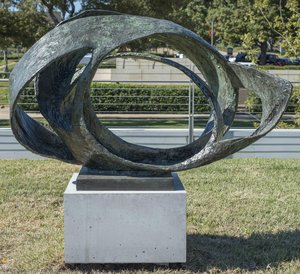
In the quiet expanse of a verdant landscape, where the soft textures of grass meet the distant silhouette of trees, stands a monumental testament to contemporary industrial vision. Peter Klasen’s Untitled (2004) is not merely a sculpture; it is a profound dialogue between the organic world and the rigid precision of human engineering. At first glance, the viewer is struck by the striking, blue-hued form that rises from the earth like a celestial umbrella, its metallic skin catching the light in a way that bridges the gap between the terrestrial and the ethereal. This massive installation, measuring an imposing 510 x 670 cm, commands the space around it, transforming a simple meadow into a stage for high-concept urban art.
The sculpture serves as a masterclass in the interplay of color and texture. While the primary structure evokes the cool, tranquil tones of a summer sky, the underlying essence of the work is rooted in the grit of industrial reality. Klasen, a pioneer known for his ability to translate technological advancement into visual language, utilizes steel and abstract geometric forms to create a sense of structured tension. The piece oscillates between being an object of protection—resembling a sheltering canopy—and a symbol of technological intrusion. For the discerning collector or interior designer, this work offers a captivating focal point that brings a sophisticated, avant-garde energy to any curated space, suggesting a narrative of modern progress and structural elegance.
The Intersection of Industry and Nature
To understand the emotional weight of Untitled, one must look toward Klasen’s broader artistic legacy. As an artist who has spent decades exploring the fragmented relationship between humanity and the machine, this sculpture represents a moment of unexpected harmony. Unlike his more unsettling depictions of disconnected bodies and cold machinery, this work allows for a certain level of atmospheric grace. The way the metallic surfaces reflect the surrounding environment—the movement of clouds, the swaying of trees, and even the presence of the distant, mundane world of parked cars and park benches—integrates the sculpture into the very fabric of the landscape.
There is a profound symbolism at play in this encounter between the manufactured and the natural. The blue, umbrella-like silhouette acts as a metaphor for the human desire to create shelter and order within the wildness of nature. It invites the observer to pause, much like the bench situated nearby, and contemplate our place within an increasingly technological era. For those seeking to incorporate art into a modern interior, a high-quality reproduction of this piece provides more than just decoration; it offers a window into a complex philosophical inquiry regarding how we inhabit a world shaped by both biological instinct and industrial innovation.
A Vision for Modern Interiors
For the art enthusiast or the professional decorator, Untitled presents an unparalleled opportunity to introduce a sense of scale and intellectual depth to a room. The sculpture’s ability to evoke both the vastness of an outdoor installation and the intimate details of its textured surface makes it a versatile masterpiece. Whether placed in a minimalist gallery setting or as a bold statement piece in a contemporary living space, the work stimulates conversation and invites prolonged contemplation.
Owning a reproduction of such a significant work by Peter Klasen allows one to capture the essence of 21st-century abstraction. It is an investment in a legacy of photorealistic industrial art that challenges the boundaries of what we perceive as beauty. Through its bold use of color, its monumental presence, and its seamless blend of industrial steel with abstract form, this piece remains a timeless icon of contemporary sculptural achievement.
Otázky a odpovede
V akom veku vytvoril/a Peter Klasen dielo „Untitled"?
Peter Klasen vytvoril/a „Untitled“ vo veku 69 rokov. Umenec sa narodil/a v roku 1935 a dielo pochádza z roku 2004.
K ktorému umelcovi sa pripisuje dielo "Untitled"?
Dielo „Untitled“ sa pripisuje autorovi Peter Klasen.
V ktorom roku bolo vytvorené dielo „Untitled“ od Peter Klasen?
Dielo „Untitled“ pochádza z roku 2004. Toto datum zaraduje prácu do kariéry umelca Peter Klasen aj do jeho éry.
Pôsobia farby diela „Untitled“ výrazne alebo jemne?
Intenzita farieb diela „Untitled“ je Balanced. Intenzita popisuje, ako silné pôsobia farby.
Do ktorej časti domova sa hodí reprodukcia diela „Untitled“?
Dla diela „Untitled“ od Peter Klasen sa odporúča Coworking. Toto odporúčanie vychádza z témy, farebnej skladby a nálady daného diela.
Využíva „Untitled“ od Peter Klasen silné kontrasty alebo jemné harmónie?
V diele „Untitled“ sa Gentle kontrast spája s Discordant Palette harmóniou.
Na čo sa odporúča reprodukcia diela „Untitled“ od Peter Klasen?
Odporúčaným použitím vytlačenej verzie diela „Untitled“ je Focal.



 Objednať ručne maľovanú reprodukciu
 Odoslať
 Zdieľať
 Podrobnosti
 Príručka

 Stiahnuť
 Podobné položky
 Prehliadanie diapo\]
 Štatistiky


 Prečítať si viac






































 Možnosť skla je dostupná len pri rozmeroch pod 110 cm