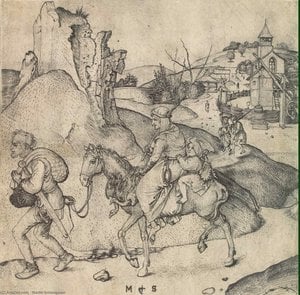
The Fourth Wise Virgin: A Glimpse into Northern Renaissance Mystery
Martin Schongauer’s “The Fourth Wise Virgin,” created around 1490, is more than just an engraving; it's a meticulously crafted window into the spiritual and artistic currents of late medieval Germany. This captivating image, housed within the National Gallery of Art in Washington D.C., draws upon both established iconography – referencing the biblical tale of the Wise Virgins – and Schongauer’s own distinctive style, blending meticulous detail with an almost haunting sense of introspection. The work immediately commands attention not through grand scale or overt drama, but through a profound quietude and a subtle layering of symbolism that invites prolonged contemplation.
Schongauer's artistic lineage is deeply rooted in the traditions of goldsmithing, a craft he likely learned from his father. This background profoundly shaped his approach to engraving – an art demanding unparalleled precision and control over line. The image’s remarkable clarity stems from Schongauer’s mastery of hatching and cross-hatching techniques, creating a sophisticated illusion of form and texture. He doesn't simply depict the figure; he sculpts her presence with carefully placed lines, imbuing the composition with an almost palpable sense of weight and volume. The use of negative space is equally crucial, drawing attention to the central subject while subtly suggesting the vastness of the surrounding world – a world both familiar and potentially perilous.
A Biblical Narrative Illuminated
The scene itself draws upon the well-known parable of the Wise and Foolish Virgins. Ten young women are preparing for the wedding of the king, each carrying a lamp filled with oil. The foolish ones neglect their duty, leaving their lamps unlit, and are subsequently barred from entering the celebration. The Fourth Virgin, depicted here in profile, embodies a serene yet subtly melancholic acceptance of her fate. Her posture is dignified, suggesting not despair but a quiet understanding of divine judgment. The candle she holds – a potent symbol of faith, enlightenment, and guidance – casts a gentle glow upon her face, illuminating her expression with an ethereal light.
Schongauer’s choice to focus on this particular virgin is intriguing. Unlike the more overtly dramatic depictions found in other prints from the series, Schongauer's rendering emphasizes introspection rather than external action. The background is deliberately sparse, devoid of elaborate details or distracting elements. This minimalist approach directs the viewer’s attention entirely onto the figure herself, amplifying her internal state and inviting us to contemplate the moral implications of the story. The composition subtly suggests a sense of isolation – a solitary figure contemplating a universal truth.
Technique and Historical Context
“The Fourth Wise Virgin” is a prime example of Northern Renaissance engraving, characterized by its meticulous detail, refined draftsmanship, and a deep engagement with both religious iconography and contemporary fashion. Schongauer’s work reflects the influence of Early Netherlandish painting, particularly the realism and attention to texture evident in the drapery and facial features. The print's creation coincided with a period of significant artistic innovation, as engravers began to explore new techniques for achieving greater tonal range and simulating the effects of paint. The use of a copper or iron plate, meticulously etched with lines using specialized tools like burins, is itself a testament to Schongauer’s technical skill.
Furthermore, the print's creation occurred during a time of intense religious fervor and social upheaval in Europe. The Reformation was gaining momentum, challenging traditional beliefs and practices. Schongauer’s work can be interpreted as a meditation on themes of faith, judgment, and redemption – timeless concerns that resonated deeply with audiences throughout the Renaissance.
A Timeless Symbol of Reflection
“The Fourth Wise Virgin” endures not merely as a beautiful engraving but as a poignant reflection on human nature. Schongauer’s masterful use of line, light, and shadow creates an image that is both visually arresting and emotionally resonant. It's a work that invites viewers to contemplate their own choices, their own faith, and their place within the larger narrative of life and death. The engraving’s quiet dignity and subtle symbolism continue to captivate audiences centuries after its creation, solidifying Schongauer’s legacy as one of the most important printmakers of the Northern Renaissance.



 Náhľad
 Prepnúť na tlač
 Odoslať
 Zdieľať
 Podrobnosti o dielo

 Stiahnuť
 Podobné diela
 RTG skúška
 Prezentácia
 Štatistiky


 Zobraziť viac