A Vision of Faith and Folklore
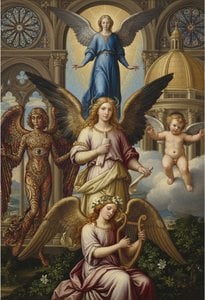
Marc Chagall’s “The Jacob’s Dream” (1963) isn’t merely a painting; it’s an immersion into a deeply personal mythology, a vibrant tapestry woven from the threads of Jewish folklore, biblical narrative, and the artist's own lifelong spiritual quest. This masterpiece, rendered in gouache, oil, and pastel on paper, captures a pivotal moment – Jacob’s encounter with divine messengers while journeying to his new home in Haran – transforming a foundational story into a dreamscape brimming with symbolic richness. The painting immediately draws the viewer in with its arresting color palette: deep purples and blues dominate the nocturnal scene, punctuated by bursts of fiery red, representing Jacob himself and the ascending angels. It’s a world both familiar and profoundly strange, echoing the artist's own unique vision.
The Ladder to Heaven: Symbolism Unveiled
At the heart of “The Jacob’s Dream” lies the iconic ladder, a motif that recurs throughout Chagall’s oeuvre. Here, it doesn’t simply represent a physical ascent; it embodies a spiritual journey, a bridge between the earthly and divine realms. The ladder, rooted firmly in the earth, reaches upwards towards the heavens, carrying angels who are both messengers and witnesses to this extraordinary event. The presence of seven angels circling the ladder reinforces its connection to the Hebrew alphabet, adding another layer of symbolic depth. Notably, Jacob’s open eye – a recurring feature in Chagall's depictions of dreams – suggests an active participation in this encounter, a recognition of the sacred unfolding before him. The inclusion of Isaac and Jesus on either side of the ladder further emphasizes the painting’s theological significance, linking ancient prophecy with Christian faith.
A Reflection of Vitebsk: Chagall's Roots
To understand “The Jacob’s Dream,” one must consider its origins in Chagall’s childhood home of Vitebsk. The town, a melting pot of Russian Orthodox and Jewish cultures, profoundly shaped the artist’s aesthetic sensibility. The influence of this diverse environment is evident in the painting's composition – the swirling figures, the vibrant colors, and the sense of movement all evoke the energy and spirit of Vitebsk. Chagall frequently depicted his hometown, often imbuing it with fantastical elements drawn from Jewish folklore and religious stories. This particular scene, rooted in Genesis 28:14-15, is a testament to how deeply personal and emotionally resonant these memories were for him.
The Dreamer's Perspective
Chagall’s masterful use of color and line creates an atmosphere of both wonder and unease. The dreamlike quality of the scene – the elongated figures, the distorted perspective, the fantastical elements – invites viewers to suspend their disbelief and enter into Jacob’s subjective experience. The painting isn't a literal depiction of the biblical story; it’s a distillation of its essence, filtered through Chagall’s unique artistic vision. It speaks not just to the narrative of Jacob’s dream but also to the universal human longing for connection with something greater than oneself – a yearning that resonates powerfully across cultures and generations. “The Jacob’s Dream” remains a profoundly moving testament to the power of art to capture the complexities of faith, memory, and the enduring mysteries of the human spirit.



 Náhľad
 Prepnúť na tlač
 Odoslať
 Zdieľať
 Podrobnosti o dielo

 Stiahnuť
 Podobné diela
 RTG skúška
 Prezentácia
 Štatistiky


 Zobraziť viac






































 Možnosť skla je dostupná len pri rozmeroch pod 110 cm