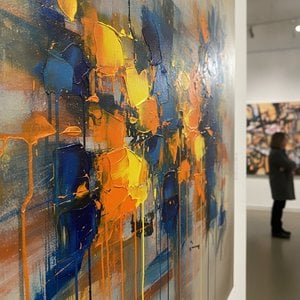
The Vibrant Tapestry of Leon Tarasewicz
Born on March 14, 1957, in the quiet village of Waliły, Poland, Leon Tarasewicz carries within his artistic DNA the rich, complex textures of the Polish borderlands. A painter of Belarusian origin, his work is deeply rooted in the cultural intersections of a region defined by shifting boundaries and historical echoes. Growing up in a working-class family, Tarasewicz found his calling through the transformative power of color and form, eventually honing his craft at the prestigious Academy of Fine Arts in Warsaw. Under the mentorship of the influential Tadeusz Dominik, he developed a technical foundation that would later allow him to transcend traditional boundaries, moving from classical training toward a profound exploration of space and light.
The evolution of Tarasewicz’s style is a journey from the representational to the sublime. While his early academic years provided him with the tools of meticulous observation, his mature work embraces the language of abstract expressionism and color field painting. He possesses a unique ability to capture the essence of the Polish landscape—not through literal depiction, but through an emotional resonance achieved via expansive washes of pigment and rhythmic, vertical stripes. His canvases often function as panoramic experiences, where the distinction between painting and environment begins to blur. By utilizing multiple stretcher bars connected to create vast, immersive spaces, he invites the viewer to step into a world where the horizon line vanishes, replaced by a sense of infinite geological or organic growth.
Symbolism and the Language of Color
To encounter a Tarasewicz painting is to engage in a sensory dialogue with nature. His palette is famously exuberant, utilizing vivid azures, deep reds, and sun-drenched yellows to evoke the vitality of forests, rivers, and skies. Yet, beneath this surface brilliance lies a deeper, more contemplative layer of symbolism. The artist’s work often references the sublimation of sensual experience into spiritual truth, a concept reminiscent of the icon traditions found in his Belarusian heritage. Even when his works appear purely abstract, they carry the weight of the landscape's history—the furrows of a field, the movement of wind through trees, and the layered memories of a borderland territory.
A defining characteristic of his practice is his deliberate avoidance of titles. By refusing to name his pieces, Tarasewicz escapes the "trap of representation," ensuring that his work cannot be confined to a single definition or historical movement. This allows for a multiplicity of interpretations, where a viewer might see a topographical map of a distant meadow one moment and a purely rhythmic exploration of color the next. His technique creates a tension between the physical texture of the paint—which hints at earth and stone—and the ethereal quality of light that seems to emanate from within the pigment itself.
Legacy and Artistic Distinction
Throughout his illustrious career, Leon Tarasewicz has garnered significant international acclaim, establishing himself as a pillar of contemporary Polish art. His contributions to the academic world are equally profound; as a professor of fine arts and a lecturer at the Academy of Fine Arts in Warsaw, he has shaped the perspectives of subsequent generations of artists. His professional journey is marked by prestigious accolades that reflect both his cultural impact and his technical mastery:
- The Order of Polonia Restituta: Awarded the Knight's Cross for his significant contributions to Polish culture.
- Paszport Polityki: A recognition of his influence within the contemporary Polish art scene.
- Gloria Artis Medal: Honored by the Minister of Culture for his merit to the arts.
- Award of Jan Cybis: A testament to his excellence in the tradition of Polish painting.
Beyond the gallery walls, Tarasewicz has served as a cultural ambassador, notably representing the European Year of Intercultural Dialogue. His life’s work remains a profound meditation on the beauty of the natural world and the enduring strength of cultural identity, proving that even in abstraction, the soul of a landscape can be found.



 Zobraziť v interiéri
 Objednať ručne maľovanú reprodukciu
 Odoslať
 Zdieľať
 Podrobnosti
 Príručka

 Stiahnuť
 Podobné položky
 RTG skúška
 Prehliadanie diapo\]
 Štatistiky


 Prečítať si viac






































 Možnosť skla je dostupná len pri rozmeroch pod 110 cm