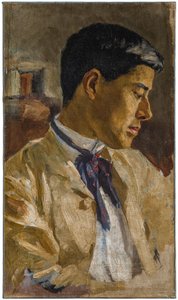
Biografia umelca
A Pioneer of Western Impressionism in Japan: The Life and Art of Kume Keiichiro
Kume Keiichiro, born in Saga Prefecture, Japan, in 1866, stands as a pivotal figure in the introduction and adaptation of Western painting techniques to Japanese art. His journey reflects not merely an adoption of foreign styles but a thoughtful synthesis between traditional aesthetics and the burgeoning world of European Impressionism. The son of the esteemed historian Kume Kunitake, Keiichiro was immersed from youth in a scholarly environment that fostered intellectual curiosity – a foundation that would prove crucial as he navigated the complexities of artistic innovation. While initially pursuing studies in law, his passion for art led him to Tokyo School of Fine Arts, where he began to grapple with the possibilities of representing light and form in ways previously unexplored within Japanese painting traditions. This early exposure ignited a desire to move beyond established conventions, setting him on a path that would redefine the landscape of modern Japanese art.
Embracing Yōga and the Influence of Kuroda Seiki
Keiichiro’s artistic development was deeply intertwined with the rise of *Yōga* – literally “Western-style painting” – in Japan during the Meiji era. This movement, born from a period of rapid modernization and increased engagement with international cultures, sought to integrate Western techniques like oil painting, perspective, and anatomical study into Japanese art practices. A defining moment came when Keiichiro became a student of Kuroda Seiki, a leading figure in Yōga who had himself studied extensively in Paris. Kuroda’s influence was profound; he instilled in Keiichiro not only technical proficiency but also a critical understanding of Western artistic principles and the importance of direct observation from nature. Kuroda encouraged his students to move beyond mere imitation and to develop their own unique voices within the framework of Yōga, emphasizing the emotional impact of color and light. This mentorship proved transformative for Keiichiro, shaping his approach to composition, brushwork, and subject matter. He wasn’t simply copying Western styles; he was learning how to *see* differently, how to capture fleeting moments and atmospheric effects with a newfound realism.
The Tenshin-dōjō and the Hakuba-kai: Collaborative Exploration
Keiichiro's commitment to artistic exploration extended beyond his individual practice. He played a central role in establishing both the *Tenshin-dōjō* – an art school dedicated to Yōga – and the *Hakuba-kai*, an influential group of Western-style painters. The Tenshin-dōjō served as a vital hub for artistic exchange, fostering a collaborative environment where artists could experiment with new techniques and share their insights. The Hakuba-kai, founded in 1893, further solidified this spirit of collaboration, providing a platform for Yōga artists to exhibit their work and engage with the public. Through these organizations, Keiichiro actively contributed to the growth and recognition of Western-style painting within Japan. The exhibitions organized by the Hakuba-kai were instrumental in challenging traditional artistic norms and introducing audiences to a new aesthetic sensibility. He wasn’t just creating art; he was building a community around it, advocating for its acceptance and fostering dialogue about its place in Japanese culture.
Themes and Legacy: Landscapes of Memory and Modernity
Keiichiro's paintings are characterized by their evocative depictions of landscapes, portraits, and still lifes, all rendered with a distinctive Impressionistic touch. He frequently returned to the scenery of his native Saga Prefecture, imbuing his works with a sense of personal memory and emotional resonance. His landscapes aren’t simply representations of physical places; they are imbued with atmosphere, capturing the subtle nuances of light and shadow, the changing seasons, and the feeling of being present in nature. He also explored portraiture, seeking to capture not just the likeness of his subjects but their inner character and psychological state. His use of color was particularly noteworthy – a vibrant palette applied with loose brushstrokes that created a sense of movement and immediacy. Although he faced criticism from some traditionalists who viewed Yōga as a departure from authentic Japanese art, Keiichiro’s work ultimately played a crucial role in bridging the gap between East and West. His paintings helped to establish a uniquely Japanese form of Impressionism, one that blended Western techniques with traditional aesthetics and sensibilities. The *Kume Museum*, dedicated to his life and work, stands as a testament to his enduring legacy – a celebration of an artist who dared to embrace innovation while remaining deeply rooted in his cultural heritage. He passed away in Tokyo in 1934, leaving behind a body of work that continues to inspire and captivate audiences today.



 Zobraziť v interiéri
 Prepnúť na tlač
 Odoslať
 Zdieľať
 Podrobnosti
 Príručka

 Stiahnuť
 Podobné položky
 RTG skúška
 Prehliadanie diapo\]
 Štatistiky
 Prečítať si viac






































 Možnosť skla je dostupná len pri rozmeroch pod 110 cm