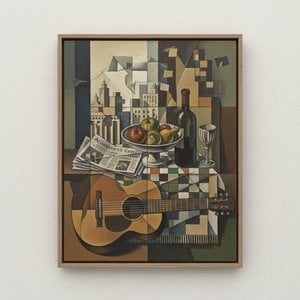
Juan Gris: A Pioneer of Synthetic Cubism
José Victoriano González-Pérez, known universally as Juan Gris (1887–1927), stands as a cornerstone figure in the genesis of Cubist art. Born in Madrid and nurtured by an analytical mind honed at the School of Arts and Sciences—a formative experience that foreshadowed his distinctive artistic approach—Gris embarked on a journey that would propel him to prominence within the vanguard of early 20th-century visual culture.
The Essence of Synthetic Cubism
Unlike Analytical Cubism, which meticulously dissected objects into geometric fragments and explored their simultaneous perspectives, Gris championed Synthetic Cubism. Spearheaded by Pablo Picasso and Georges Braque, this revolutionary style prioritized simplification and abstraction, utilizing techniques like papier collé—the incorporation of textured materials—to imbue canvases with a palpable sense of materiality. “Landscape at Beaulieu,” created in 1918, exemplifies this approach perfectly.
A Harmonious Blend of Color and Form
The painting’s dominant palette—a striking juxtaposition of blues and reds—immediately draws the eye. Gris skillfully employs these hues to depict a rural scene centered around a house rendered in stone, accented by a vibrant red roof. Two chimneys punctuate the upper façade, while an open window invites glimpses of interior light and air circulation. Beyond the central structure lie supplementary buildings—a smaller dwelling and a towering clock tower—adding depth and complexity to the composition.
Historical Significance and Artistic Influence
Gris’s artistic trajectory was inextricably linked to the burgeoning Cubist movement, fostered by Parisian intellectual circles. Influenced profoundly by Henri Matisse's expressive use of color, he achieved a remarkable balance between geometric precision and emotional resonance. Landscape at Beaulieu wasn’t merely an aesthetic achievement; it served as a catalyst for subsequent generations of artists, shaping their understanding of representation and paving the way for innovations in abstraction.
A Legacy Preserved
Currently housed within the Kröller-Müller Museum in Otterlo, Netherlands—a bastion of modern art—Landscape at Beaulieu continues to captivate viewers with its understated elegance and intellectual depth. Its enduring appeal lies not only in its visual beauty but also in its embodiment of a pivotal moment in artistic history: the audacious embrace of Synthetic Cubism as a vehicle for conveying profound ideas about perception and reality.



 Náhľad
 Kúpiť ručne maľovaný obraz
 Odoslať
 Zdieľať
 Podrobnosti o dielo

 Stiahnuť
 Podobné diela
 RTG skúška
 Prezentácia
 Štatistiky


 Zobraziť viac






































 Možnosť skla je dostupná len pri rozmeroch pod 110 cm