A Tableau Vivant of Artistic Rebellion
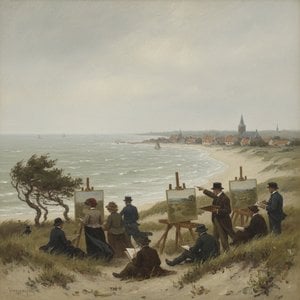
In the vibrant heart of the Düsseldorf School of Painting, Johann Peter Hasenclever captures a moment that transcends mere studio documentation to become a profound manifesto of artistic identity. His 1836 masterpiece, Studio Scene, presents us with a meticulously orchestrated tableau vivant, where a group of genre painters—including A. Greven, J. P. Hasenclever, J. Wilms, O. Grashof, W. Heine, and C. Engel von der Rabenau—assemble as if upon a theatrical stage. This is not a scene drawn from the lofty, often detached realms of classical literature, but one rooted deeply in the textures and truths of real life. The atmosphere is electric with the energy of a creative collective, a lively gathering where the boundaries between work, camaraderie, and social interaction blur into a single, spirited event.
The composition invites the viewer to wander through a workshop teeming with life and movement. At least twelve individuals populate this expansive space, some caught in quiet moments of reading or contemplation, others engaged in animated dialogue or focused on their artistic endeavors. The room is a rich tapestry of objects: chairs are scattered with an organic randomness that suggests a lived-in space, while dining tables, books, and vases add layers of domesticity to the professional setting. There is a palpable sense of a workshop where ideas are not just conceived but shared, making the painting feel less like a static portrait and more like a breathing, pulse-filled environment.
Symbolism and the Rejection of Tradition
Beneath the surface humor of this gathering lies a sophisticated layer of symbolic rebellion. Hasenclever uses the studio setting to signal a definitive break from the outdated pedagogical traditions of the past. We see the discarded remnants of an era defined by poetic-idealist history painting: ancient plaster models of fencers, manikins, and even a knight’s helmet are cast aside, treated as relics of a bygone way of seeing. By depicting these items as mere clutter or even refuse, the artist asserts that the new generation of painters is no longer interested in the artificiality of academic tropes.
Instead, the true focus shifts to the gritty, authentic details of contemporary existence. The presence of mouse traps and a map of Düsseldorf serves as a poignant reminder that the true subject of art lies in the tangible world—the space between the pawn shop and the brothel. Even the use of a large history painting as a mere wind trap or a rag to wipe brushes is a daring statement of intent. It suggests that the grand, sweeping narratives of the past are being repurposed to serve the practical, immediate needs of a new, realistic art form. This programmatic approach transforms the studio into a site of revolution, where the "true image" of life is being painstakingly constructed.
An Invitation to Authenticity
For the discerning collector or interior designer, Studio Scene offers much more than visual splendor; it provides a window into a pivotal moment of art history. The painting’s technique, characterized by its ability to render both the grand scale of the gathering and the minute, humorous details of the studio, makes it a captivating centerpiece for any sophisticated collection. It evokes an emotional response of warmth, intellectual curiosity, and a sense of belonging to a community of creators.
Integrating a high-quality reproduction of this work into a space brings with it an aura of cultured vitality. It is a piece that rewards prolonged study, revealing new layers of meaning—from the camaraderie of the "drinking companions" to the profound shift in art theory—each time it is viewed. Whether placed in a library, a creative studio, or a grand living area, Studio Scene serves as a timeless tribute to the enduring power of realism and the beautiful chaos of the creative process.
Otázky a odpovede
Akým mierou sú farby diela „Studio Scene“ od Johann Peter Hasenclever harmonické?
„Studio Scene“ od Johann Peter Hasenclever predstavuje Strong Color Unity farebnú harmóniu.
Kde by mala byť zavesená reprodukcia diela „Studio Scene“ od Johann Peter Hasenclever?
Pre dielo „Studio Scene“ od Johann Peter Hasenclever sú uvedené formát (Landscape) a odporúčaný priestor (Living Room).
Je Johann Peter Hasenclever, autor diela „Studio Scene“, známy aj pod inými menami?
Johann Peter Hasenclever sa objavuje aj pod inými menami: Johannes Hasenclever.



 Náhľad v interiéri
 Prepnúť na tlač
 Odoslať ako digitálnu kartu
 Zdieľať
 Podrobnosti o dielo
 Príručka

 Stiahnuť obraz
 Podobné položky
 RTG skúška
 Prehliadanie diapozoje
 Q&A
Q&A Štatistiky


 Zobraziť viac






































 Možnosť skla je dostupná len pri rozmeroch pod 110 cm