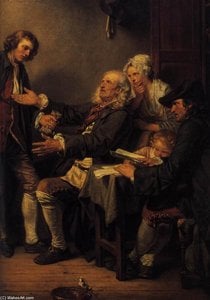
A Life Etched in Sentiment: The World of Jean-Baptiste Greuze
Jean-Baptiste Greuze, a name synonymous with the intimate and emotionally charged world of 18th-century French painting, was born in Tournus, a small Burgundian town steeped in history, on August 21st, 1725. His early life, far from the grand salons and aristocratic circles that typically shaped artistic careers, was marked by a modest upbringing – his father a roofer, instilling in him a practical understanding of the world’s realities. Yet, even as a young boy, Greuze possessed an undeniable spark, a sensitivity to human emotion that would later become the hallmark of his art. This nascent talent wasn't immediately nurtured; societal expectations and his father’s reservations initially discouraged artistic pursuits. However, a pivotal encounter with Grandon, a Lyon-based artist who recognized Greuze’s potential, proved transformative. Grandon became a mentor, providing guidance and encouragement that ignited the young painter’s passion and set him on a path toward realizing his extraordinary gift. This early influence, coupled with subsequent studies in both Lyon and, crucially, Paris under the tutelage of Charles-Joseph Natoire at the prestigious Royal Academy, laid the foundation for Greuze's distinctive style and approach to art.
The Rise of a Genre Painter
Greuze’s artistic breakthrough arrived in 1755 with *Le Père de famille expliquant la Bible à ses enfants* (The Father Explaining the Bible to His Children). This wasn’t merely a depiction of domestic life; it was an embodiment of the Enlightenment's core values, a powerful statement on familial piety and moral instruction. The painting resonated profoundly with contemporary audiences, capturing a spirit of bourgeois virtue – a burgeoning sense of morality and social responsibility that was rapidly gaining traction in French society. The discerning collector Ange-Laurent de La Live de Jully recognized the work’s significance and acquired it, catapulting Greuze to immediate fame. He swiftly followed this success with a series of further genre scenes—intimate glimpses into everyday life imbued with an extraordinary depth of emotional resonance and subtle moral undertones. A journey to Italy in 1755, undertaken alongside Abbé Louis Gougenot, broadened his artistic horizons, exposing him to classical models and influencing his compositional techniques. However, Greuze ultimately found a deeper wellspring of inspiration in the realities of French society than in the idealized world of ancient Greece and Rome. His ability to capture genuine feeling—joy, sorrow, remorse—set him apart from many of his contemporaries and firmly established him as a leading figure in the emerging Rococo style, albeit one distinguished by its profound moralizing quality.
Mastering Emotion and Moral Narrative
Greuze’s artistic strength resided in his unparalleled ability to tell stories through paint. His works weren't simply representations of scenes; they were carefully constructed narratives designed to evoke empathy and provoke reflection. Paintings like *La Jeune Fille qui pleure son oiseau mort* (The Young Girl Weeping for Her Dead Bird) and *Savoyard with a Dancing Doll* exemplify this skill, demonstrating his mastery of emotional expression and poignant storytelling. He possessed an extraordinary talent for capturing subtle nuances of facial expression—a fleeting glance, a delicate tremor—conveying inner turmoil with remarkable sensitivity. His compositions were often meticulously staged, utilizing dramatic lighting and expressive gestures to heighten the emotional impact of each scene. The influence of Dutch genre painters is evident in his work, particularly in their focus on everyday life and their ability to capture the complexities of human relationships. However, Greuze infused this tradition with a distinctly French sensibility, imbuing his scenes with a heightened sense of drama and moral urgency.
Denis Diderot, the influential philosopher and art critic of the Enlightenment, became a fervent champion of Greuze’s work, praising his ability to “endow art with morality” – a sentiment that perfectly encapsulated the artist's core mission.
Key Works & Their Significance
- Le Père de famille expliquant la Bible à ses enfants (1755): A cornerstone of his early success, embodying Enlightenment ideals of familial piety and setting the tone for much of his subsequent work.
- La Jeune Fille qui pleure son oiseau mort (c. 1765): Demonstrates Greuze’s mastery of emotional expression and poignant storytelling, capturing a universal experience of grief with heartbreaking detail.
- Savoyard with a Dancing Doll (c. 1763): Captures the spirit and vulnerability of childhood, showcasing his skill in portraiture and his ability to convey innocence and melancholy.
- Septimius Severus Reproaching Caracalla (1769): A failed attempt at historical painting that highlighted his strengths lay elsewhere – he was a master of genre, not grand narratives.
- The Broken Pitcher (c. 1770s): Represents a shift towards more sensual and morally ambiguous themes in his later work, exploring the complexities of human relationships with greater frankness.
Later Years and Lasting Legacy
Despite achieving considerable success during his lifetime, Greuze’s career took a dramatic turn when he was rejected by the Académie Royale de Peinture et de Sculpture in 1769. His ambitious attempt to be recognized as a history painter – the most prestigious category within the Academy – resulted in a harsh critique and ultimately led to his exclusion from official exhibitions. This rejection, coupled with personal difficulties—including a failed marriage—plunged Greuze into a period of isolation and poverty. He continued to paint privately, producing works that often explored themes of seduction and moral transgression, sometimes venturing into territory that was overtly sensual. These later paintings, while technically proficient, lacked the emotional depth and moral clarity of his earlier masterpieces. He died in 1805, impoverished and largely forgotten, within the Louvre itself – a poignant irony for an artist who had once been celebrated as a leading figure in French art. However, Jean-Baptiste Greuze’s influence endures to this day. He pioneered a new form of genre painting that focused on contemporary life and explored universal human emotions—a style that profoundly impacted subsequent generations of artists. His work remains a testament to the power of art to evoke empathy, provoke reflection, and capture the complexities of the human experience.



 Náhľad
 Kúpiť ručne maľovaný obraz
 Odoslať
 Zdieľať
 Podrobnosti o dielo

 Stiahnuť
 Podobné diela
 RTG skúška
 Prezentácia


 Zobraziť viac






































 Možnosť skla je dostupná len pri rozmeroch pod 110 cm