A Symphony of Light and Hope
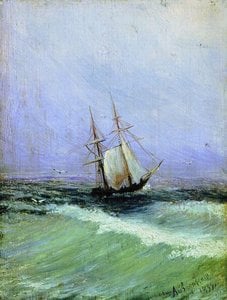
To gaze upon Ivan Konstantinovich Aivazovsky’s 1873 masterpiece, “The Rainbow,” is to witness a profound dialogue between the heavens and the sea. Aivazovsky, a titan of Romantic marine painting, possessed an almost supernatural ability to act as a conduit for the ocean’s soul. In this particular work, we find ourselves not merely observing a seascape, but participating in a moment of celestial alchemy. The painting captures that fleeting, ethereal instant where sunlight and rain converge to fracture white light into a breathtaking spectrum of color, casting a prismatic promise over the undulating waves. It is a scene that transcends mere maritime documentation, offering instead a meditative exploration of transition and the divine intersection of the earthly and the ethereal.
The composition is anchored by the delicate interplay of two vessels navigating the vast expanse. One small boat rests toward the left, while a larger vessel occupies much of the right-hand side, their presence providing a sense of scale against the infinite horizon. Within these boats, figures can be seen—some standing, some preparing for the journey ahead—adding a layer of human narrative to the elemental drama. There is a palpable sense of quiet anticipation; the atmosphere is at once serene and picturesque, capturing a moment of calm that feels both fragile and enduring.
The Mastery of Romantic Technique
Aivazovsky’s technical prowess is on full display through his sophisticated use of light and shadow. While many of his contemporaries, such as Turner, leaned into bold and vibrant palettes to depict maritime drama, Aivazovsky chose a more restrained, contemplative approach for “The Rainbow.” He employs a subdued tonal range—a delicate tapestry of muted blues, deep greens, and earthy ochres—to create an atmosphere of grandeur rather than mere spectacle. This deliberate restraint serves to heighten the emotional resonance of the work, drawing the viewer’s eye toward the subtle shifts in luminosity that define the water's surface.
The artist’s brushwork captures the very texture of the sea, from the translucent crest of a wave to the heavy, salt-laced weight of the deep. Through his mastery of light, he guides us through the turbulent seascape, emphasizing the vulnerability of the human element against the backdrop of nature's immense power. For the collector or interior designer, this technique offers a unique visual depth; the painting does not simply sit upon a wall but seems to breathe with an inner light, making it a captivating centerpiece for any sophisticated space.
Symbolism and Emotional Resonance
Beyond its aesthetic brilliance, “The Rainbow” carries deep symbolic weight. In the lexicon of art history, the rainbow has long served as a symbol of hope, a bridge between the turbulent storms of life and the promise of peace. By juxtaposing the potential for maritime struggle with the serene beauty of the atmospheric phenomenon, Aivivelysky creates a powerful metaphor for resilience. The painting speaks to the human spirit's ability to find beauty and light even amidst the unpredictable and often dangerous currents of existence.
For those seeking to bring a sense of tranquility and intellectual depth into their homes or galleries, this work offers an unparalleled emotional impact. It is a piece that invites long periods of contemplation, rewarding the viewer with new layers of meaning upon every encounter. Whether viewed as a triumph of 19th-century Romanticism or as a timeless emblem of hope, Aivazovsky’s vision remains as potent today as it was when the final brushstroke was applied in 1873.



 Náhľad
 Prepnúť na tlač
 Odoslať
 Zdieľať
 Podrobnosti o dielo

 Stiahnuť
 Podobné diela
 RTG skúška
 Prezentácia
 Štatistiky


 Zobraziť viac






































 Možnosť skla je dostupná len pri rozmeroch pod 110 cm