Získajte súbor pripravený na tlač, ktorý ponúka oveľa vyššiu kvalitu než online náhľad. Každý predávaný digitálny obraz pochádza z vysokorozlíseného originálu v našej databáze – zvyčajne s šírkou 5 000 až 15 000 pixelov – takže môžete s istotou tlačiť vo veľkom formáte, vytvárať detailné výrezy alebo reprodukovať jemné detaily.
Žiadny súbor neopustí naše štúdio bez úprav. Digitálny expert kontroluje farby v porovnaní s originálnym obrazom a v prípade potreby ich opraví, následne nástrojmi na profesionálnu retuš zvyšuje mieru ostrosti a detailov — pričom vždy zostáva verný umeleckému ťahu štetca a štýlu autora. Výsledkom je obraz, ktorý pôsobí ako samotné dielo, nie ako naskenovaný snímok s filtrom.
Schvaľujete ešte pred dokončením: náš expert vám obrazový súbor do 72 hodín pošle e-mailom na kontrolu. Nie ste spokojní? Požiadajte o vylepšenia alebo opravy, prípadne si môžete vyžiadať vrátenie platby, ak kvalita nedosahuje očakávanú úroveň.
Táto kvalita je základom dôvery vydavateľov, dizajnových štúdií, galérií a tlačovníkov.
Stiahnite si vysokorozlíšený súbor na osobné zobrazovanie, tlačenie a kreatívne projekty. ( Prepnúť na tlač Kúpiť ručne maľovaný obraz)
Keď si vyberiete WahooArt.com, nezískate len obyčajný obrázok – získate profesionálne upravené digitálne umenie, vytvorené s maximálnou precíznosťou a podložené zárukou vašej spokojnosti. Tu je všetko, čo je súčasťou vašej objednávky automaticky:
Vaša vysokorozlíšená digitálna súprava obrázkov vám bude zaslaná e-mailom do 72 hodín od objednávky – pripravená na okamžité použitie.
Vaše dielo je profesionálne optimalizované pomocou pokročilých nástrojov umelej inteligencie a manuálnej úpravy, čo zaručuje maximálnu mieru detailov, čistotu a presnosť farieb.
Súbor ste náhodou zmazali alebo ste ho stratili? Žiadne starosti – kedykoľvek vám ho môžeme poslať znova, úplne bez poplatkov.
Užite si svoje umenie okamžite bez colných poplatkov, daní alebo nákladov na dopravu – digitálne stiahnutia sú vždy oslobodené od dane.
Pomocou profesionálnych nástrojov a farebného manažmentu zabezpečujeme, aby vaša digitálna fotografia čo najpresnejšie odrážala pôvodné farby.
Ak nebudete spokojní so svojím digitálnym obrázkom, upravíme ho alebo vám v priebehu 100 dní vrátime 100% – bez zbytočných otázok.
Nie ste spokojní? Získajte plnú náhradu platby do 100 dní od prijatia digitálneho súboru – bez zbytočných otázok.
Pri kúpe 3 obrázkov získate zľavu 10% - Pri kúpe 5 obrázkov získate zľavu 15% - Pri kúpe 10+ obrázkov získate zľavu 20%. Ideálne pre kreatívne projekty, galérie a agentúry.

Erik Olson was born on 9 May 1901 in Halmstad, Sweden. Growing up in Halmstad, he was part of an artistic environment that included his brother, the artist Axel Olson. His early path was not set on a creative life; his father had expected him to become an engineer. Instead, Olson spent his evenings cultivating his interest in drawing and painting by studying at the Halmstad Technical School. This period of self-directed study provided the foundation for a career that would eventually move far beyond the technical constraints his father had envisioned.
The trajectory of his training shifted significantly through contact with the avant-garde. In 1919, Olson participated in an amateur show in Halmstad secondary school alongside his brother and cousin Waldemar Lorentzon. This exhibition brought him into contact with Gosta Adrian-Nilsson, a meeting that fundamentally altered his artistic direction. By 1924, Olson had moved to Paris with Lorentzon. They enrolled at the Academie Moderne, studying under Fernand Léger. This formal training in the school spirit of cubism provided the technical rigor that would define his later explorations of surrealism and complex spatial perspectives.
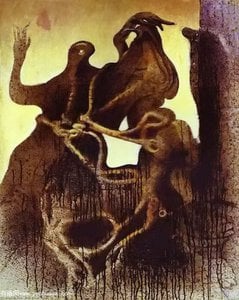
Olson’s reputation rests on his command of Swedish surrealism. He moved away from the rigid structures of cubism to embrace a style defined by dream-like, over-realistic depictions. His canvases do not merely represent objects; they construct entire psychological landscapes. These works often feature ecstatic and erotic space travels, pushing the viewer into environments that defy standard logic. He utilized light paintings to define these spaces, creating a sense of depth that feels both physical and hallucinatory.
The technical execution of his work relies on the use of labyrinthine spaces and impossible perspectives. He rejected the comfort of a stable horizon, opting instead to build complex, winding environments that trap the eye. Within these distorted geometries, he placed mythological figures that feel grounded by their hyper-realistic rendering. This tension between the recognizable detail of the subject and the irrationality of the setting is what gives his visionaries such weight. He did not rely on abstraction to create unease; he used clarity to make the impossible feel tangible.
Olson’s career was defined by a restless movement between the avant-garde circles of Europe and the regional art scene of Sweden. In 1915, he helped form the group Gnistan, an early step that preceded his significant shift toward international modernism. His time in Paris was particularly decisive. While studying at the Académie Moderne, he became part of the concrete art group Cercle et Carré, a connection that solidified his standing within the European avant-garde. This period was not merely about learning; it was about positioning himself within the most radical shifts of the era.
His commitment to collective identity was a recurring theme. In 1929, he became a co-founder of Halmstadgruppen, a group that would become a central force in Swedish art. This membership was not a static affiliation; it remained a constant throughout his professional life. His influence also extended across borders, as he became a member of a Danish surrealist group in Copenhagen after moving to Denmark in 1935. Even when political tensions forced him to flee occupied Denmark in 1944, his ties to the Halmstadgruppen remained intact, anchoring his return to Sweden.
Olson’s artistic trajectory shifted significantly in 1950 when he converted to Catholicism. This spiritual turn redirected his focus toward religious art, moving away from the earlier surrealist explorations that defined his mid-career. His later years were marked by a renewed engagement with sacred themes, translating his visual language into the medium of glass.
His contribution to ecclesiastical architecture is most visible in his stained glass commissions. He moved beyond the canvas to manipulate light through glass, creating works that occupy specific liturgical spaces. These installations demonstrate how his formal training in composition was applied to the structural requirements of church interiors.
Olson’s presence in major institutional collections confirms his standing within the Swedish and international canon. His works are represented at the National Museum, ensuring his contribution to the country's visual history remains accessible. On a global scale, his pieces are held by the Museum of Modern Art, placing his surrealist explorations within a broader context of twentieth-century modernism.
The reach of his legacy extends through significant exhibition histories in Sweden. His paintings have been featured at Liljevalchs konsthall in Stockholm, a venue that has hosted his work alongside other major movements. Additionally, his art has been exhibited at the Malmö museum, marking his continued relevance in regional art discourse. These locations provide the necessary physical evidence of his influence on the development of surrealism and cubism in the Nordic region.

1901 - 1986 , Švédsko
 Náhľad v interiéri

 Odoslať ako digitálnu kartu
 Zdieľať
 Podrobnosti o dielo
 Príručka


 Stiahnuť obraz
 Podobné položky
 RTG skúška
 Prehliadanie diapozoje
 Otázky a odpovede

 Štatistiky


 Zobraziť viac