The Enigmatic Charm of “Joking Couple”
Hans von Aachen’s “Joking Couple,” a captivating painting from the late 16th century, isn't merely a portrait; it’s a carefully constructed tableau brimming with subtle humor and an undercurrent of aristocratic intrigue. Executed in the vibrant style characteristic of Mannerism – a movement that prized elegance, artificiality, and psychological complexity over strict realism – this work offers a glimpse into the refined world of the Habsburg court at Prague, where Emperor Rudolf II fostered a remarkable confluence of artistic talent.
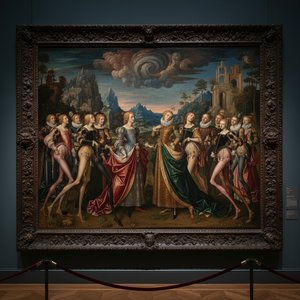
The painting depicts a man and woman standing close together, their postures suggesting an intimate yet playful exchange. The man, dressed in richly embroidered velvet and adorned with a jeweled belt, holds aloft a small mirror, reflecting the woman’s image back at herself. Her expression is one of amused contemplation as she observes her reflection, while the man appears to be enjoying his role as a mischievous observer. A single, elegant bird perches near the top left corner, adding a touch of unexpected detail and perhaps hinting at themes of fidelity or observation.
Mannerist Techniques: A Dance of Illusion
Von Aachen’s mastery lies in his skillful deployment of Mannerist techniques. Notice the elongated figures, a hallmark of the style, which contribute to an air of heightened drama and theatricality. The composition is deliberately unbalanced, creating a sense of dynamism and movement – the mirror's reflection pulling the viewer into the scene. The use of color is particularly noteworthy; rich reds, deep blues, and shimmering golds dominate the palette, reflecting the opulence associated with the imperial court. Von Aachen employs a technique known as *sfumato*, subtly blurring lines and edges to create an atmospheric haze, adding depth and mystery to the figures.
The painting’s surface is rendered with meticulous detail, particularly in the rendering of fabrics and jewelry – evidence of the artist's training in Venice, where he spent a significant portion of his career. Von Aachen’s style was influenced by Italian masters like El Greco, incorporating dramatic lighting and expressive gestures to convey emotion and psychological states.
Symbolism and Courtly Context
Beyond its immediate visual appeal, “Joking Couple” is laden with symbolic meaning. The mirror itself represents vanity, self-reflection, and perhaps even the complexities of relationships. The man’s gesture – holding up the mirror – can be interpreted as a playful challenge or an invitation to engage in witty banter. The woman's amused expression suggests she is aware of this dynamic, adding another layer of intrigue to the scene.
Considering the historical context, it’s important to remember that Rudolf II’s court was renowned for its patronage of the arts and its embrace of unconventional ideas. The painting reflects this atmosphere of intellectual curiosity and artistic experimentation. Von Aachen's work served as a visual representation of the courtly life – filled with elaborate rituals, witty conversation, and subtle power plays.
A Timeless Portrait of Human Connection
“Joking Couple” endures not simply as a beautiful painting but as a poignant meditation on human connection, vanity, and the art of social interaction. Its skillful composition, vibrant colors, and nuanced symbolism continue to captivate viewers centuries after its creation. Reproductions offer an accessible way to appreciate this remarkable work of Mannerist art, bringing its enigmatic charm into any space.



 Náhľad
 Kúpiť ručne maľovaný obraz
 Odoslať
 Zdieľať
 Podrobnosti o dielo

 Stiahnuť
 Podobné diela
 RTG skúška
 Prezentácia
 Štatistiky


 Zobraziť viac






































 Možnosť skla je dostupná len pri rozmeroch pod 110 cm