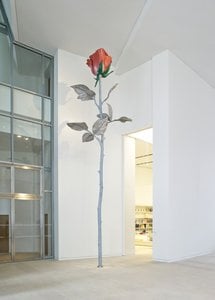
Early Life and Artistic Foundations
Hanne-Rose Genzken, known widely as Isa Genzken, emerged as a pivotal figure in the contemporary art landscape, her journey beginning in the quiet northern German city of Bad Oldesloe in 1948. Her formative years unfolded against the backdrop of post-war Germany, an environment steeped in reconstruction and grappling with its complex past—a context that would subtly yet profoundly influence her artistic trajectory. She pursued formal training at the Hamburg University of Fine Arts from 1968 to 1971, followed by studies at the Berlin University of the Arts. Recognizing the financial demands of art school, Genzken supplemented her education with part-time modeling work, an experience that perhaps subtly informed her later engagement with notions of representation and the body in her sculptures.
A crucial turning point arrived in 1973 when she transferred to the Kunstakademie Düsseldorf. This move placed her within a vibrant artistic milieu alongside peers like Katharina Fritsch and Thomas Struth, fostering an environment of critical dialogue and experimentation. The academy’s faculty—including influential figures such as Joseph Beuys, Bernd and Hilla Becher, and Gerhard Richter—provided a stimulating intellectual atmosphere that encouraged Genzken to push the boundaries of artistic convention.
A Multifaceted Practice: Sculpture, Installation, and Beyond
Isa Genzken’s work defies easy categorization. While sculpture remains central to her practice, she consistently expands into diverse media including photography, video, film, collage, and even assemblage. This refusal to be confined by a single discipline is a hallmark of her artistic approach. Her early sculptures, particularly the Hyperbolos and Ellipsoids series from the late 1970s, demonstrate a fascination with minimalist forms and geometric abstraction. However, these were not merely exercises in formal purity; they subtly questioned the utopian ideals often associated with Minimalism.
Throughout the 1980s, Genzken’s work began to engage more directly with architecture, exploring themes of urban space, modernity, and alienation. She conceived a series of plaster and concrete sculptures that investigated architectural structures—often fragmented or incomplete—reflecting a critical perspective on the built environment. This period also saw her collaboration with Gerhard Richter on the design of the König-Heinrich-Platz underground station in Duisburg, an ambitious project that further solidified her interest in public space.
Navigating Personal and Sociopolitical Landscapes
Genzken’s life has been marked by both artistic triumph and personal challenges. Her diagnosis with bipolar disorder profoundly impacted her creative process, leading to periods of intense productivity interspersed with times of withdrawal and treatment for substance abuse. She openly acknowledges the influence of these experiences on her work, suggesting that her art serves as a means of processing and confronting complex emotional states.
The 1990s witnessed a significant shift in Genzken’s aesthetic. She began incorporating found objects—plastic furniture, mannequins, everyday detritus—into her sculptures and installations. These assemblages often possess a raw, unsettling quality, reflecting the anxieties and contradictions of contemporary consumer culture. The Empire/Vampire series, created in response to the September 11th attacks, exemplifies this period, using fragmented figures and discarded materials to evoke a sense of trauma and disorientation.
Legacy and Historical Significance
Isa Genzken’s influence on contemporary art is undeniable. Her willingness to embrace diverse media, her critical engagement with architecture and consumer culture, and her unflinching exploration of personal experience have inspired generations of artists. She challenges traditional notions of sculpture, blurring the boundaries between high art and everyday life.
Her work resonates deeply within a postmodern context, questioning grand narratives and embracing fragmentation and ambiguity. She is celebrated for her ability to create works that are both visually striking and intellectually provocative—works that demand attention not only for their formal qualities but also for the complex social and political issues they address.
- Genzken’s sculptures often incorporate materials associated with construction and demolition, reflecting a critical perspective on urban development and societal decay.
- Her use of mannequins and dolls raises questions about representation, identity, and the commodification of the body.
- She consistently challenges traditional notions of artistic authorship, embracing chance encounters and found objects in her creative process.
Isa Genzken continues to live and work in Berlin, remaining a vital force in the contemporary art world. Her prolific output and unwavering commitment to experimentation ensure her enduring legacy as one of the most important artists of our time.



 Náhľad
 Kúpiť ručne maľovaný obraz
 Odoslať
 Zdieľať
 Podrobnosti o dielo

 Stiahnuť
 Podobné diela
 RTG skúška
 Prezentácia

 Zobraziť viac






































 Možnosť skla je dostupná len pri rozmeroch pod 110 cm