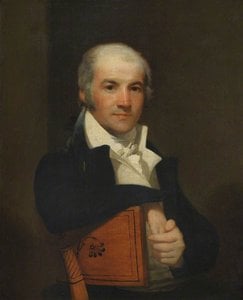
Sir Edward Thornton (1766–1852): Portrait of Dignity Amidst Uncertainty
Gilbert Stuart’s depiction of Sir Edward Thornton stands as a testament to the Romantic ideal of portraiture—a celebration not merely of likeness but of character and intellect. Painted in 1799, this monumental canvas captures Thornton, a prominent British diplomat and statesman, with remarkable precision and imbued with an aura of quiet contemplation. The artwork resides presently at Pembroke College, Cambridge, safeguarding its legacy for future generations of art historians and enthusiasts alike.
- Subject Matter: Stuart’s gaze focuses intently on Thornton's face—a study in repose—highlighting the sitter’s dignified countenance and conveying a profound sense of inner composure. His hand rests upon an unidentified object, possibly a book or manuscript, symbolizing erudition and intellectual engagement – hallmarks of Thornton’s distinguished career.
- Style: The painting embodies Neoclassicism, reflecting the artistic sensibilities prevalent during Stuart's era. However, unlike the rigid formalism characteristic of earlier neoclassical works, Stuart skillfully blends meticulous observation with expressive brushwork, creating a dynamic interplay between form and emotion.
Technique & Materials: A Masterful Blend
Stuart employed oil paints on canvas—a technique favored by artists of his time for its ability to achieve rich colors and textural depth. The artist’s meticulous layering of glazes contributes to the painting's luminous quality, capturing subtle nuances of light and shadow that illuminate Thornton’s features with breathtaking realism. Examination reveals a remarkable level of detail in Thornton’s clothing—a testament to Stuart’s dedication to achieving an accurate representation of his subject.
Historical Context: Diplomacy and Enlightenment Values
Thornton's portrait emerges from the crucible of the Napoleonic Wars, a period marked by political upheaval and international tension. Yet, Stuart manages to convey Thornton’s inner serenity—a reflection of the Enlightenment ideals that underpinned British society at the time—emphasizing reason, virtue, and intellectual pursuits. The painting serves as an emblem of Britain's commitment to upholding moral principles amidst turbulent circumstances.
Symbolism & Emotional Impact
The composition itself speaks volumes about Stuart’s artistic intentions. Thornton’s gaze directs towards the viewer—a gesture that invites contemplation and establishes a connection between sitter and observer. The subtle expression on Thornton's face conveys dignity, thoughtfulness, and perhaps even melancholy—capturing the complexities of human experience with sensitivity and grace. Ultimately, Stuart’s masterpiece transcends mere likeness; it embodies an enduring portrait of intellect, virtue, and unwavering composure.
Otázky a odpovede
Kde môžem nájsť sprievodnú stránku k dielu "Sir Edward Thornton"?
Stránka Sprievodca študentom diela „Sir Edward Thornton“ od Gilbert Stuart ponúka tlačiteľný dvojstranný informačný list: samotné umelecké dielo s identifikačnou tabuľkou, časovú os situujúcu dielo do obdobia života umelca, ďalšie práce daného umelca, nameranú farebnú paletu a citácie vo štyroch štýloch pripravené na skopírovanie.
Do ktorej časti domova sa hodí reprodukcia diela „Sir Edward Thornton“?
Reprodukcia diela „Sir Edward Thornton“ sa skvele hodí do Denná miestnosť.
Kedy bolo dielo „Sir Edward Thornton“ vytvorené a k ktorému umeleckému smeru patrí?
Dielo „Sir Edward Thornton“ od Gilbert Stuart pochádza z roku 1799 a patrí do smeru Neoclassicism.



 Náhľad v interiéri
 Kúpiť ručne maľovaný obraz
 Odoslať ako digitálnu kartu
 Zdieľať
 Podrobnosti o dielo
 Príručka

 Stiahnuť obraz
 Podobné položky
 RTG skúška
 Prehliadanie diapozoje
 Q&A
Q&A Štatistiky


 Zobraziť viac






































 Možnosť skla je dostupná len pri rozmeroch pod 110 cm