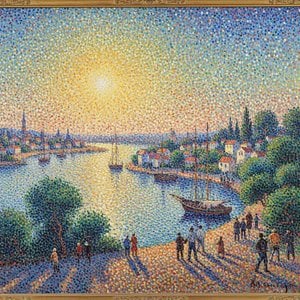
A Symphony of Light and Precision
In the quiet transition between day and night, Georges Seurat’s “Grandcamp, Evening” captures a moment where the world seems to hold its breath. Painted in 1885, this masterpiece transports the viewer to the tranquil harbor of Grandcamp-sur-Mer in Normandy, France. It is not merely a landscape; it is a profound meditation on the fading light of dusk. As the sun retreats, the canvas reveals a serene seascape where the calm waters reflect the soft, muted hues of twilight. A distant lighthouse stands as a silent sentinel, its beacon promising guidance amidst the encroaching shadows, while small boats and scattered figures move with a gentle grace across the coastal scene. The presence of a single bird in flight adds a delicate touch of movement, breathing life into an otherwise still and contemplative atmosphere.
To gaze upon this work is to witness the birth of a revolution. Seurat, moving beyond the spontaneous, often hazy impressions of his predecessors, sought to anchor art in the immutable laws of science. This painting serves as a cornerstone of Pointillism, a technique that demands both immense patience and intellectual rigor. Rather than blending pigments on a palette, Seurat applied thousands of minuscule, distinct dots of pure color directly onto the canvas. This method, known as chromoluminarism, relies on the viewer's eye to perform the final act of creation—blending these tiny points of light into a luminous, shimmering whole. The result is an optical brilliance that traditional brushstrokes simply cannot replicate, creating a sense of vibration and depth that feels almost alive.
The Science of Beauty and Emotional Resonance
The technical brilliance of “Grandcamp, Evening” is deeply rooted in the scientific theories of the era, specifically the research into color perception by Eugène Chevreuil. Seurat utilized a systematic approach to capture the objective reality of light, treating the canvas as a laboratory for optical truth. Every dot was a deliberate choice, calculated to maximize luminosity and simulate the way light interacts with the atmosphere at dusk. This meticulousness does not strip the painting of its soul; rather, it enhances its emotional depth. The structured precision of his technique provides a stable foundation for the profound sense of peace that radiates from the scene.
For the discerning collector or interior designer, this artwork offers more than just aesthetic appeal; it offers an atmosphere of sophisticated tranquility. The muted palette and balanced composition make it a versatile centerpiece, capable of anchoring a room with its quiet dignity. Whether placed in a contemporary gallery setting or a classic study, “Grandcamp, Evening” invites the observer into a state of calm contemplation. It is a piece that rewards long periods of looking, revealing new nuances of color and light with every glance. Owning a high-quality reproduction of this work means bringing a fragment of art history’s most luminous revolution into one's personal space—a permanent window into a sunset that never truly ends.



 Zobraziť v interiéri
 Objednať ručne maľovanú reprodukciu
 Odoslať
 Zdieľať
 Podrobnosti
 Príručkovo

 Stiahnuť
 Podobné položky
 RTG skúška
 Prehliadanie diapo\]
 Štatistiky

 Prečítať si viac






































 Možnosť skla je dostupná len pri rozmeroch pod 110 cm