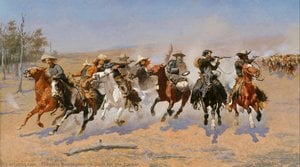
An Indian Trapper: A Chronicle of the American West
Frederic Remington’s “An Indian Trapper,” painted in 1889, isn't merely a portrait; it’s a carefully constructed narrative of the fading frontier and the complex relationship between European settlers and Native Americans. Born in Canton, New York, in 1861 – a place far removed from the landscapes he would immortalize – Remington initially sought a military career but found his true calling in capturing the spirit of the American West through art. This particular painting, created after his travels to Alberta, Canada, reflects a period of profound change and increasing tension as the vast territories were rapidly being claimed by white settlers.
The scene unfolds with remarkable detail against a backdrop of rugged, snow-dusted mountains – a quintessential vista of the Canadian Rockies. At the center stands a Native American man, identified often as a Cree or Blackfoot warrior, mounted on horseback and expertly maneuvering his mount through the challenging terrain. His attire—a traditional headdress, buckskin clothing, and a rifle slung across his back—immediately anchors him within this specific cultural context. Remington’s meticulous rendering of the horse, its powerful muscles straining with effort, underscores the vital role of animals in Native American life and their mastery of the wilderness.
The Painter's Technique: Realism Infused with Romanticism
Remington was a master of realism, meticulously documenting the details of his subjects – from the weathered texture of the man’s clothing to the intricate patterns of the headdress. However, “An Indian Trapper” transcends simple representation; it’s imbued with a romantic sensibility characteristic of Remington's work. The dramatic lighting—a strong contrast between light and shadow—heightens the sense of adventure and emphasizes the rugged beauty of the landscape. Notice how the artist uses loose brushstrokes to convey movement and energy, particularly in the horse’s stride and the man’s determined posture.
The painting's composition is carefully balanced, drawing the viewer’s eye across the scene. The figure dominates the foreground, while the distant mountains create a sense of scale and emphasize the vastness of the territory. Remington employed oil paints on canvas, utilizing layering techniques to achieve depth and texture. His use of color—earth tones punctuated by flashes of white snow—further enhances the painting’s realism and evokes the harsh beauty of the Western landscape.
Symbolism and Historical Context
“An Indian Trapper” is more than just a depiction of an individual; it's a visual statement about the era. The title itself suggests a figure caught between two worlds – a skilled hunter and tracker, yet also a participant in a rapidly changing society. The painting was initially conceived during Remington’s sketching expedition to Alberta, where he sought to document the lives of Native Americans before they were largely displaced by settlers. It's important to note that Remington’s portrayal, while detailed, has been subject to criticism for potentially perpetuating stereotypes about Native American culture.
However, considering the context of the late 19th century, when westward expansion was accelerating and Native American tribes were facing increasing pressure, “An Indian Trapper” offers a valuable glimpse into a vanishing way of life. The painting’s inclusion in *Harper's Monthly Magazine* in 1891 further cemented its place as a significant representation of the West during that period, sparking debate and discussion about the future of Native American communities.
Emotional Impact and Legacy
Looking at “An Indian Trapper” today, one is struck by its powerful sense of adventure and resilience. The figure’s determined gaze and confident posture convey a spirit of independence and mastery over his environment. The painting evokes a feeling of both admiration for the Native American warrior and a poignant awareness of the impending loss of their traditional way of life. It remains a compelling testament to Frederic Remington's skill as an artist and his enduring fascination with the American West – a landscape forever shaped by conflict, exploration, and transformation.



 Zobraziť v interiéri
 Prepnúť na tlač
 Odoslať
 Zdieľať
 Podrobnosti
 Príručkovo

 Stiahnuť
 Podobné položky
 RTG skúška
 Prehliadanie diapo\]
 Štatistiky


 Prečítať si viac