River Scene – A Window Into Impressionistic Vision
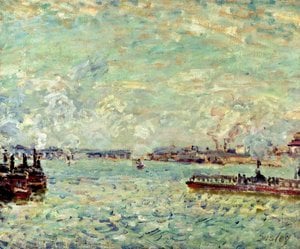
“River Scene,” painted by Ferdinand Guillaumin in 1890, stands as a quintessential example of Impressionism’s fascination with capturing fleeting moments and sensory impressions. More than just a depiction of a riverside landscape, it's an invitation to experience the atmosphere of a bygone era—a testament to Guillaumin’s ability to distill the essence of light and color into a single canvas.
Subject Matter & Composition
The artwork portrays a bustling waterway dominated by several boats – barges laden with cargo, smaller vessels navigating calmer stretches – reflecting the industrial growth occurring in France during the late 19th century. Guillaumin skillfully employs horizontal lines to emphasize the expansive space of the river and horizon, creating a visual rhythm that draws the viewer’s eye across the composition. The arrangement of boats contributes to this sense of movement and dynamism.
Style & Technique – Impasto and Atmospheric Light
Guillaumin's distinctive style is characterized by “impasto,” where thick layers of paint are applied directly onto the canvas, creating a palpable textural surface that captures the shimmering effect of sunlight on the water’s surface. Short, broken brushstrokes dominate the technique, mirroring the fragmented nature of perception itself—a hallmark of Impressionism’s rejection of academic realism.
Color Palette & Symbolism
The color palette leans heavily towards blues and greens – reflecting the dominant hues of the river environment – punctuated by yellows and browns that add warmth and depth. Guillaumin utilizes a muted tonal range, prioritizing atmospheric light over precise representation. The boats themselves could symbolize progress, trade, or perhaps even the passage of time, subtly enriching the artwork’s narrative.
Historical Context & Artistic Legacy
Painted during the height of Impressionism's influence, “River Scene” aligns perfectly with the movement’s core principles—a deliberate departure from traditional artistic conventions. Its inclusion in exhibitions alongside Claude Monet solidified Guillaumin’s place within the canon of Impressionist art. Today, reproductions of this evocative piece continue to inspire collectors and interior designers seeking a connection to the beauty and immediacy of nature.
Additional Research
Further exploration into Ferdinand Guillaumin's artistic career reveals his membership in the Société Nautique de Marne, where he championed the depiction of maritime subjects. His work at the Musée d’Art Moderne de Paris alongside Monet exemplifies the collaborative spirit that propelled Impressionism forward.
Otázky a odpovede
Aká je odporúčaná veľkosť a orientácia tlače pre dielo "River Scene"?
Pre dielo „River Scene“ sa odporúča tlač vo veľkosti Large v orientácii Landscape.
Z akého materiálu je vyrobené „River Scene“?
Jean-Baptiste Armand Guillaumin použil/a techniku Oil On Canvas pre dielo „River Scene“. Táto technika definuje materiálnu podstatu originálneho diela.
Na čo sa odporúča použiť „River Scene“ od Jean-Baptiste Armand Guillaumin?
Odporané použitie pre „River Scene“ od Jean-Baptiste Armand Guillaumin je Accent. Môže však slúžiť aj na iné účely.



 Zobraziť v interiéri
 Objednať ručne maľovanú reprodukciu
 Odoslať
 Zdieľať
 Podrobnosti
 Príručka

 Stiahnuť
 Podobné položky
 RTG skúška
 Prehliadanie diapo\]
 Štatistiky


 Prečítať si viac






































 Možnosť skla je dostupná len pri rozmeroch pod 110 cm