Edward Bird (1772–1819): A Life Rooted in Craft
- Early Years and Apprenticeship
- The Bristol School and Artistic Flourishing
- Recognition in London and a Shift to Historical Themes
- Later Years, Legacy, and Artistic Style
Early Years and Apprenticeship
Edward Bird was born in Wolverhampton, Staffordshire, England, on April 12th, 1772. His father, a carpenter, instilled in him an early appreciation for craftsmanship—a skill that would profoundly shape his artistic trajectory. Unlike many artists of his time who pursued formal training, Bird’s education stemmed from practical experience gained as an apprentice to a japanning artist. This occupation demanded meticulous attention to detail and a mastery of decorative techniques, equipping him with foundational skills that transcended mere aesthetic sensibility. The process of applying intricate designs onto tea trays—a painstaking endeavor requiring precision and artistic vision—became more than just a trade; it was the crucible where Bird’s innate talent began to coalesce into something truly remarkable. This grounding in craftsmanship would prove unexpectedly formative, informing his later work with an unwavering commitment to realism and textural richness.
The Bristol School and Artistic Flourishing
Seeking broader horizons beyond Wolverhampton, Bird relocated to Bristol in 1794—a burgeoning port city brimming with cultural dynamism. There, he married Martha Dodrell and embarked on a career as an independent artist, accepting commissions ranging from intimate portraiture to expansive illustrative works for books and grand decorative paintings adorning local churches. It was within the vibrant milieu of Bristol that Bird discovered his artistic kindred spirits—fellow artists who shared a fervent passion for experimentation and mutual encouragement. This wasn’t a rigidly structured academy but rather a dynamic network where ideas circulated freely, pushing the boundaries of artistic convention. Among these influential figures was George Cumberland, an art collector and connoisseur whose extensive library served as an invaluable source of inspiration. Cumberland's patronage opened doors to study masterpieces from the Old Masters—a formative experience that instilled in Bird’s aesthetic sensibilities a deep respect for tradition while simultaneously fostering a desire to forge new paths. Regular evening sketching sessions conducted amidst Bristol’s picturesque landscapes nurtured both technical prowess and a shared artistic vision. The Bristol School championed a naturalistic style, prioritizing fresh color palettes and an acute observation of everyday life—qualities that would become hallmarks of Bird’s oeuvre and profoundly influence artists like Francis Danby.
Recognition in London and a Shift to Historical Themes
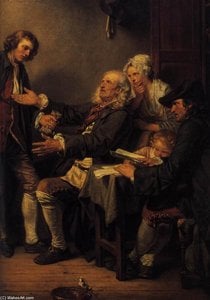
A pivotal moment arrived in 1809 when Bird submitted his painting ‘Good News’ to the Royal Academy—a daring undertaking that immediately garnered critical acclaim and captivated the patronage of influential figures. The artwork's compelling narrative and masterful execution resonated deeply with both critics and collectors alike, establishing Bird’s reputation as a significant talent within the artistic landscape. This success brought royal recognition; His Majesty bestowed upon him the honor of appointment as historical painter to Princess Charlotte—a prestigious commission that underscored his growing stature in London society. Furthermore, he was elected Associate of the Royal Academy in 1812 and Full Member in 1815—affirming his position among Britain’s most celebrated artists. Recognizing the potential for greater artistic ambition, Bird transitioned towards history painting—a genre demanding both technical virtuosity and a profound understanding of dramatic storytelling. He undertook ambitious projects depicting pivotal battles and historical events—capturing their intensity and emotional weight with unparalleled skill. Works like ‘The Field of Chevy Chase’ and ‘The Day After the Battle’ showcased his burgeoning ability to convey the visceral experience of warfare, cementing his legacy as one of Britain's foremost history painters.
Later Years, Legacy, and Artistic Style
Despite achieving considerable acclaim during his lifetime, Bird’s later years were marked by persistent health challenges—a sobering reminder that artistic genius is often accompanied by personal vulnerability. His attempts to tackle monumental historical canvases proved particularly demanding, reflecting the difficulties inherent in translating grand narratives onto canvas. Tragically, he succumbed to illness on November 2nd, 1819—leaving behind a diverse body of work celebrated posthumously at a retrospective exhibition held shortly thereafter in Bristol. Edward Bird’s enduring influence extends beyond his artistic output; he stands as a pivotal figure in British art history—a testament to the transformative power of collaboration and the timeless appeal of naturalistic representation. His meticulous attention to detail, combined with his masterful blending of genre and historical styles, continues to inspire artists today—solidifying his place among the giants of 19th-century British painting.



 Zobraziť v interiéri
 Prepnúť na tlač
 Odoslať
 Zdieľať
 Podrobnosti
 Príručka

 Stiahnuť
 Podobné položky
 RTG skúška
 Prehliadanie diapo\]
 Štatistiky
 Prečítať si viac