Coquillages: A Study in Surrealist Still Life
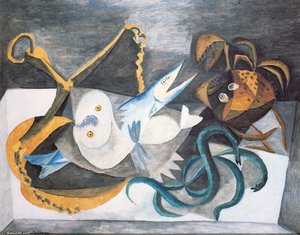
The painting “Coquillages” by Edward Alexander Wadsworth, completed in 1926, stands as a quintessential example of British Surrealism—a movement that sought to liberate art from rational constraints and tap into the subconscious mind. More than just a depiction of seashells scattered across a tabletop, it’s an exploration of form, texture, and mood, reflecting Wadsworth's fascination with modernist aesthetics while simultaneously embracing dreamlike imagery.
The Artist and His Context
Born in Cleckheaton, West Yorkshire, in 1889, Edward Alexander Wadsworth experienced early loss when his mother succumbed to puerperal sepsis shortly after childbirth. This formative experience instilled a contemplative spirit that would permeate his artistic vision throughout his life. Initially drawn to engineering—a profession dictated by paternal expectations—Wadsworth swiftly abandoned it for the transformative embrace of art during his time in Munich, where he discovered the burgeoning currents of Cubism and Futurism. His exposure to these influential movements profoundly shaped his stylistic sensibilities, propelling him toward a distinctive blend of abstraction and observation.
Composition and Technique
“Coquillages” showcases Wadsworth’s masterful command of tempera on board—a medium known for its luminous quality and ability to capture subtle tonal variations. The painting's composition is deliberately understated yet meticulously balanced. Two columns dominate the background, anchoring the scene against a backdrop of muted blues and greens evocative of the ocean. At the forefront sits a woman seated calmly on the edge of a cliff overlooking the sea—a pose that conveys both vulnerability and resilience. Scattered amongst the columns are seashells—their irregular shapes and textures providing textural contrast and adding an element of organic beauty to the scene. Wadsworth’s meticulous attention to detail is evident in every brushstroke, creating a surface imbued with palpable atmosphere.
Symbolism and Emotional Resonance
Beyond its formal qualities, “Coquillages” resonates with deeper symbolic meanings. Shells are traditionally associated with protection, rebirth, and contemplation—themes that align seamlessly with Wadsworth’s artistic ethos. The woman's posture suggests introspection and acceptance of fate, mirroring the broader Surrealist preoccupation with confronting anxieties and exploring hidden desires. The ocean itself represents vastness, mystery, and the subconscious—a realm where reason yields to intuition. Ultimately, “Coquillages” invites viewers to engage in a meditative contemplation of beauty, fragility, and the enduring power of nature.
Legacy and Recognition
Currently housed at The Whitworth museum in Manchester, United Kingdom, “Coquillages” exemplifies Wadsworth’s contribution to British Modernism—a movement that championed innovation and challenged conventional artistic conventions. Its inclusion in The Whitworth's collection underscores its significance as a landmark achievement of Surrealist art and serves as an inspiration for collectors and interior designers seeking pieces that embody both intellectual depth and aesthetic elegance.
- Artist: Edward Alexander Wadsworth
- Year: 1926
- Medium: Tempera on Board
- Location: The Whitworth Museum, Manchester
Further Information: Discovering Masterpieces of The Whitworth, Manchester, United Kingdom. Handmade oil painting reproductions of Coquillages and other notable works can be found on WahooArt.com.



 Zobraziť v interiéri
 Prepnúť na tlač
 Odoslať
 Zdieľať
 Podrobnosti
 Príručka

 Stiahnuť
 Podobné položky
 RTG skúška
 Prehliadanie diapo\]
 Štatistiky


 Prečítať si viac






































 Možnosť skla je dostupná len pri rozmeroch pod 110 cm