A Window Into The Soul: Exploring A Masterpiece Of Emotional Expression
Edvard Munch’s *untitled (5918)* stands as an arresting testament to the anxieties simmering beneath the surface of modern consciousness—a painting that transcends mere visual representation and plunges directly into the turbulent realm of human emotion. Created in 1893, during a period marked by profound societal shifts and burgeoning psychological awareness, this artwork embodies Munch’s signature style: Expressionism, prioritizing subjective experience over objective observation. Unlike Impressionists who sought to capture fleeting moments of light and color, Munch aimed to convey the visceral impact of inner turmoil—a feat accomplished with remarkable skill through masterful use of oil paints on canvas.
The composition itself is deliberately unsettling. Two young women dominate the scene, positioned slightly off-center, creating an immediate imbalance that mirrors the psychological unease at its core. Their figures are rendered in muted tones – predominantly yellows and browns – contributing to a sense of melancholy and isolation. The backdrop—a hazy expanse suggestive of an outdoor setting—is deliberately ambiguous, lacking detail and reinforcing the feeling of confinement within the women’s internal landscape. Munch wasn't interested in *what* he saw; rather, he sought to distill *how* it made him feel – translating this profound emotional resonance onto canvas with breathtaking precision.
Style & Influences: A Pioneer Of Expressionism
Munch’s artistic vision was deeply rooted in the burgeoning Expressionist movement, spearheaded by artists like Vincent van Gogh and Paul Gauguin who rejected academic conventions in favor of bold color palettes and distorted forms. Van Gogh's expressive brushstrokes and Gauguin’s symbolic imagery served as crucial inspiration for Munch, guiding him toward a visual language that prioritized emotional intensity over literal depiction. He deliberately eschewed traditional perspective, flattening the canvas to heighten the sense of claustrophobia and psychological pressure—a technique characteristic of Expressionist painters who wished to convey inner states rather than external realities. The influence of Symbolism is palpable in Munch’s use of color and imagery; he employed hues that evoke feelings of sorrow, fear, and longing, mirroring the pervasive anxieties of his time.
Technique & Materials: Textured Emotion
Munch's masterful manipulation of oil paints on canvas exemplifies Expressionist technique—a deliberate rejection of naturalistic representation in favor of conveying raw emotion through visible brushstrokes and impasto textures. Thick layers of paint build up on the surface, creating a palpable physicality that amplifies the painting’s emotional impact. The artist employed a technique known as *alla prima*, applying pigment directly onto the canvas without underpainting—a method that ensured maximum vibrancy and immediacy. Careful attention to detail is evident in the rendering of the women's faces, where Munch skillfully captures subtle expressions of vulnerability and contemplation. Furthermore, the use of chiaroscuro – dramatic contrasts between light and shadow – intensifies this effect, drawing the viewer’s gaze into the painting’s emotional core.
Historical Context: A Reflection Of Modern Anxiety
*untitled (5918)* emerged during a period of significant intellectual ferment—the dawn of psychoanalysis spearheaded by Sigmund Freud, which challenged prevailing notions about consciousness and emotion. Munch's own life was marked by profound personal tragedy – the premature deaths of his mother and sister from tuberculosis instilled in him an enduring preoccupation with mortality and illness. These experiences fueled his artistic impulse to explore the darker recesses of human psychology—a mission he pursued relentlessly throughout his career, paving the way for future generations of Expressionist artists who dared to confront uncomfortable truths about the human condition. The painting reflects the pervasive anxieties of modernity—the disillusionment following the decline of religious faith and the growing awareness of psychological instability—themes that resonated deeply with audiences grappling with existential questions.
Symbolism & Interpretation: Whispers Of Inner Turmoil
The symbolism within *untitled (5918)* is subtle yet profoundly evocative. The positioning of the two women – their proximity juxtaposed with apparent emotional distance – suggests a shared experience of sorrow or contemplation—a poignant reflection of human relationships burdened by grief and unspoken anxieties. Their faces, rendered in muted tones, convey expressions of quiet resignation and vulnerability—capturing the essence of psychological fragility. Munch’s deliberate use of color contributes to this symbolic dimension; the dominant yellows and browns evoke feelings of decay and melancholy, mirroring the pervasive sense of loss that characterizes the painting's atmosphere. The hazy background symbolizes uncertainty and isolation—underscoring the women’s predicament as individuals adrift in a turbulent world. Ultimately, *untitled (5918)* invites viewers to contemplate themes of grief, loneliness, and existential angst—a timeless exploration of the human psyche that continues to captivate audiences today.
Emotional Resonance & Contemporary Appeal
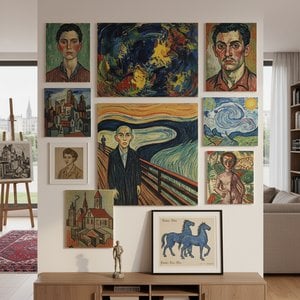
This painting transcends its historical context, resonating with contemporary sensibilities through its unflinching portrayal of emotional vulnerability. Its enduring appeal lies in its ability to tap into universal feelings of sorrow and contemplation—offering viewers a space for introspection and empathy. Whether viewed as a standalone artwork or incorporated into an interior design scheme, *untitled (5918)* serves as a powerful reminder of the complexities of human experience—a testament to Munch’s genius and a captivating centerpiece for any discerning collection.
- For Collectors: A significant work representing a pivotal moment in art history, embodying the core tenets of Expressionism.
- For Interior Designers: Provides a striking visual element that adds depth, sophistication, and emotional resonance to any space—particularly suited for contemplative interiors.
- For Art Lovers: An invitation to engage with Munch’s masterful exploration of human emotion—a timeless masterpiece deserving of careful contemplation.
A high-quality reproduction of *untitled (5918)* would serve as a lasting tribute to Munch's artistic legacy and enrich any home or gallery setting.
Otázky a odpovede
Aké farby dominujú v díle „untitled (5918)“ od Edvard Munch?
„untitled (5918)“ od Edvard Munch využíva paletu v odtieňoch Zemité tóny, pričom dominantnou farbou je Čierna (#20100b).
Má dielo „untitled (5918)“ náhľad v rozšírenej realite?
Stránka AR náhľad diela „untitled (5918)“ od Edvard Munch využíva rozšírenú realitu na zobrazenie umelackého diela vo vašom vlastnom priestore pomocou kompatibilného zariadenia.
Aké miesto si v dejinách umenia predstavuje „untitled (5918)“ od Edvard Munch?
Arthistorické klasifikovanie diela „untitled (5918)“ od Edvard Munch patrí do smeru Expressionizmus, v období Moderná éra.



 Zobraziť v interiéri
 Objednať ručne maľovanú reprodukciu
 Odoslať
 Zdieľať
 Podrobnosti
 Príručka

 Stiahnuť
 Podobné položky
 RTG skúška
 Prehliadanie diapo\]
 Štatistiky

 Prečítať si viac






































 Možnosť skla je dostupná len pri rozmeroch pod 110 cm