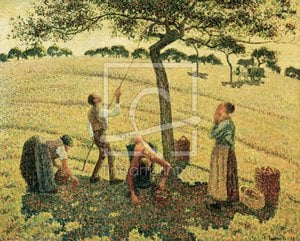
Pere Melon Resting – A Study in Tranquility
Camille Pissarro’s “Pere Melon Resting,” painted in 1879, stands as a cornerstone of Impressionism—a movement that irrevocably altered the course of art history. More than just a depiction of a man enjoying a moment outdoors, it embodies the very essence of Pissarro's artistic philosophy: capturing fleeting impressions of light and atmosphere with loose brushstrokes and vibrant color palettes.
The painting portrays a solitary figure seated on the grass in a rural landscape near Pontoise. The man’s posture exudes calmness—his legs crossed, suggesting repose after exertion. Surrounding him are two baskets filled with produce and a spade, hinting at agricultural labor but simultaneously emphasizing the harmony between humanity and nature – a recurring theme throughout Pissarro's oeuvre.
Stylistic Influences and Technique
Pissarro’s distinctive style owes considerable debt to Impressionist predecessors like Claude Monet and Eugène Boudin. Like Monet, he prioritized observing natural light conditions directly on canvas, striving to convey the subtle nuances of color and texture as they shift throughout the day. However, unlike Monet's often idealized landscapes, Pissarro’s compositions retain a palpable sense of realism.
His technique is characterized by rapid brushstrokes—often feathery and blended—that create an illusion of movement and luminosity. He employed broken color, applying pigment in small patches rather than blending it smoothly, allowing individual hues to mingle optically on the viewer’s eye. This method brilliantly captures the diffused light filtering through foliage, imbuing the scene with a palpable warmth.
Historical Context – The Birth of Impressionism
“Pere Melon Resting” emerged during a pivotal moment in artistic innovation—the genesis of Impressionism. Artists like Pissarro rejected academic conventions that demanded meticulous detail and polished surfaces, instead prioritizing subjective experience and emotional resonance. This rebellion against established norms was fueled by scientific discoveries concerning color perception, notably Hermann Helmholtz’s work on the physiology of vision.
The Impressionist movement sought to depict scenes from everyday life with unprecedented honesty and immediacy. Artists were encouraged to paint outdoors (“en plein air”), capturing the transient effects of weather and time—a radical departure from studio painting where artists meticulously recreated idealized subjects.
Symbolism and Emotional Impact
Beyond its technical brilliance, “Pere Melon Resting” resonates with deeper symbolic meanings. The man’s stillness represents contemplation and connection to the natural world – values that were central to the humanist ideals of the era. The baskets symbolize labor and sustenance, grounding the scene in the realities of rural existence.
Ultimately, Pissarro's painting invites viewers into a moment of serene beauty—a celebration of simple pleasures and an affirmation of life’s inherent rhythms. It exemplifies Impressionism’s ability to evoke emotion through visual sensation, transporting us back to a time when art prioritized capturing the fleeting impressions of experience.



 Náhľad
 Kúpiť ručne maľovaný obraz
 Odoslať
 Zdieľať
 Podrobnosti o dielo

 Stiahnuť
 Podobné diela
 RTG skúška
 Prezentácia
 Stats
Stats


 Zobraziť viac






































 Možnosť skla je dostupná len pri rozmeroch pod 110 cm