A Tapestry of Tradition and Modernity
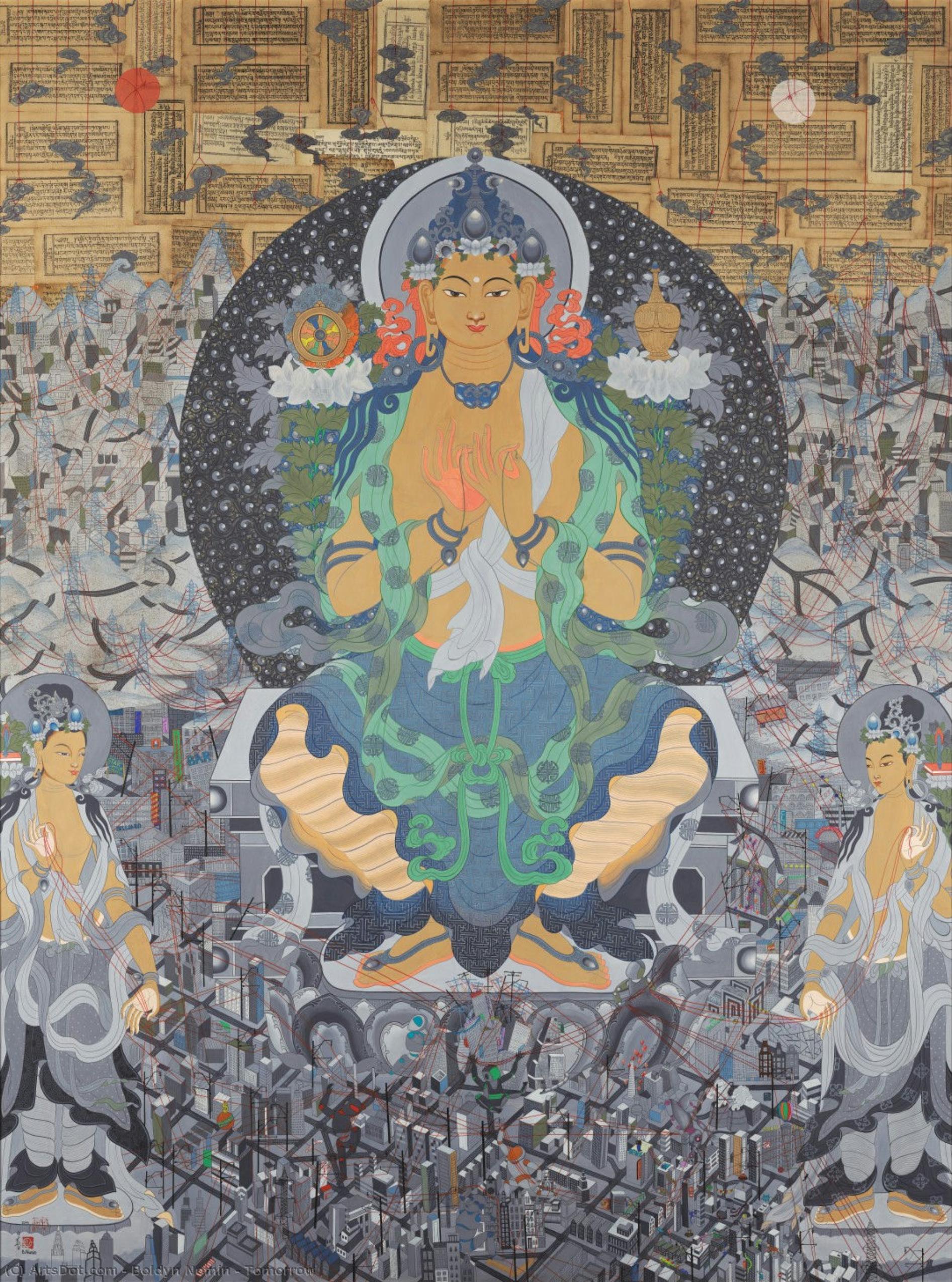
In the breathtaking masterpiece Tomorrow, the contemporary Mongolian artist Nomin Bold orchestrates a visual symphony that bridges the ancient spiritualities of the past with the electric, often jarring realities of the present. At first glance, the viewer is drawn into a celestial realm, where a large central deity sits in serene repose, flanked by two consubstantial consorts. Yet, as the eye wanders through this intricate landscape, the divine and the mundane begin to intertwine in a way that is both startling and profoundly moving. Bold utilizes the sacred geometry of Tibetan Buddhist tangka painting to structure her composition, creating a sense of eternal order that stands in stark contrast to the chaotic energy of the modern world creeping into the frame.
The brilliance of this work lies in its ability to find the divine within the urban. While the central figures command a space of spiritual stillness, the background reveals a receding tangle of city streets, rendered with a fascinating use of linear perspective. In a stroke of creative genius, Bold uses power lines—the very veins of modern infrastructure—to thread the gods through the scene, physically and metaphorically connecting the heavens to the earth. This juxtaposition serves as a poignant commentary on the contradictions of contemporary Mongolian life, where ancient traditions must navigate the rapid urbanization and technological shifts of the twenty-first century.
The Mastery of Mongol Zurag
To appreciate Tomorrow is to understand the revival of Mongol Zurag, a painterly idiom that serves as a vessel for national identity. This style, which emerged during Mongolia's struggle for independence in the early twentieth century, is a sophisticated synthesis of Tibetan Buddhist tangka, Chinese guohua, and the equestrian artistry of the Liao dynasty. Bold’s execution of this technique is nothing short of extraordinary; her ultra-fine brushwork creates a level of detail that demands close, intimate inspection, while her use of bright, vibrant colors breathes life into every figure and element within the composition.
The artist’s technical prowess is further elevated by her experimental use of materials. By incorporating collaged pages from Mongolian scriptures and delicate gold-leafing, Bold adds a tactile, multidimensional quality to the canvas. These elements do more than just decorate; they imbue the painting with an inherent sanctity, reminding the viewer of the sacred texts that have shaped Mongolian thought for centuries. The interplay between the flat, stylized perspective characteristic of zurag and the shimmering gold accents creates a luminous effect that captures the light, making the artwork feel as though it is vibrating with its own internal energy.
An Invitation to Contemplation
For the discerning collector or interior designer, Tomorrow offers much more than mere aesthetic beauty; it provides a profound emotional resonance. The painting captures the tension of an era—the struggle between the weight of history and the uncertainty of what lies ahead. It is a work that speaks to the resilience of culture and the enduring power of spiritual symbols in a secularizing world. The presence of everyday objects, such as the apple or the subtle inclusion of birds, grounds the celestial drama in a relatable, earthly reality, making the divine feel accessible.
Owning a high-quality reproduction of this work allows one to bring a piece of Mongolia's cultural renaissance into their personal space. Whether placed in a quiet study for meditative reflection or as a bold focal point in a contemporary living area, Tomorrow serves as a conversation piece that invites inquiry and deep thought. It is an evocative testament to Nomin Bold’s ability to transform the historical struggles of her people into a universal narrative of hope, continuity, and the beautiful, complex dance between our ancestors and our future.
Otázky a odpovede
Do ktorej obdobia tvorby Boldyn Nomin patrí dielo „Tomorrow“?
Dielo „Tomorrow“ patrí do obdobia Mature Period v tvorbe umelca Boldyn Nomin. Táto klasifikácia spája toto dielo s vývojom umeleckej dráhy autora.
Kde sa nachádza „Tomorrow“ v rámci opakujúcich sa tém umelca Boldyn Nomin?
Opakujúce sa témy umelca Boldyn Nomin zahŕňajú tibetan buddhist tangka influence, mongolian zurag revival, contemporary life contradictions, secular nationalism themes, spiritual and urban tension, mastery of fine brushwork; dielo „Tomorrow“ sa zameriava na mongol zurag, tibetan buddhist, contemporary life, deity, gold leaf, spiritual, urbanization.
Ako sa vzájomne dopĺňajú farby diela „Tomorrow“?
„Tomorrow“ od Boldyn Nomin predstavuje Softly Mixed Palette farebnú harmóniu.


 Zobraziť v interiéri
 Objednať ručne maľovanú reprodukciu
 Odoslať
 Zdieľať
 Podrobnosti
 Príručka

 Stiahnuť
 Podobné položky
 RTG skúška
 Prehliadanie diapo\]
 Štatistiky


 Prečítať si viac






































 Možnosť skla je dostupná len pri rozmeroch pod 110 cm