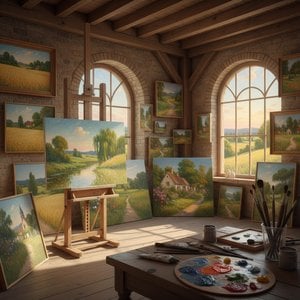
Angelo Morbelli: A Painter of Humanity’s Echoes
Angelo Morbelli, born in Alessandria in 1853, wasn't merely a painter; he was a chronicler of his time, a witness to the profound shifts occurring within Italian society at the turn of the century. His artistic journey, initially marked by landscapes and historical scenes, took an unexpected and deeply compassionate turn as he dedicated himself to portraying the lives – and ultimately, the sorrows – of the elderly in Milan’s Pio Albergo Trivulzio. This commitment to social realism, coupled with his innovative use of Divisionist technique, cemented Morbelli's place as a significant figure in late 19th and early 20th-century Italian art.
Morbelli’s early life provided the foundation for his artistic sensibilities. Born into a comfortable family, he initially pursued music but was forced to abandon it due to a progressive hearing loss. This shift led him to the Brera Academy in Milan, where he studied under influential figures like Giuseppe Bertini and Raffaele Casnedi. It was here that he began experimenting with photography, meticulously studying compositions and lighting – techniques he would later integrate into his paintings. His early works, while technically proficient, hinted at a growing interest in capturing the realities of everyday life, foreshadowing his future focus on marginalized communities.
The Turning Point: The Pio Albergo Trivulzio
A pivotal moment in Morbelli’s career arrived with his decision to document the lives within the Pio Albergo Trivulzio, a home for the aged and infirm. This wasn't simply an act of charity; it was a profound artistic undertaking. He spent years observing these residents, immersing himself in their stories and experiences. The resulting series of paintings – *The Last Days* (1883), *A Christmas at the Pio Albergo Trivulzio* (1903), and many others – became his most celebrated work, a poignant meditation on aging, vulnerability, and the human condition. These canvases weren’t idealized portraits; they were raw, honest depictions of elderly individuals grappling with illness, loneliness, and the passage of time.
Morbelli's approach was revolutionary for its time. He moved beyond traditional representations of the elderly as passive subjects, instead portraying them as active participants in their own lives – engaged in conversation, tending to small tasks, or simply reflecting on memories. His use of light and color became increasingly expressive, employing a Divisionist technique that broke down forms into tiny dots of pure color, creating a shimmering, atmospheric effect. This method allowed him to convey not only the physical appearance of his subjects but also their emotional states – a sense of melancholy, resilience, or quiet dignity.
Divisionism and the Language of Color
Morbelli’s embrace of Divisionism was deeply influenced by the theories of Georges Seurat and Paul Signac. He meticulously applied small, distinct brushstrokes of color to create an illusion of depth and luminosity. This technique wasn't merely a stylistic choice; it represented a fundamental shift in his artistic philosophy – a belief that color itself could convey meaning and emotion. He experimented with complementary colors, creating vibrant contrasts that heightened the emotional impact of his paintings. His work from this period, including landscapes of the Monferrato hills and scenes from the Pio Albergo Trivulzio, demonstrates a masterful command of color theory and a willingness to push the boundaries of traditional painting.
Furthermore, Morbelli’s exploration of Divisionism was intertwined with his social concerns. He sought to capture not just the outward appearance of his subjects but also their inner lives – their memories, hopes, and fears. His paintings became visual narratives, offering a glimpse into the experiences of those often overlooked by society.
Legacy and Influence
Angelo Morbelli’s legacy extends far beyond his individual works. He is remembered as one of the most important exponents of Italian Divisionism and a pioneer in social realism. His commitment to portraying the lives of the elderly challenged conventional artistic norms and raised awareness about the plight of vulnerable populations. His paintings continue to resonate with viewers today, offering a powerful reminder of the dignity and humanity of all individuals, regardless of age or circumstance.
Morbelli’s influence can be seen in the work of subsequent generations of Italian artists, who were inspired by his innovative techniques and compassionate vision. His paintings remain an important part of the national collection, serving as a testament to his artistic talent and social conscience.



 Náhľad
 Kúpiť ručne maľovaný obraz
 Odoslať
 Zdieľať
 Podrobnosti o dielo

 Stiahnuť
 Podobné diela
 RTG skúška
 Prezentácia
 Štatistiky
 Zobraziť viac






































 Možnosť skla je dostupná len pri rozmeroch pod 110 cm