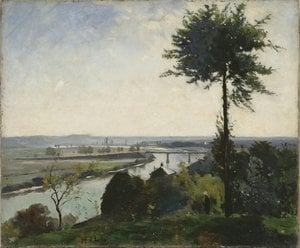
Alexandre-Hyacinthe Dunouy: A Parisian Painter of Italian Light
Born in the heart of Paris in 1757 and passing away in Jouy-en-Josas in 1841, Alexandre-Hyacinthe Dunouy remains a quietly significant figure within the landscape painting traditions of late 18th and early 19th century France. Often categorized as one of the “little masters,” a group known for their meticulous detail and classical compositions, Dunouy’s work offers a serene glimpse into the world of French art during a period of immense social and political change. His career, spanning over five decades, was marked by a consistent dedication to capturing the beauty of both his native Paris and the captivating landscapes he encountered through extensive travels, particularly in Italy.
Dunouy’s early artistic development was undoubtedly influenced by the prevailing classical ideals that dominated French painting at the time. His initial works focused on depicting familiar Parisian views – streets, parks, and surrounding regions – exhibiting these scenes at the prestigious Paris Salon starting in 1791. These early pieces demonstrate a strong adherence to established compositional principles, showcasing a careful attention to detail and an attempt to emulate the idealized landscapes favored by artists like Claude Lorrain and Nicolas Poussin. However, it was Dunouy’s journeys south, particularly his sojourn in Italy between 1810 and 1815 under the patronage of Joachim Murat, that truly shaped his artistic vision and established him as a distinct voice within the landscape genre.
Italian Influences and Patronage
Dunouy’s time in Italy proved transformative. He was immersed in the very landscapes he had long admired through prints and descriptions, experiencing firsthand the dramatic light, vibrant colors, and architectural grandeur of the region. This immersion profoundly impacted his style, moving him away from a purely academic approach towards a more expressive and nuanced depiction of nature. The influence of Italianate landscape painting is readily apparent in works like “Italian Landscape with a Village at the Foot of a Mountain Range,” where the warm light, atmospheric perspective, and idealized forms evoke the spirit of artists such as Canaletto and Marcantonio Raimondi.
Crucially, his patronage by Joachim Murat, then ruling over Naples, provided him with unprecedented access to artistic resources and opportunities. This privileged position allowed Dunouy to study directly under Italian masters, observe architectural details, and gain a deeper understanding of the region’s visual language. The resulting paintings are not simply copies of Italian scenes but rather sophisticated interpretations imbued with his own Parisian sensibility.
Notable Works and Recognition
Dunouy's oeuvre is characterized by a remarkable consistency in style and subject matter. He frequently depicted views of Rome, Naples, and the surrounding countryside – landscapes that he meticulously rendered with an almost photographic precision. His paintings are often small-scale, intended for decorative purposes rather than grand historical narratives. Despite this, they possess a remarkable depth and atmospheric quality, capturing the essence of light and shadow with subtle grace.
Throughout his career, Dunouy received significant recognition for his artistic skill. He was awarded medals in 1819 and 1827 by the French government, acknowledging his contributions to the art world. His works are now housed in museums across Europe, including the Musée Réattu in Arles, France, a testament to their enduring appeal and historical significance.
Teaching and Legacy
While much remains unknown about Dunouy’s personal life, there is evidence suggesting that he may have played a role in mentoring younger artists. He is believed to have instructed Achille-Etna Michallon, another notable landscape painter of the period. This suggests a commitment to passing on his knowledge and artistic principles to future generations.
Dunouy’s legacy lies not in revolutionary innovation but rather in his steadfast dedication to classical ideals and his ability to capture the beauty of the natural world with remarkable skill and subtlety. He represents a vital link between the Neoclassical tradition and the emerging Romantic movement, offering a serene counterpoint to the dramatic intensity that characterized some of his contemporaries. His paintings continue to be appreciated for their exquisite detail, atmospheric quality, and timeless appeal – a testament to the enduring power of a Parisian painter’s love affair with Italian light.



 Zobraziť v interiéri
 Prepnúť na tlač
 Odoslať
 Zdieľať
 Podrobnosti
 Príručkovo

 Stiahnuť
 Podobné položky
 RTG skúška
 Prehliadanie diapo\]
 Štatistiky
 Prečítať si viac