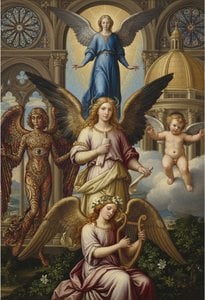
A Glimpse of Celestial Grace: Agnolo Bronzino’s “Vault Decoration”
Within the opulent Palazzo Vecchio in Florence resides a breathtaking fresco—Agnolo Bronzino's "Vault Decoration," completed in 1541 for Duchess Eleonora di Toledo. More than just a decorative scheme, this monumental work offers a profound meditation on divine order, classical beauty, and the burgeoning complexities of Renaissance courtly life. It’s a visual symphony that invites contemplation, revealing layers of symbolism woven into its meticulously rendered figures and vibrant palette.
Bronzino, a master of Mannerism, eschewed the dramatic emotionality favored by his predecessors like Pontormo in favor of a refined elegance and controlled composition. His style is characterized by elongated forms, subtle distortions, and an almost disconcerting stillness—a deliberate departure from the dynamism of earlier Renaissance painting. “Vault Decoration” exemplifies this perfectly; each figure possesses a serene composure, their gazes fixed with an unnerving intensity that draws the viewer into a world both familiar and subtly unsettling.
A Tapestry of Myth and Religion
The fresco’s central theme is deeply rooted in biblical narrative and classical mythology. The vault itself depicts a celestial scene, dominated by St. Michael, St. John the Evangelist, St. Jerome, and St. Francis—figures representing key virtues and patrons of the Medici court. Below them unfolds a series of allegorical scenes: “Moses Striking the Rock,” illustrating the miraculous parting of the Red Sea; “Moses Gathering Manna,” depicting God’s provision for his people in the wilderness; and “Crossing of the Red Sea.” These stories, rendered with exquisite detail and bathed in a rich, jewel-toned palette of reds, blues, and golds, speak to themes of faith, obedience, and divine guidance.
However, Bronzino doesn’t simply present these narratives as straightforward accounts. He imbues them with a distinctly Mannerist sensibility—figures are often idealized, their bodies rendered with an almost sculptural quality, reminiscent of ancient Greek sculpture. The drapery is voluminous and complex, creating intricate patterns that seem to shimmer with light. The use of gold leaf further enhances the sense of opulence and divinity, transforming the vault into a veritable temple of beauty.
Symbolism and Courtly Intrigue
Beyond the readily apparent religious iconography, “Vault Decoration” is laden with subtle symbolic meaning. The placement of each figure—their gestures, their attire—holds significance within the context of Renaissance courtly life. The Duchess herself, Eleonora di Toledo, was a woman of considerable influence and intelligence; her presence in this grand design underscores the power and sophistication of the Medici court.
Furthermore, the fresco’s meticulous detail suggests an underlying concern with status and prestige—a reflection of the patronage system that fueled Renaissance art. Bronzino's skill was highly sought after by wealthy families and powerful figures, and this work stands as a testament to his ability to fulfill their desires for artistic expression and social affirmation.
A Legacy of Elegance
“Vault Decoration” remains a pivotal masterpiece in the history of Renaissance art. It showcases Bronzino’s mastery of technique, his profound understanding of classical ideals, and his unique Mannerist vision. The fresco's enduring appeal lies not only in its technical brilliance but also in its ability to evoke a sense of awe and wonder—a reminder of the beauty, complexity, and spiritual depth that characterized the High Renaissance.
Today, reproductions of this extraordinary work continue to captivate audiences worldwide. Its timeless elegance and profound symbolism make it an ideal addition to any discerning collection or a stunning focal point for interior design, transporting viewers to a world of celestial grace and courtly splendor.



 Zobraziť v interiéri
 Prepnúť na tlač
 Odoslať
 Zdieľať
 Podrobnosti
 Guide
Guide

 Stiahnuť
 Podobné položky
 RTG skúška
 Prehliadanie diapo\]
 Štatistiky


 Prečítať si viac






































 Možnosť skla je dostupná len pri rozmeroch pod 110 cm