A Dramatic Embrace: Adriaen van der Werff’s “Shepherd and Shepherdess”
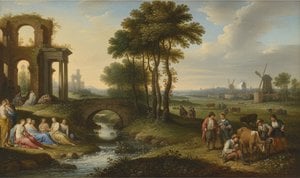
Adriaen van der Werff's "Shepherd and Shepherdess," painted in 1696, isn’t merely a portrait; it’s a carefully constructed tableau of yearning and unspoken desire. This arresting scene, currently residing within the Wallace Collection in London, immediately draws the viewer into a world steeped in Baroque drama – a world where classical ideals intertwine with potent emotionality. The painting depicts a man and woman locked in an intense embrace amidst a subtly rendered pastoral backdrop, hinting at a narrative rooted in mythology, perhaps referencing the tragic tale of Narcissus and Echo, though Van der Werff’s masterful execution transcends simple allegory.
The composition is meticulously balanced, employing a pyramidal structure that anchors the central figures. The couple's intertwined forms dominate the upper portion of the canvas, their bodies almost merging in a gesture both passionate and vulnerable. Around them, a small group of onlookers – likely representing the community observing this intimate moment – adds depth to the scene and suggests a wider social context. Notice how Van der Werff uses light and shadow—a technique known as chiaroscuro—to sculpt the figures, highlighting their muscular forms and emphasizing the intensity of their connection. The cool blues and greens of the distant landscape provide a stark contrast to the warm golds and oranges that bathe the central couple, further intensifying the drama.
The Master’s Technique: A Symphony of Oil Paint
Van der Werff's skill as an artist is immediately apparent in the painting’s remarkable detail. He was renowned for his ability to render drapery with breathtaking realism – a testament to his rigorous training under Eglon van der Neer, a specialist in costume design. Observe how each fold of fabric appears to ripple and flow, conveying both weight and movement. The figures themselves are rendered with anatomical precision, yet imbued with an expressive quality that transcends mere representation. Van der Werff doesn’t simply depict; he captures the very essence of human emotion.
The painting's texture is rich and layered, achieved through meticulous application of oil paint. Van der Werff built up color gradually, creating subtle gradations in tone and value that add depth and luminosity to the scene. The artist’s use of glazing – applying thin layers of translucent paint over dried underlayers – allows light to penetrate deeply into the canvas, giving the figures a remarkable sense of volume and presence. The brushstrokes are generally smooth and controlled, contributing to the painting's overall polished appearance, yet there is also evidence of deliberate impasto—thickly applied paint—in areas where Van der Werff wanted to emphasize texture or create visual interest.
Historical Context & Symbolism
Created during the height of the Dutch Golden Age, “Shepherd and Shepherdess” reflects the era’s fascination with classical antiquity and its embrace of human emotion. The subject matter – a passionate love affair – was a common theme in Baroque art, often used to explore themes of desire, loss, and mortality. The inclusion of onlookers suggests that this intimate moment is being observed by society, highlighting the social implications of such intense emotions.
Beyond its immediate narrative, the painting can be interpreted as an allegory for the human condition. The embrace represents a yearning for connection and fulfillment, while the distant landscape symbolizes the isolation and uncertainty of life. The figures’ expressions – a mixture of longing, vulnerability, and perhaps even sorrow – invite viewers to contemplate their own experiences of love and loss. Van der Werff's ability to imbue such a seemingly simple scene with profound emotional resonance is what elevates “Shepherd and Shepherdess” beyond mere portraiture.
A Timeless Masterpiece: Reproduction & Beyond
“Shepherd and Shepherdess” stands as a testament to Adriaen van der Werff’s extraordinary talent and his mastery of the Baroque style. Today, high-quality reproductions offer an accessible way to experience this captivating artwork, bringing its drama and beauty into any setting. Whether adorning a grand salon or a cozy study, a faithful reproduction captures the essence of Van der Werff's vision – a poignant exploration of human emotion set against a backdrop of classical elegance.



 Náhľad
 Prepnúť na tlač
 Odoslať
 Zdieľať
 Podrobnosti o dielo

 Stiahnuť
 Podobné diela
 RTG skúška
 Prezentácia
 Štatistiky


 Zobraziť viac






































 Možnosť skla je dostupná len pri rozmeroch pod 110 cm