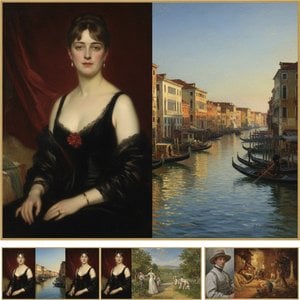
John Ponsford: A Victorian Portraitist of Subtle Grace
John Ponsford (1790–1870) remains a quietly significant figure in 19th-century British art, often overshadowed by the grander narratives of his era but possessing a distinctive style and a remarkable ability to capture the nuances of human character. Born in WahooArt, he honed his skills through early training before establishing himself as a respected portraitist, primarily serving the military and aristocratic circles of Victorian England. His work isn’t characterized by dramatic flourishes or bold statements; rather, it's defined by an understated elegance, meticulous detail, and a profound sensitivity to light and shadow – qualities that have ensured his paintings continue to resonate with collectors and art historians alike.Early Life and Artistic Training
Details surrounding Ponsford’s early life are somewhat sparse, though it's known he received instruction in drawing and painting during his youth. He was associated with Herbert Marsh, a prominent Fellow of Lady Margaret College and Bishop of Peterborough, whose portrait he painted around 1839 – a work that exemplifies Ponsford’s early style: a dignified depiction of the bishop showcasing Baroque influence and rich textures. This collaboration likely provided him with valuable exposure to classical techniques and an appreciation for formal composition. Further evidence suggests connections to Reverend Henry Williams, another artist whose portrait Ponsford created, demonstrating a potential apprenticeship or shared artistic environment during this formative period. These early influences shaped his approach to portraiture – a focus on realism combined with a subtle understanding of color and form.The Rise of a Military Portraitist
Ponsford’s career gained considerable momentum through his commissions for the military, particularly the Royal Welsh Regiment. His portraits of officers and soldiers became highly sought after, reflecting the importance placed on visual representation within the ranks. Works like ‘Reverend Henry Williams’ (1839) demonstrate this period's stylistic shift towards Neo-Classicism, characterized by a refined elegance and attention to detail – hallmarks of Ponsford’s growing reputation. These commissions not only provided financial stability but also exposed him to diverse subjects and settings, broadening his artistic experience and refining his technique. The meticulous rendering of uniforms, medals, and personal effects speaks volumes about the artist's dedication to accuracy and his ability to capture the individual character of each sitter.Technique and Style: A Master of Subtlety
Ponsford’s artistic signature lies in his remarkable ability to convey a sense of quiet observation and psychological depth within his portraits. He eschewed dramatic lighting or exaggerated poses, instead favoring soft, diffused light that subtly illuminates the subject's features and expressions. His brushwork is remarkably delicate, layering thin glazes of paint to create a luminous surface texture – a technique reminiscent of John Frederick Lewis, another prominent Orientalist painter. He was particularly adept at capturing subtle shifts in mood and emotion, conveying a sense of inner life through carefully observed details such as the angle of the eyes, the set of the mouth, or the way the subject holds their hands. His portraits are not merely likenesses; they are intimate glimpses into the souls of his sitters.Legacy and Influence
While Ponsford may not be as widely celebrated as some of his contemporaries, his work continues to be appreciated for its quiet beauty and technical mastery. His paintings offer a valuable window into Victorian society, providing insights into the lives and aspirations of military officers, clergymen, and other prominent figures of the era. The meticulous detail and psychological sensitivity evident in his portraits demonstrate a level of artistic skill rarely matched by his peers. His influence can be seen in the work of later portraitists who followed in his footsteps, particularly those interested in capturing the subtleties of human character. Today, Ponsford’s paintings are held in prestigious collections, testament to their enduring appeal and historical significance. The availability of high-quality reproductions through platforms like WahooArt ensures that his art continues to be enjoyed by a wider audience, preserving his legacy as a master of Victorian portraiture.Вопросы и ответы
Где можно найти работы John Ponsford, сгруппированные по цветовой палитре?
На странице По палитрам работы John Ponsford сгруппированы по цветовым палитрам.
Можно ли просматривать работы John Ponsford по технике исполнения?
На странице По технике исполнения работы John Ponsford сгруппированы по технике исполнения.
Под какими еще именами известен John Ponsford?
John Ponsford также известен под именами Herbert Marsh, Reverend Henry Williams.