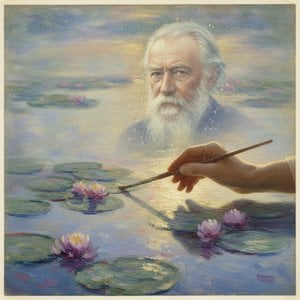
The Sculptor of Light and Bronze: The Life of Frederick William MacMonnies
In the vibrant intersection of American ambition and European refinement, the name Frederick William MacMonnies resonates as a symbol of the Beaux-Arts era. Born in Brooklyn Heights in 1863, MacMonnies was a child prodigy of stone carving, possessing an innate ability to breathe life into cold medium from a remarkably young age. His journey was not merely one of personal growth but a transatlantic odyssey that would eventually see him become the most celebrated expatriate sculptor of his generation. He possessed a rare, dual mastery over both the fluid strokes of painting and the structural permanence of sculpture, allowing him to approach form with a unique sensitivity to light and movement that few of his contemporaries could replicate.
The foundations of his greatness were laid in the prestigious studio of Augustus Saint-Gaudens. Entering the studio as an apprentice at just eighteen, MacMonnies transitioned from a humble assistant—running errands and maintaining models—to a vital collaborator. It was within this crucible of talent that he forged lifelong connections with other titans of the era, such as the architect Stanford White. This period of his life was defined by a rigorous immersion in the principles of classical form, supplemented by nocturnal studies at the National Academy of Design and the Art Students League of New York. These early years instilled in him a profound respect for the weight and texture of materials, a discipline that would later allow him to execute works of both monumental scale and delicate intimacy.
A Parisian Renaissance and the Beaux-Arts Triumph
Driven by an insatiable hunger for artistic excellence, MacMonnies departed for Paris in 1884, a move that would irrevocably alter the trajectory of his career. Enrolling at the École des Beaux-Arts, he quickly distinguished himself, earning the highest honors available to foreign students. The Parisian Salon became his stage, a place where he presented works that synthesized classical mythology with a modern, rhythmic vitality. In Paris, MacMonnies did not merely study; he thrived, establishing his own studio and eventually becoming a mentor to rising stars like Janet Scudder. His ability to navigate the sophisticated cultural landscape of France allowed him to achieve a level of international prestige that few American artists of the nineteenth century could claim.
His sculptural language was characterized by a sense of lithe, energetic motion. Whether working in bronze or marble, he had an uncanny knack for capturing the fleeting moment—the tension of a muscle, the grace of a nymph, or the solemnity of a hero. His most iconic works, such as Diana and Bacchante and Infant Faun, exemplify this mastery of the human form in motion. These pieces were not merely static figures but were imbued with a sense of breath and vitality that seemed to defy the very bronze from which they were cast.
Legacy of a Master: Public Monuments and Artistic Innovation
Beyond the ethereal beauty of his mythological figures, MacMonnies left an indelible mark on the urban landscape through his monumental public commissions. Perhaps his most enduring contribution to American civic identity is the Nathan Hale statue. Erected in New York City in 1893, this powerful depiction of the American spy stands as a testament to his ability to imbue historical portraiture with profound dignity and patriotic fervor. He was also a pioneer in the democratization of art; recognizing the growing middle class, he was among the first sculptors to copyright his designs and work with foundries to produce reduced-size reproductions, ensuring that fine art could reside in the homes of many, not just the elite.
The historical significance of Frederick William MacMonnies lies in his role as a bridge between the old world and the new. He took the classical traditions of Europe and infused them with an American vigor and accessibility. His life, spanning from the streets of Brooklyn to the grand ateliers of Paris, mirrored the growth of American art itself—moving from provincial beginnings toward a confident, global presence. Even today, his works continue to command attention in museums such as the Metropolitan Museum of Art and the Smithsonian, serving as enduring reminders of an era when sculpture sought to capture the very essence of the human spirit through the marriage of tradition and innovation.
Вопросы и ответы
Можно ли проследить использование цвета в творчестве Frederick William Macmonnies по всем его работам?
Палитра художника художника Frederick William Macmonnies — это страница, представляющая цветовую палитру всего его творчества.
Где и в каком году родился Frederick William Macmonnies?
Frederick William Macmonnies родился в Brooklyn Heights в 1863 году.
Как я могу проследить творческий путь Frederick William Macmonnies по годам?
Существует хронология работ Frederick William Macmonnies: на странице Хронология работ произведения художника расположены в порядке даты их создания.