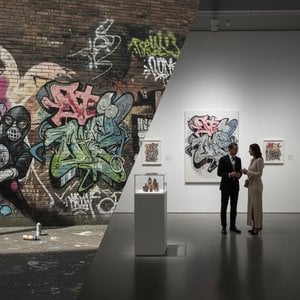
Early Life and Graffiti Roots
Fintan Magee, born in 1985 in Lismore, New South Wales, Australia, emerged from a creative upbringing—his mother an architect, his father a sculptor—that instilled a natural inclination towards visual expression. However, the initial spark wasn’t found within the confines of traditional art spaces but rather on the streets of Brisbane. Growing up in Highgate Hill, Magee was immersed in a vibrant graffiti culture that flourished during a period when the city was shedding its reputation as a cultural backwater. The 1990s saw a surge in DIY artistic endeavors, filling the void left by a fading punk scene with an energetic wave of hip-hop and tagging. Brisbane’s competitive graffiti landscape provided a fertile ground for Magee to hone his skills, navigating the challenges of “racking” paint and contributing to the city's evolving urban canvas. Crews like DTS and WTCS dominated the scene, fostering a localized rivalry that fueled creativity and pushed boundaries. This early immersion in train bombing and whole-car graffiti instilled not only technical proficiency but also a rebellious spirit—a willingness to challenge conventions and claim public space.
From Graffiti to Murals: A Shift in Focus
The trajectory of Magee’s artistic journey took a pivotal turn with his enrollment at Griffith University's Queensland College of Art. While art school initially disrupted his established graffiti practice, it ultimately proved transformative. He began integrating the formal techniques and conceptual frameworks learned within academia into his wall work, moving away from purely stylistic concerns towards more narrative and socially conscious themes. This period marked a crucial transition—a shift from clandestine tagging to large-scale murals that directly engaged with public audiences. By 2009, Magee was able to sustain himself entirely through his art, solidifying his position as a professional artist. His work began to reflect a growing interest in political and global issues, particularly environmental concerns and the complexities of human migration.
Themes and Influences: Social Realism and Personal Narratives
Magee’s murals are characterized by their striking realism and poignant subject matter. He often depicts ordinary people in everyday situations, imbuing them with a sense of vulnerability and dignity. These figures aren't merely portraits; they serve as vessels for broader narratives—stories of displacement, environmental degradation, and the search for connection. His artistic lineage is deeply rooted in the tradition of social realist muralism, drawing inspiration from artists who used public art as a tool for political commentary and community engagement. The influence of his father’s heritage – growing up with stories of murals from Northern Ireland – played a significant role in shaping Magee's understanding of the power of public artwork to both divide and unite communities. Beyond this historical connection, Magee’s work is also informed by personal experiences and observations, often using intimate moments as entry points for exploring larger societal issues. He frequently incorporates elements of children’s books and Low Brow art, lending a softness and sentimentality to his otherwise weighty themes.
Global Reach and Recognition: “Australia’s Banksy”
Over the past decade, Fintan Magee has established himself as one of Australia's leading public artists, extending his reach far beyond its borders. He has completed projects in numerous countries across the globe—from Belarus and India to Jordan, Spain, Tahiti, the USA, and Argentina—each mural a testament to his commitment to addressing universal concerns. His work can be found in major cities such as Los Angeles, Paris, New York, and London, captivating audiences with its scale, detail, and emotional resonance. While he has garnered widespread acclaim, including comparisons to Banksy by various media outlets, Magee himself expresses discomfort with this label, attributing it to “lazy journalism.” He prefers to be recognized for the unique qualities of his work—its focus on realism, social commentary, and personal storytelling. His solo exhibitions, including ‘Big Dry’ at Think Space in Los Angeles (2018), *‘Waves’* at Mathgoth Gallery in Paris (2017) and ‘Water World’ at Backwoods Gallery in Melbourne (2016), further demonstrate his versatility as an artist.
Historical Significance and Ongoing Impact
Fintan Magee's contribution to contemporary art lies not only in the technical brilliance of his murals but also in their ability to spark dialogue and raise awareness about critical social and environmental issues. He represents a new generation of muralists who are actively using public space as a platform for political expression, challenging viewers to confront uncomfortable truths and consider alternative perspectives. His work transcends geographical boundaries, resonating with audiences across cultures and fostering a sense of shared responsibility for the future of our planet. Magee’s commitment to personal storytelling, combined with his mastery of realism, sets him apart as a unique voice in the world of street art—a voice that continues to inspire and provoke thought long after the paint has dried.
Вопросы и ответы
В каком городе и стране родился(ась) Fintan Patrick Magee?
Fintan Patrick Magee родился в Lismore, Australia.
Можно ли посетить виртуальный 3D-тур по работам Fintan Patrick Magee?
Страница художника художника Fintan Patrick Magee — это страница, на которой произведения автора представлены в виртуальной трехмерной галерее.
Где можно найти работы Fintan Patrick Magee, сгруппированные по цветовой палитре?
Работы Fintan Patrick Magee можно просмотреть по цветовой палитре на странице По палитрам художника.