The Ink and the Spirit
In the quietude of eighteenth-century Japan, the brush of Daidō Bunka moved with a purpose that transcended mere decoration. Born in 1680, this painter sought to capture the intangible through the disciplined application of ink on paper. His work suggests a life spent in contemplation, where the physical act of painting became a form of meditation. The strokes he laid down were not merely marks, but reflections of a deeper internal state, seeking to bridge the gap between the visible world and the unseen essence of being.
His existence, spanning until 1752, coincided with a period of profound cultural shifts in Japan. Through his art, one senses a man deeply attuned to the philosophical currents of his era. He did not merely paint subjects; he sought to manifest the very spirit of his themes, using the simplicity of black ink to express the complexities of the human condition.
The Calligraphy of the Soul
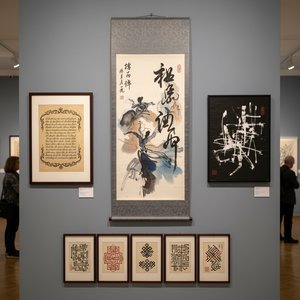
The most profound expression of his vision is found in his treatment of the character for "Heart/Mind" as an Ensō. In this work, the boundaries between calligraphy and abstract expression dissolve. The ink flows in a singular, sweeping motion, creating a circle that represents both completeness and the void. It is a study in controlled spontaneity, where the weight of the ink reveals the artist's breath and movement.
To understand the technical precision required for such a task, one must consider the elements of his practice:
- The use of ink on paper to achieve varying shades of grey and deep black.
- The hanging scroll format which dictates the verticality and flow of the composition.
- The integration of Zen-inspired symbolism into formal painting.
A Legacy in Ink
Though the records of his daily life remain sparse, the physical remnants of his hand tell a story of immense focus. His ability to transform a single character into a profound visual statement remains his most significant contribution to the visual language of his time. This work, held within the collections of the Los Angeles County Museum of Art, survives as a quiet witness to his skill. He remains a painter who understood that sometimes, the most powerful way to show the world is to show the emptiness within it.
Вопросы и ответы
Где можно найти работы Daidō Bunka, распределенные по цветам?
Страница Спектральный индекс художника Daidō Bunka позволяет просматривать его работы, распределенные по цветам.
Как я могу проследить творческий путь Daidō Bunka по годам?
Работы Daidō Bunka представлены в хронологическом порядке на странице Хронология работ.
К каким направлениям относится творчество Daidō Bunka?
Работы Daidō Bunka можно просматривать по направлениям на странице Все направления художника.
Где я могу посмотреть все работы Daidō Bunka?
Все работы Daidō Bunka на данный сайт можно найти на странице Все работы художника художника.