Paul Sérusier: Pioneer of Abstraction and the Nabis Movement
Paul Sérusier, born in Paris on November 9th, 1864, and passing away on October 7th, 1927, stands as a pivotal figure in the evolution of modern art. More than simply a painter, he was a visionary who profoundly influenced the trajectory of abstract expressionism and laid the groundwork for the Nabis movement – a group that sought to redefine the very essence of painting. His early life, steeped in Parisian culture and artistic education, provided the fertile ground from which his revolutionary ideas blossomed.
Sérusier’s formal training began at the Académie Julian, an institution known for its progressive approach to art education, offering a more open-ended environment than the rigid structure of the École des Beaux-Arts. This allowed him to explore diverse styles and techniques, ultimately shaping his unique artistic vision. Crucially, he spent a summer in 1888 at Pont-Aven, a small village nestled in Brittany, where he encountered a vibrant community of artists – Paul Gauguin, Édouard Vuillard, Pierre Bonnard, and Maurice Denis – who would become his closest collaborators and intellectual peers. It was during this period that Sérusier’s artistic philosophy began to take shape, moving away from traditional representational techniques towards a more subjective and evocative approach.
The Cloisonnism Experiment and the Birth of Abstraction
The summer at Pont-Aven proved transformative for Sérusier. Under Gauguin's guidance, he embarked on an ambitious project: “Bois d’Amour” (The Lovers’ Wood), a painting that would become synonymous with cloisonnism – a technique pioneered by Gauguin and later embraced by Sérusier. Cloisonnism involved creating flat planes of color separated by bold black outlines, resembling the individual cells of a stained-glass window. This radical departure from traditional perspective and shading resulted in an image that was almost entirely devoid of recognizable forms, pushing the boundaries of representation towards pure abstraction. “Bois d’Amour” wasn't merely a painting; it was an experiment – a deliberate attempt to strip away illusion and capture the essence of perception through color and line.
Sérusier’s exploration of cloisonnism didn’t end with "The Talisman," another significant work from 1894, also created at Pont-Aven. He continued to refine this technique, using it as a springboard for further experimentation with form and color. His paintings during this period are characterized by flattened planes, simplified shapes, and a vibrant palette – a deliberate rejection of academic conventions in favor of a more personal and expressive style.
The Nabis: A Collective Pursuit of Spiritual Expression
Sérusier’s artistic journey culminated in his involvement with the Nabis (meaning “prophets”), a small group of artists who formed around Paul Gauguin in the early 1890s. The Nabis sought to create a new form of art that combined decorative elements with profound spiritual and emotional content. They rejected the prevailing trends of Impressionism and Post-Impressionism, aiming instead for a synthesis of color, line, and symbolism. Sérusier played a crucial role in shaping the group’s aesthetic principles, advocating for the use of bold colors, simplified forms, and evocative imagery.
The Nabis' work was deeply influenced by Symbolism, a literary and artistic movement that explored themes of mysticism, dreams, and the subconscious. They believed that art should not merely imitate reality but rather convey deeper truths about the human condition. Sérusier’s paintings often reflected this spiritual dimension, imbued with a sense of melancholy, introspection, and longing.
Notable Works and Lasting Legacy
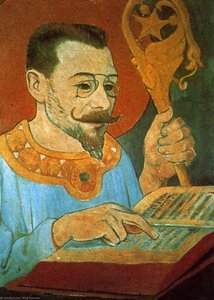
Sérusier's artistic output includes several key works that exemplify his innovative approach to painting. “L’Averse” (The Shower), painted in 1893, showcases his mastery of color and composition. His portrait of Paul Ranson, completed in 1890, is a testament to his ability to capture the essence of his subject through subtle gestures and expressive brushstrokes. "Melancholy," created in 1890, embodies the group's exploration of emotional depth. “The Snake Eaters,” painted in 1894, demonstrates his continued experimentation with abstraction and symbolism.
Beyond his individual achievements, Sérusier’s legacy extends far beyond his own paintings. He was a key figure in the development of abstract art, inspiring generations of artists to explore new ways of seeing and representing the world. His influence can be seen in the work of many prominent modernists, including Matisse, Kandinsky, and Nolde. Sérusier’s dedication to exploring the expressive potential of color and line paved the way for a radical shift in artistic thinking, solidifying his place as one of the most important figures in the history of art.



 Предпросмотр
 Перейти к печати
 Поделиться
 Поделиться
 Детали произведения

 Скачать
 Похожие работы
 Рентгенография
 Слайд-шоу
 Статистика


 Читать далее