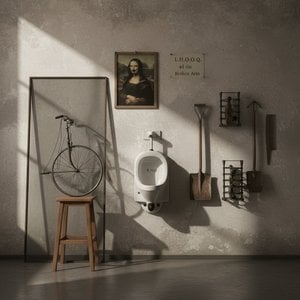
Примерить в интерьере Примерить в AR Заказать репродукцию ручной работы Перейти к цифровым изображениям Отправить
Подробнее Руководство Добавить в избранное Скачать Похожие объекты Рентгенография Слайд-шоу Статистика

Marcel Duchamp

Explore Marcel Duchamp's iconic 'Fountain,' a readymade urinal that challenged art conventions and sparked a revolution, redefining what constitutes sculpture & artistic expression.

Ма Рей – новатор фотоискусства и кино, участник Дада и сюрреализма. Его эксперименты с rayographs, портретами и фильмами исследуют границы восприятия реальности.

Произведение искусства, представленное на этой странице, защищено законом об авторском праве, что исключает возможность законного создания или продажи его точной репродукции. Данная защита обеспечивается международными соглашениями, такими как Бернская конвенция и национальным законодательством, включая положения, изложенные в Закон США об авторском праве — Раздел 17.

Этот метод полностью соответствует нормам авторского права, так как он не предполагает копирования или дублирования защищенного произведения. Напротив, это творческая реинтерпретация — создание новой картины, которая вдохновлена оригиналом, но не является его точной копией.

Жикле / Арт-принты

Печать (жикле) или холст музейного качества с быстрыми сроками изготовления и широким выбором вариантов отделки. ( Заказать репродукцию ручной работы Перейти к цифровым изображениям)

Corner sample of the P118B picture frame: формованный полистирол, 5 cm wide and 3 cm thick
P118B $10
Corner sample of the P118H picture frame: формованный полистирол, 5 cm wide and 3 cm thick
P118H $10
Corner sample of the P118W picture frame: формованный полистирол, 5 cm wide and 3 cm thick
P118W $10
Corner sample of the P438Z picture frame: формованный полистирол, 5.5 cm wide and 3.5 cm thick
P438Z $10
Corner sample of the P508JH picture frame: формованный полистирол, 7 cm wide and 3.5 cm thick
P508JH $12
Corner sample of the P508YH picture frame: формованный полистирол, 7 cm wide and 3.5 cm thick
P508YH $12
Corner sample of the P805H picture frame: формованный полистирол, 5 cm wide and 3.5 cm thick
P805H $10
Corner sample of the P805Z picture frame: формованный полистирол, 5 cm wide and 3.5 cm thick
P805Z $10
Corner sample of the P919BZ picture frame: формованный полистирол, 7 cm wide and 3.5 cm thick
P919BZ $10
Corner sample of the P919G picture frame: формованный полистирол, 7 cm wide and 3.5 cm thick
P919G $10
Corner sample of the P919XJ picture frame: формованный полистирол, 7 cm wide and 3.5 cm thick
P919XJ $10
Corner sample of the P959ZH picture frame: формованный полистирол, 5 cm wide and 3 cm thick
P959ZH $10
Corner sample of the P968JZ picture frame: формованный полистирол, 6 cm wide and 4 cm thick
P968JZ $12
Corner sample of the W106C picture frame: массив дерева, 5 cm wide and 3 cm thick
W106C $8
Corner sample of the W218G picture frame: массив дерева, 5 cm wide and 3 cm thick
W218G $10
Corner sample of the W218JH picture frame: массив дерева, 5 cm wide and 3 cm thick
W218JH $8
Corner sample of the W218Y picture frame: массив дерева, 5 cm wide and 3 cm thick
W218Y $10
Corner sample of the W307PJ picture frame: массив дерева, 6 cm wide and 3 cm thick
W307PJ $10
Corner sample of the W316G picture frame: массив дерева, 6 cm wide and 3 cm thick
W316G $10
Corner sample of the W316PJ picture frame: массив дерева, 6 cm wide and 3 cm thick
W316PJ $8
Corner sample of the W316Y picture frame: массив дерева, 6 cm wide and 3 cm thick
W316Y $10
Corner sample of the W398PJ picture frame: массив дерева, 5 cm wide and 3 cm thick
W398PJ $8
Corner sample of the W4111J picture frame: массив дерева, 6.5 cm wide and 3.5 cm thick
W4111J $10
Corner sample of the W500HY picture frame: массив дерева, 7 cm wide and 5 cm thick
W500HY $15
Corner sample of the W500JH picture frame: массив дерева, 7 cm wide and 5 cm thick
W500JH $15
Corner sample of the W692G picture frame: массив дерева, 8 cm wide and 4 cm thick
W692G $12
Corner sample of the W849H picture frame: массив дерева, 5 cm wide and 3 cm thick
W849H $8
Corner sample of the W940BG picture frame: массив дерева, 7.5 cm wide and 4.5 cm thick
W940BG $15
Corner sample of the W953PJ picture frame: массив дерева, 6 cm wide and 3.5 cm thick
W953PJ $8

Стандартный размер
индивидуальный заказ
CM
INCH

Выберите один из наших стандартных размеров, соответствующих оригинальным пропорциям произведения искусства.

ширина
высота

Вы можете указать свои собственные размеры, чтобы репродукция идеально подошла под конкретную раму или пространство. Если выбранный вами размер не будет соответствовать пропорциям оригинала, мы либо обрежем произведение, либо дополним изображение зеркальным отражением краев или однотонной заливкой. Перед началом производства вам будет отправлен цифровой макет для утверждения.
Пожалуйста, обратите внимание, что предварительный просмотр на экране не отображает фактическую обрезку или расширение изображения. Только макет точно покажет финальную композицию.
Несмотря на возможность заказа индивидуальных размеров, мы рекомендуем выбирать размер из предопределенного списка, чтобы сохранить оригинальные пропорции.

Доставка по всему миру () за 2 недели вместо стандартных 4–5 недель. (13 Октябрь)

Бесплатная экспресс-доставка по всему миру
Высококачественный льняной холст
Полное страхование при транспортировке
Гарантия возврата таможенных пошлин
Гарантия точного цветового соответствия
100-дневный период возврата (только при обнаружении дефектов)
Гарантия возврата 100% средств
Скидка при заказе нескольких работ

Итоговая стоимость

$ 68

Marcel Duchamp

Жикле / Арт-принты

Размер репродукции

-

Итоговая стоимость

$ 68

Краткая справка

  • Medium: Silver gelatin print
  • Subject or theme: Intellectual contemplation
  • Artistic style: Experimental photography
  • Notable elements: Formal portraiture, grayscale
  • Location: Metropolitan Museum of Art

Викторина по искусству

В каждом вопросе только один правильный ответ.

Вопрос 1:
What artistic movement is Man Ray most closely associated with?
Вопрос 2:
The photograph of Marcel Duchamp by Man Ray primarily emphasizes which aspect of the subject?
Вопрос 3:
What technique is most prominently featured in Man Ray's 'rayographs'?
Вопрос 4:
According to the description, what is a key characteristic of Duchamp's approach to art?
Вопрос 5:
The photograph's perspective suggests what about the viewer’s relationship to Duchamp?

Marcel Duchamp’s “Man Ray” – A Portrait of Intellectual Intensity

The photograph by Man Ray of Marcel Duchamp, captured in 1920-21, isn't merely a portrait; it’s a carefully constructed tableau of intellectualism and quiet contemplation. More than just a likeness, it embodies the spirit of the era – the burgeoning avant-garde, the questioning of artistic conventions, and the embrace of new perspectives. Duchamp himself, already a pivotal figure in challenging established norms, is presented here with an arresting formality that belies his revolutionary ideas. The image immediately draws the viewer into a space of considered observation, inviting us to decipher the subtle cues within its composition.

Composition and Visual Elements

The photograph’s strength lies in its deliberate asymmetry. Duchamp is positioned slightly off-center, anchoring the frame while simultaneously creating a sense of dynamic movement. The chair he occupies—a sturdy, almost austere piece of furniture—becomes a crucial element, grounding the image and providing a visual counterpoint to Duchamp's more fluid form. Behind him, a glimpse of a couch and another chair adds depth, suggesting a space both familiar and subtly unsettling. Man Ray’s masterful use of lines further enhances this effect; vertical lines are established by Duchamp’s posture and the chair, while diagonal lines trace his gaze and the angle of his body, creating a subtle tension within the image.

Technical Details and Artistic Style

Rendered in stark black and white, the photograph utilizes a grayscale palette that emphasizes form and texture. The diffused lighting, likely achieved through studio techniques, casts soft shadows that define Duchamp’s features without resorting to harsh contrasts. This deliberate choice contributes to the image's overall atmosphere of quiet seriousness. Man Ray’s signature style is evident in his experimental approach to photography – a blend of portraiture with elements of surrealism and artistic exploration. The photograph feels like a carefully considered study, reflecting Duchamp’s own meticulous approach to art.

Symbolic Resonance and Historical Context

Duchamp's expression—serious and contemplative—immediately speaks to his intellectual rigor and his willingness to challenge conventional notions of beauty. The photograph captures a moment of profound introspection, hinting at the complex ideas swirling within his mind. Considering Duchamp’s broader artistic trajectory – his embrace of “readymades” like the flatiron with tacks – this portrait feels particularly significant. It's a visual representation of an artist who was actively dismantling traditional definitions of art and redefining its possibilities. The photograph, alongside other works from that period, offers a window into the intellectual climate of Paris in the early 20th century, a time of radical experimentation and profound artistic shifts.

A Legacy of Innovation

Man Ray’s portrait of Marcel Duchamp is more than just a photograph; it's a document of an era. It captures not only the likeness of a groundbreaking artist but also the spirit of innovation and intellectual daring that defined his work. The image continues to resonate today, serving as a reminder of Duchamp’s profound impact on the history of art and his enduring legacy as a revolutionary thinker.

Вопросы и ответы

Какая цветовая гармония представлена в работе «Marcel Duchamp», Ман Рей?

В работе «Marcel Duchamp», Ман Рей представлена Unified Palette цветовая гармония.

Какова насыщенность цветов в работе «Marcel Duchamp», Ман Рей?

Цвета в работе «Marcel Duchamp», Ман Рей обладают Muted насыщенностью. Насыщенность определяет, насколько яркими или приглушенными являются цвета.

Можно ли посмотреть «Marcel Duchamp» в режиме полноэкранного слайд-шоу?

Доступна презентация: страница Слайд-шоу работы «Marcel Duchamp», Ман Рей.

Кто создал "Marcel Duchamp"?

Автор произведения «Marcel Duchamp» — Ман Рей. Работа внесена в каталог под именем Ман Рей.

Для каких целей рекомендуется использовать «Marcel Duchamp», Ман Рей?

Репродукция произведения «Marcel Duchamp», Ман Рей рекомендуется для Reflective. Это предложение продиктовано сюжетом, настроением и цветовой гаммой работы.

Допускается ли законное воспроизведение произведения «Marcel Duchamp», Ман Рей, хранящегося в Музей Оскара Нимейера?

Статус авторского права на «Marcel Duchamp», Ман Рей определен однозначно: произведение находится в все еще защищено авторским правом. Его нахождение в Музей Оскара Нимейера не меняет этого статуса.

К какому виду произведений искусства относится «Marcel Duchamp», Ман Рей?

Произведение «Marcel Duchamp», Ман Рей классифицируется как WallArt. Данная категория определяет тип оригинального произведения искусства.

Как в «Marcel Duchamp», Ман Рей переплетаются художественное направление и эпоха?

«Marcel Duchamp» относится к направлению Dada Surrealism, а его создатель работал в эпоху — Модернизм.


Биография художника

A Life Illuminated by Shadows

Emmanuel Radnitzky, a name forever intertwined with the enigmatic “Man Ray,” was born in Philadelphia in 1890 into a family of Russian Jewish immigrants. His early life, steeped in the vibrant energy of New York City, proved to be a crucible for his artistic development—a melting pot of European avant-garde influences and the raw, burgeoning spirit of American modernity. From a young age, Ray demonstrated an innate fascination with visual arts, nurtured by his family’s connection to the world of craftsmanship and design. He initially pursued architecture and engineering, but it was art that truly captured his soul, leading him to immerse himself in the galleries and studios of New York's burgeoning artistic scene. This exposure ignited a lifelong passion for experimentation and a relentless desire to break free from conventional boundaries—a characteristic that would define his entire career.

Dada, Surrealism, and the Alchemy of Light

Man Ray’s artistic trajectory took an extraordinary turn with his encounter in 1915 with Marcel Duchamp. This meeting sparked a shared rebellion against established norms, propelling them both into the heart of the Dada movement—a visceral response to the devastation of World War I and a profound disillusionment with traditional art forms. Dada wasn’t merely an artistic style; it was a philosophy, a protest, a rejection of logic and reason in favor of chance, absurdity, and the irrational. Ray quickly embraced this spirit, participating actively in the movement's radical experiments—from creating “ready-mades” – ordinary manufactured objects elevated to the status of art – to challenging conventional notions of beauty and value. This rebellious energy fueled his exploration of photography, a medium he would ultimately master with unparalleled innovation. It was during this period that Ray began to develop his signature technique: rayographs—cameraless photographs created by placing objects directly onto light-sensitive paper and exposing them to light. These weren’t mere reproductions; they were entirely new forms of image-making, capturing the essence of their subjects through a process of direct inscription rather than traditional representation. The resulting images possessed an ethereal quality, imbued with a sense of mystery and otherworldliness—a testament to Ray's ability to transform the mundane into the extraordinary.

The Surrealist Embrace

Following the collapse of Dada in Paris, Man Ray found himself drawn into the orbit of the Surrealists, led by André Breton. While he never fully identified with any single artistic movement, Ray’s work resonated deeply with the Surrealists' exploration of the unconscious mind, dreams, and the irrational. He embraced their fascination with chance, symbolism, and the juxtaposition of unexpected elements—techniques that informed his photographic portraits, often unsettling yet undeniably captivating. His collaborations with other Surrealist artists, such as Salvador Dalí, further solidified his position within the movement, resulting in a body of work characterized by dreamlike imagery and a rejection of conventional narrative structures. Ray’s approach to photography during this period was profoundly influenced by his interest in psychology and the subconscious—he sought not merely to depict reality but to evoke emotional responses and explore hidden depths of human experience.

Beyond Stillness: Film and a Lasting Legacy

Man Ray's artistic curiosity extended beyond still images into the realm of filmmaking. He experimented with innovative techniques, creating short films like *Le Retour à la Raison* (1923) and *L’Étoile de Mer* (1928), which defied conventional cinematic storytelling. These weren’t narratives in the traditional sense; they were visual poems— explorations of form, rhythm, and the subconscious. Ray employed techniques such as stop-motion animation and superimposition to create disorienting and dreamlike effects, pushing the boundaries of what film could achieve. While his film work remained relatively small in volume, it was profoundly influential on subsequent generations of avant-garde filmmakers—demonstrating Ray’s pioneering spirit and his willingness to challenge established cinematic conventions.

A Continuing Influence

Man Ray's impact extends far beyond his own lifetime, continuing to resonate with artists and audiences today. His techniques, particularly rayography and solarization, continue to be explored by contemporary photographers. His contributions solidified the Surrealist movement’s visual language and inspired countless artists across disciplines. His pioneering work in film laid the groundwork for future generations of avant-garde filmmakers. Furthermore, his innovative approach to portraiture influenced the development of modern fashion photography. Man Ray remains a pivotal figure in 20th-century art—a true innovator whose work continues to challenge, provoke, and delight. His legacy lies not only in his technical innovations but also in his unwavering commitment to artistic freedom and his relentless pursuit of the impossible—a testament to the enduring power of vision and creativity.
Ман Рей

Ман Рей

1890 - 1976 , США

Краткая справка

  • Artistic Movement Or Style: Дада, Сюрреализм
  • Artists Or Movements Influenced By This Artist: ['Сюрреализм']
  • Artists Who Influenced This Artist: ['Marcel Duchamp']
  • Date Of Birth: 27 августа 1890
  • Date Of Death: 18 ноября 1976
  • Full Name: Emmanuel Radnitzky
  • Nationality: Американский
  • Notable Artworks:
    • Rayographs
    • Le Retour à la Raison
    • L'Étoile de Mer
  • Place Of Birth: Филадельфия, США
Откройте для себя произведения искусства, распределенные по темам, стилям и характеристикам.