ПредпросмотрПредпросмотр Предпросмотр в ARПредпросмотр в AR Купить картину ручной работы Купить картину ручной работыПерейти к цифровым изображениям Перейти к цифровым изображениям ПоделитьсяПоделиться
Детали произведенияДетали произведения Добавить в избранное Добавить в избранное СкачатьСкачать Похожие работыПохожие работы РентгенографияРентгенография Слайд-шоуСлайд-шоу СтатистикаСтатистика

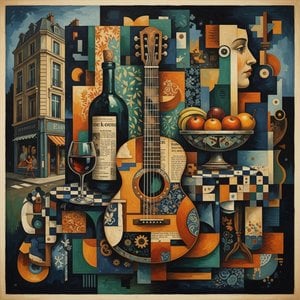
Guitar on the Table

A masterful display of Synthetic Cubism featuring a fragmented guitar on a table by Spanish visionary Juan Gris, this 1913 oil painting invites you to explore the geometric beauty of a true modern masterpiece.

Хуан Грис (1887-1927) – выдающийся испанский кубист! Геометрический стиль, синтетическая кубизм и влияние на современное искусство. Откройте мир модернизма!

Жикле / Арт-принт

Печать (жикле) или холст музейного качества с быстрыми сроками изготовления и широким выбором вариантов отделки. (Купить картину ручной работы Купить картину ручной работыПерейти к цифровым изображениям Перейти к цифровым изображениям)

P118B $10
P118H $10
P118W $10
P438Z $10
P508JH $12
P508YH $12
P805H $10
P805Z $10
P919BZ $10
P919G $10
P919XJ $10
P959ZH $10
P968JZ $12
W106C $8
W218G $10
W218JH $8
W218Y $10
W307PJ $10
W316G $10
W316PJ $8
W316Y $10
W398PJ $8
W4111J $10
W500HY $15
W500JH $15
W692G $12
W849H $8
W940BG $15
W953PJ $8

Стандартный размер
на заказ
CM
INCH

Выберите один из наших стандартных размеров, соответствующих оригинальным пропорциям произведения искусства.

ширина
высота

Вы можете указать свои собственные размеры, чтобы репродукция идеально подошла под конкретную раму или пространство. Если выбранный вами размер не будет соответствовать пропорциям оригинала, мы либо обрежем произведение, либо дополним изображение зеркальным отражением краев или однотонной заливкой. Перед началом производства вам будет отправлен цифровой макет для утверждения.
Пожалуйста, обратите внимание, что предварительный просмотр на экране не отображает фактическую обрезку или расширение изображения. Только макет точно покажет финальную композицию.
Несмотря на возможность заказа индивидуальных размеров, мы рекомендуем выбирать размер из предопределенного списка, чтобы сохранить оригинальные пропорции.

Доставка по всему миру () за 2 недели вместо стандартных 4/5 недель. (9 Сентябрь)

why_choose_icon
Бесплатная экспресс-доставка по всему миру
why_choose_icon
Высококачественный льняной холст
why_choose_icon
Полное страхование доставки
why_choose_icon
Гарантия возмещения таможенных пошлин
why_choose_icon
Гарантия точного соответствия цветов
why_choose_icon
100-дневная политика возврата (только при обнаружении дефектов)
why_choose_icon
Гарантия возврата 100% средств
why_choose_icon
Предложение оптовых скидок

Общая стоимость

$ 68

reproduction

Guitar on the Table

Жикле / Арт-принт

Размер репродукции

-

Итоговая стоимость

$ 68

Основные сведения

  • Dimensions: 60 x 73 cm
  • Year: 1913
  • Movement: Cubism
  • Location: Museo Thyssen-Bornemisza, Madrid
  • Artist: Juan Gris
  • Medium: Oil on canvas
  • Notable elements or techniques: Overlapping shapes and textured patterns

A Symphony of Geometry: The Essence of Juan Gris

In the pantheon of early twentieth-century modernism, few names resonate with as much analytical precision and poetic grace as Juan Gris. His masterpiece, Guitar on the Table, created in 1913, serves as a breathtaking window into the heart of Synthetic Cubism. This oil on canvas work is not merely a depiction of an instrument; it is a profound exploration of how reality can be dismantled and reconstructed through the lens of geometric abstraction. As one contemplates this piece, the eye is immediately drawn to the central motif—a guitar that appears both solid and ephemeral, its form broken into a rhythmic dance of overlapping planes and intersecting lines. The painting captures a moment where the physical world dissolves into a sophisticated arrangement of shapes, inviting the viewer to participate in the intellectual reconstruction of the subject.

The technical mastery displayed in this work lies in Gris's ability to balance complexity with a restrained, almost meditative palette. Eschewing the chaotic fragmentation seen in earlier Analytic Cubism, Gris employs a harmonious blend of blues, browns, and whites, punctuated by subtle greens and intricate speckled patterns. These textures do more than provide visual interest; they create a tactile depth that mimics the grain of wood or the weave of fabric. The background, adorned with decorative motifs reminiscent of fine wallpaper or draped cloth, provides a soft counterpoint to the structural rigidity of the guitar. This interplay between the organic and the geometric, the flat and the dimensional, is what gives the composition its enduring vitality.

Historical Resonance and Interior Elegance

To possess or display a reproduction of Guitar on the Table is to bring a piece of art history into the contemporary living space. Created during the height of the Parisian avant-garde movement, this work stands as a testament to the era when artists like Picasso and Braque were redefining the very boundaries of sight. The painting carries with it the intellectual weight of the Museo Thyssen-Bornemisza, where such treasures are preserved, yet its aesthetic appeal is remarkably versatile for modern interior design. For the discerning collector or interior designer, this piece offers a sophisticated focal point that complements both minimalist contemporary settings and richly textured, classical environments.

Beyond its formal qualities, the painting evokes a sense of quiet introspection. The presence of secondary guitars and the subtle, abstracted figures in the periphery suggest a larger, bustling social scene—perhaps a Parisian café or a private studio—yet all is distilled into a singular, focused harmony. This creates an emotional impact of calm stability amidst complexity. Whether placed in a sunlit gallery or a moody, dimly lit study, Guitar on the Table acts as a conversation starter, prompting reflections on the nature of perception and the enduring beauty of structured abstraction. It is an investment in a legacy of innovation, offering a timeless elegance that transcends the decades.


Биография художника

A Spanish Visionary of Cubism: The Life and Art of Juan Gris

José Victoriano González-Pérez, a name that would become synonymous with artistic innovation, was born in Madrid on March 23, 1887. This young man, destined to be known as Juan Gris, embarked on a journey that would not only establish him as one of the most significant figures of early 20th-century art but also profoundly reshape our understanding of visual perception. Initially pursuing an engineering degree at the School of Arts and Sciences in Madrid, a logical mind began to develop alongside a burgeoning creative spirit. Even during his studies, glimpses of his artistic talent emerged – contributions to local periodicals hinted at a future dedicated to capturing the world through a unique lens. It was in 1905 that he adopted the pseudonym Juan Gris, a name imbued with a newfound sense of identity and purpose, marking a deliberate step towards embracing his artistic aspirations.

Parisian Awakening and the Embrace of Cubism

The year 1906 proved to be a pivotal moment in Gris’s life – he relocated to Paris, a city then brimming with an unparalleled concentration of artistic energy. This move was not merely a geographical shift; it represented a complete immersion into a vibrant cultural landscape. He quickly established connections with luminaries such as Henri Matisse, Georges Braque, and Fernand Léger, forging friendships that would profoundly influence his artistic development. Initially, Gris engaged in the demanding world of satirical illustration for publications like *L'Assiette au Beurre*, honing his observational skills and developing a keen eye for detail – a skill he would later translate into his groundbreaking paintings. However, it was Pablo Picasso who exerted the most significant impact on his artistic trajectory. Around 1910, Gris began to dedicate himself wholeheartedly to painting, moving away from caricature and embracing the revolutionary language of Cubism. This wasn’t simply imitation; it was a deliberate quest to distill the essence of form and space, seeking a new visual order – a radical departure from traditional representation.

The Geometry of Perception: Style and Key Works

Juan Gris's artistic output is characterized by an extraordinary clarity and intellectual rigor. He didn’t merely deconstruct objects; he meticulously reconstructed them, emphasizing geometric forms and employing a carefully considered palette. This approach led to what became known as his “crystal period,” exemplified in masterpieces such as *Still Life Before an Open Window* (1912) and *Place Ravignan* (1915). These works showcase a remarkable interplay of planes and angles, creating a sense of depth and solidity while simultaneously challenging conventional notions of perspective. The influence of Picasso is undeniable, yet Gris developed his own distinct style – one characterized by a precise geometric structure, a harmonious color scheme, and an innovative use of *papier collé* (collage). He incorporated real-world materials like newspaper clippings and textured papers into his compositions, blurring the boundaries between painting and sculpture. Notable examples include *Guitar in front of the sea* (1925), a testament to his simplified forms and adherence to cubist principles, and *Homage à Pablo Picasso* (1912), which signaled his growing recognition within the avant-garde art world.

Synthetic Cubism and Lasting Influence

Following the initial explorations of Analytical Cubism, Gris transitioned to Synthetic Cubism around 1913, a period marked by a shift towards greater simplification and a vibrant use of color. He pioneered the extensive use of *papier collé*, incorporating fragments of everyday life – advertisements, fabrics, and even pieces of fruit – into his paintings. This technique added layers of complexity and tactile richness to his work, transforming his canvases into dynamic visual dialogues. Unlike Picasso and Braque, whose Cubist works were often monochromatic, Gris employed bold, harmonious color palettes, creating a distinctive aesthetic that resonated with the principles of Matisse’s art. His emphasis on geometric forms, combined with his innovative use of collage, established him as a pivotal figure in 20th-century art. His legacy extends beyond mere stylistic innovation; he brought a unique intellectual depth and structural clarity to the movement, profoundly influencing the Purist style championed by Amédée Ozenfant and Charles Edouard Jeanneret (Le Corbusier). Juan Gris’s work continues to inspire artists today, demonstrating the enduring power of Cubism and the visionary genius of a Spanish master who reshaped our understanding of perception and representation.

Key Facts

  • Full Name: José Victoriano González-Pérez
  • Born: March 23, 1887, Madrid, Spain
  • Died: May 11, 1927, Paris, France
  • Artistic Movement: Cubism (Analytical and Synthetic)
  • Influenced By: Pablo Picasso, Henri Matisse
  • Notable Works: *Still Life Before an Open Window*, *Place Ravignan*, *Guitar in front of the sea*, *Homage à Pablo Picasso*

Хуан Грис

Хуан Грис

1887 - 1927 , Испания

Основные сведения

  • Artistic Movement Or Style: Кубизм, Синтетический кубизм
  • Artists Or Movements Influenced By This Artist:
    • Пуризм
    • Озенфан
  • Artists Who Influenced This Artist:
    • Пикассо
    • Матисс
    • Брак
  • Date Of Birth: 23 марта 1887
  • Date Of Death: 11 мая 1927
  • Full Name: José Victoriano González-Pérez
  • Nationality: Испанский
  • Notable Artworks:
    • «Гитара перед морем»
    • «Художественный коллаж»
    • «Дом с сине-зелеными окнами»
  • Place Of Birth: Мадрид, Испания
Откройте для себя произведения искусства, подобранные по темам, стилям и характеристикам.