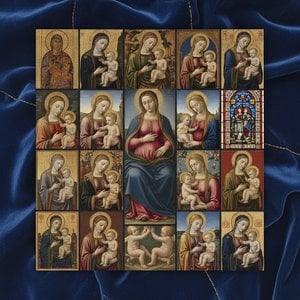
The Enduring Embrace: A Study in Bengali Folk Spirit
To stand before Jamini Roy's depiction of Mother and Child is to step across the threshold of colonial influence and into the vibrant, deeply rooted heart of Bengal’s cultural soul. This painting is far more than a mere portrait; it is an eloquent testament to cultural resilience. While Roy initially honed his craft mastering the techniques of European Academic realism at the Government School of Art in Calcutta, the very act of creation became an act of profound artistic rebellion. He consciously shed the polished veneer of Western tradition, channeling instead the raw, immediate energy found in Bengal’s indigenous art forms—the earthy narratives of pat paintings and the intricate storytelling etched into temple terracotta reliefs.
The scene itself captures a moment suspended in time: an intimate tableau where connection is palpable. The mother tenderly guides her child, their hands resting upon one another’s shoulders in a gesture of profound mutual support. This central bond radiates warmth, yet the composition expands beyond this core pair. Peripheral figures populate the space, grounding the loving interaction within a larger community setting, all framed by the suggestion of an outdoor environment marked by the presence of foliage.
Stylistic Echoes and Folk Simplicity
What immediately draws the discerning eye is Roy’s masterful simplification of form. His technique eschews academic verisimilitude for something far more primal and emotionally resonant. The lines employed are a beautiful marriage of sweeping curves and deliberate angles, lending the figures a stylized grace that speaks directly to folk aesthetics. This stylistic choice was not merely decorative; it was ideological. By embracing the visual language of village life—the subjects often drawn from Santhal women—Roy anchored his art in the tangible reality of rural Bengali existence. The resulting flatness and bold outlines give the work an immediate, almost graphic power that transcends passing trends.
For those considering a reproduction for your space, understanding this stylistic commitment is key; it promises an artwork with undeniable character, far removed from sterile imitation.
Symbolism of Connection and Identity
At its heart, Mother and Child functions as a powerful allegory. The mother-child dynamic symbolizes nurturing, continuity, and the passing down of cultural memory. In the context of Roy’s life, this symbolism deepened: it represented the preservation of Bengali identity against external pressures. The figures are not just connected physically; they are linked by an unbroken thread of tradition and belonging. The inclusion of other community members suggests that this intimate moment is witnessed, supported, and woven into the fabric of a larger cultural tapestry.
The emotional impact is one of deep comfort mixed with quiet strength—a feeling that resonates universally, making it a centerpiece capable of elevating any room from merely decorated to truly soulful.
A Legacy in Color and Line
Jamini Roy’s genius lies in his ability to synthesize high artistic training with the vernacular spirit. The resulting work possesses an elegance that is simultaneously rustic and sophisticated. When viewing this piece, one appreciates the deliberate economy of line—every curve serves a narrative purpose. It invites contemplation on what truly defines humanity: Is it perfect anatomical rendering, or is it the shared glance, the guiding hand, the enduring bond? This painting argues passionately for the latter.
Owning this piece, or a high-quality reproduction capturing its essence, means bringing home not just paint on canvas, but a vibrant echo of Bengal’s artistic soul—a celebration of life's most fundamental and beautiful connections.



 Примерить в интерьере
 Заказать репродукцию ручной работы
 Отправить
 Поделиться
 Подробнее
 Руководство

 Скачать
 Похожие объекты
 Рентгенография
 Слайд-шоу
 Статистика


 Развернуть текст






































 Вариант со стеклом доступен только для размеров менее 110 см