ПредпросмотрПредпросмотр Предпросмотр в ARПредпросмотр в AR Купить картину ручной работы Купить картину ручной работыПерейти к цифровым изображениям Перейти к цифровым изображениям ПоделитьсяПоделиться
Детали произведенияДетали произведения Добавить в избранное Добавить в избранное СкачатьСкачать Похожие работыПохожие работы РентгенографияРентгенография Слайд-шоуСлайд-шоу СтатистикаСтатистика

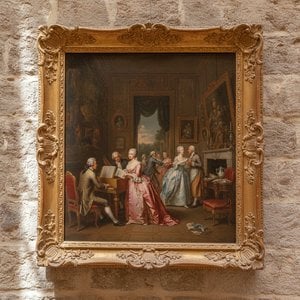
Gallant Conversation, known as

Герард тер Борх был выдающимся нидерландским художником эпохи Золотого века, известным своими жанровыми картинами и мастерством передачи света и текстуры. Его работы вдохновляют и сегодня!

Жикле / Арт-принт

Печать (жикле) или холст музейного качества с быстрыми сроками изготовления и широким выбором вариантов отделки. (Купить картину ручной работы Купить картину ручной работыПерейти к цифровым изображениям Перейти к цифровым изображениям)

P118B $10
P118H $10
P118W $10
P438Z $10
P508JH $12
P508YH $12
P805H $10
P805Z $10
P919BZ $10
P919G $10
P919XJ $10
P959ZH $10
P968JZ $12
W106C $8
W218G $10
W218JH $8
W218Y $10
W307PJ $10
W316G $10
W316PJ $8
W316Y $10
W398PJ $8
W4111J $10
W500HY $15
W500JH $15
W692G $12
W849H $8
W940BG $15
W953PJ $8

Стандартный размер
на заказ
CM
INCH

Выберите один из наших стандартных размеров, соответствующих оригинальным пропорциям произведения искусства.

ширина
высота

Вы можете указать свои собственные размеры, чтобы репродукция идеально подошла под конкретную раму или пространство. Если выбранный вами размер не будет соответствовать пропорциям оригинала, мы либо обрежем произведение, либо дополним изображение зеркальным отражением краев или однотонной заливкой. Перед началом производства вам будет отправлен цифровой макет для утверждения.
Пожалуйста, обратите внимание, что предварительный просмотр на экране не отображает фактическую обрезку или расширение изображения. Только макет точно покажет финальную композицию.
Несмотря на возможность заказа индивидуальных размеров, мы рекомендуем выбирать размер из предопределенного списка, чтобы сохранить оригинальные пропорции.

Доставка по всему миру () за 2 недели вместо стандартных 4/5 недель. (9 Сентябрь)

why_choose_icon
Бесплатная экспресс-доставка по всему миру
why_choose_icon
Высококачественный льняной холст
why_choose_icon
Полное страхование доставки
why_choose_icon
Гарантия возмещения таможенных пошлин
why_choose_icon
Гарантия точного соответствия цветов
why_choose_icon
100-дневная политика возврата (только при обнаружении дефектов)
why_choose_icon
Гарантия возврата 100% средств
why_choose_icon
Предложение оптовых скидок

Общая стоимость

$ 68

reproduction

Gallant Conversation, known as

Жикле / Арт-принт

Размер репродукции

-

Итоговая стоимость

$ 68

Основные сведения

  • Artistic style: Genre painting, realism
  • Influences: European travel
  • Notable elements: Subtle scene, brothel
  • Medium: Oil on panel
  • Dimensions: 73 x 71 cm
  • Artist: Gerard ter Borch
  • Location: Private Collection

Тест по искусству

В каждом вопросе только один правильный ответ.

Вопрос 1:
What is the most significant and initially misleading aspect of Gerard ter Borch’s ‘Gallant Conversation’?
Вопрос 2:
Based on the image description, what specific elements within the room strongly suggest the illicit setting?
Вопрос 3:
Gerard ter Borch is best known for his work in which genre of painting?
Вопрос 4:
What historical period does Gerard ter Borch primarily represent in his art?
Вопрос 5:
Which of the following best describes a key characteristic of Gerard ter Borch’s artistic style?

A Shadowed Intimacy: Unraveling Gerard ter Borch’s *Gallant Conversation*

Gerard ter Borch's *Gallant Conversation*, painted in 1655, is not merely a portrait; it’s an exquisitely rendered tableau of veiled secrets and subtle anxieties. Initially known as “The paternal admonition,” the painting quickly revealed a far more complex narrative – one that challenged viewers at the time and continues to intrigue today. It's a masterful example of Dutch Golden Age genre painting, showcasing ter Borch’s unparalleled ability to capture not just appearances but the very essence of human interaction, particularly within the confines of a private, almost clandestine setting.

The scene unfolds within a modestly furnished room, bathed in a muted red light that casts long shadows and adds an air of mystery. A young soldier, strikingly handsome yet undeniably youthful, occupies a central position, engaged in conversation with a woman of considerable elegance – likely a courtesan or prostitute. A third figure, a woman holding a glass, observes the interaction from a distance, her expression hinting at both amusement and perhaps a degree of control. The inclusion of a dog, casually observing the scene, further contributes to the feeling that this is a carefully constructed tableau, a staged moment rather than an impromptu gathering. The deliberate ambiguity surrounding the relationships – who is admonishing whom? – is precisely what makes this painting so compelling.

The Delicate Dance of Light and Shadow: Ter Borch’s Technique

Ter Borch's genius lies in his painstaking attention to detail and his revolutionary approach to light. Unlike many of his contemporaries, he eschewed the dramatic chiaroscuro favored by Rembrandt, opting instead for a subtle, almost photographic realism. He meticulously built up layers of translucent glazes, creating an astonishingly delicate surface texture that captures the sheen of silk, the gleam of metal, and the softness of skin with remarkable precision. Notice how the light catches the folds of the woman’s dress, revealing the intricate weave, or how it subtly illuminates the soldier's face, highlighting his youthful features and a hint of vulnerability. This technique wasn’t simply about realism; it was about capturing the *atmosphere* of the scene – a sense of quiet contemplation punctuated by unspoken tensions.

  • Glazing Technique: Ter Borch employed countless thin layers of translucent paint, building up color and depth gradually.
  • Subtle Modeling: He masterfully used light and shadow to sculpt the figures, creating a sense of volume and form without resorting to harsh contrasts.
  • Attention to Texture: The meticulous rendering of fabrics, metal, and skin demonstrates his dedication to capturing the tactile qualities of the scene.

A Brothel in Disguise: Historical Context and Symbolism

The painting’s true subject matter – a clandestine meeting within a brothel – was initially met with considerable debate. The original title, “The paternal admonition,” suggested a familial setting, leading to confusion about the nature of the scene. However, clues abound that point towards a more illicit reality: the bed in the background, the table with a mirror (a common feature in such establishments), and the overall atmosphere of intimacy and veiled intent. This ambiguity reflects the social realities of 17th-century Amsterdam – a city rife with wealth, commerce, and a thriving underworld. Ter Borch’s willingness to depict this darker side of society was remarkably bold for his time.

The soldier's youth is particularly significant. He isn’t a father dispensing wisdom; he’s a young man indulging in the pleasures of the flesh, suggesting themes of youthful folly and the corrupting influence of wealth. The woman observing from afar embodies a certain power – perhaps ownership or control – while the courtesan herself represents allure and danger.

Capturing Emotion: A Portrait of Quiet Tension

*Gallant Conversation* is not a painting that shouts; it whispers. It’s a study in restraint, conveying a complex web of emotions through subtle gestures and averted glances. The figures are caught in a moment of quiet contemplation, their faces betraying a mixture of curiosity, amusement, and perhaps even apprehension. The overall effect is profoundly unsettling – a reminder that appearances can be deceiving and that beneath the surface of polite conversation often lie hidden desires and unspoken truths. This painting’s enduring power lies in its ability to evoke a sense of unease and intrigue, prompting viewers to question what they are seeing and, more importantly, what they *aren't* being told.


Биография художника

Gerard ter Borch - A Pioneer of Dutch Genre Painting

Gerard ter Borch (Dutch: Gerard Terburg; December 1617 – 8 December 1681) was an influential and pioneering Dutch genre painter who lived in the Dutch Golden Age. He influenced fellow Dutch painters Gabriel Metsu, Gerrit Dou, Eglon van der Neer and Johannes Vermeer.

According to Arthur K. Wheelock Jr., Ter Borch “established a new framework for subject matter, taking people into the sanctum of the home”, showing the figures’ uncertainties and expertly hinting at their inner lives. His influence as a painter, however, was later surpassed by Vermeer.

Biography

Gerard ter Borch was born in December 1617 in Zwolle in the province of Overijssel in the Dutch Republic. He received an excellent education from his father Gerard ter Borch the Elder, also an artist, and developed his talent very early. The inscription on a study of a head proves that Ter Borch was at Amsterdam in 1632, where he studied possibly under Willem Cornelisz Duyster or Pieter Codde. Duyster's influence can be traced in a picture bearing the date 1638, in the lonides Bequest (Victoria and Albert Museum), London. In 1634 he studied under Pieter de Molijn in Haarlem. A record of this Haarlem period is the Consultation (1635) at the Berlin Gallery. In 1635 he was in London, and subsequently he travelled in Germany, France, Spain and Italy. His sister Gesina also became a painter. It is certain that he was in Rome in 1641, when he painted the small portraits on copper of Jan Six ,A Young Lady (Six Collection, Amsterdam) and the portrait of a Gentleman (DMK Collection Nuermberg).

At this time Ter Borch was invited to visit Madrid, where he received employment and the honour of knighthood from Philip IV, but, in consequence of an intrigue, it is said, he was obliged to return to the Netherlands. He seems to have resided for a time in Haarlem; but he finally settled in Deventer, where he became a member of the town council, as which he appears in the portrait now in the gallery of the Hague.

Notable Works and Achievements

  • The Letter: A masterpiece showcasing ter Borch's skill in capturing texture and light.
  • The Gallant Conversation: Engraved by johann georg wille, this piece exemplifies the artist’s ability to convey nuanced emotions.
  • Man on horseback (1634): An early work demonstrating ter Borch's emerging talent.
  • Adrian Pauw's arrival in münster (1646): A significant piece that highlights the artist’s narrative capabilities.

Museums and Collections Featuring Ter Borch’s Work

  • The Hermitage: With six of his works, it boasts one of the largest collections.
  • Berlin Museum: Features six pieces, showcasing ter Borch's international appeal.
  • Getty Center: Three of his paintings are part of this esteemed collection.

Legacy and Impact

Ter Borch’s influence on Dutch painters like Gabriel Metsu, Gerrit Dou, Eglon van der Neer, and Johannes Vermeer is well-documented. His innovative approach to genre painting has made him a pivotal figure in the history of art.

Геррит тер Борх

Геррит тер Борх

1617 - 1681 , Нидерланды

Основные сведения

  • Artistic Movement Or Style: Голландская золотая эпоха
  • Artists Or Movements Influenced By This Artist: ['Ян Вермер']
  • Artists Who Influenced This Artist:
    • Вилем Корнелис Дуйстер
    • Пьер Кодде
  • Date Of Birth: Декабрь 1617 г.
  • Date Of Death: 8 декабря 1681 г.
  • Full Name: Gerard ter Borch
  • Nationality: Нидерландцы
  • Notable Artworks:
    • Письмо
    • Галантный разговор
  • Place Of Birth: Зволь, Нидерланды
Откройте для себя произведения искусства, подобранные по темам, стилям и характеристикам.