Печать (жикле) или холст музейного качества с быстрыми сроками изготовления и широким выбором вариантов отделки. ( Купить картину ручной работы Перейти к цифровым изображениям)





























Выберите один из наших стандартных размеров, соответствующих оригинальным пропорциям произведения искусства.

Введите необходимую ширину и высоту, чтобы репродукция подошла к вашей раме или стене. При печати изображение можно только уменьшить, но нельзя увеличить больше оригинала, поэтому при выборе другого формата часть изображения может быть обрезана. Перед печатью мы отправим вам цифровой макет на утверждение. Изображение на этой странице не отображает реальную обрезку — ее можно увидеть только на макете.
Доставка по всему миру () за 2 недели вместо стандартных 4–5 недель. (7 Ноябрь)
The part of Chart
Размер репродукции
Fernand Léger stands as a singular voice within the tumultuous landscape of early twentieth-century art, resisting the prevailing trend toward abstraction while simultaneously forging a path towards its expressive potential. Born Joseph Fernand Henri Léger in Argentan, Normandy, in 1881, his formative years amidst rural traditions provided a crucial counterpoint to the burgeoning industrial revolution that would irrevocably reshape European culture and profoundly influence his artistic vision.
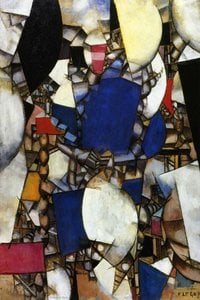
"The Part of Chart," completed in 1917, exemplifies Léger's Tubist aesthetic with remarkable clarity. The painting depicts a group of figures seated on the ground amidst bicycles—a scene deliberately devoid of realistic detail but brimming with symbolic significance. Léger’s masterful use of tubular forms dominates the composition, conveying a sense of movement and suggesting the relentless pace of industrial society.
The palette is restrained yet impactful, utilizing primary colors accented by green, black, and white—a deliberate choice that underscores Léger's commitment to reducing visual information to its most essential components. The fragmented geometric shapes create an illusion of depth and perspective without resorting to traditional techniques, reflecting Léger’s belief in the transformative power of abstraction.
Beyond its formal qualities, “The Part of Chart” speaks to broader themes—community, interaction, and the human condition amidst technological advancement. Léger's simplification isn’t merely stylistic; it serves as a conduit for conveying emotional resonance. The figures are rendered with minimal anatomical detail, prioritizing expressive gesture and posture over precise representation.
Considered a forerunner of Pop Art, Léger’s work anticipates the movement’s fascination with commonplace subjects—the bicycle, in particular—and its rejection of academic conventions. He sought to capture not just what he saw but *how* it felt—a humanist impulse that distinguishes him from many abstract artists of his time.
Fernand Léger’s unwavering dedication to geometric abstraction cemented his place as a pivotal figure in modern art history. His influence extended beyond painting into sculpture, filmmaking, and design—demonstrating the breadth of his artistic vision. Today, reproductions of “The Part of Chart” continue to inspire collectors and interior designers alike, offering a glimpse into Léger’s groundbreaking exploration of form and symbolism.
Для работы «The part of Chart», Леже рекомендуется Living Room. Это предложение основано на сюжете, цветовой гамме и настроении произведения.
Цифровой вариант работы «The part of Chart» можно приобрести как скачивание цифрового изображения в высоком разрешении, оформив заказ непосредственно на странице Цифровое изображение в высоком разрешении.
В творческом наследии Леже работа «The part of Chart» относится к стилю Cubist Tubism и созвучна темам cubist exploration, geometric abstraction, industrial society, dynamism, social commentary, human form, tubism style, pioneering vision.

1881 - 1955 , Франция

Explore the vibrant world of Fernand Léger. Discover how his 'Tubism' and Machine Age aesthetics redefined modern art, offering profound inspiration for discerning collectors seeking geometric beauty and industrial dynamism.

Explore the profound impact of Constructivism on modern art. Discover how geometric abstraction and industrial aesthetics revolutionized design, from avant-garde textiles to architectural mastery, curated for the discerning art collector seeking depth and historical significance.

Explore the profound intersection of industry and artistry. Discover museum-quality reproductions of Machine Age masterpieces by Léger and Rivera, curated for elite collectors seeking to infuse luxury interiors with the powerful, geometric soul of industrial progress.
 Предпросмотр
 Поделиться
 Поделиться
 Детали произведения
 Руководство

 Скачать
 Похожие предметы
 Рентгенография
 Слайд-шоу
 Вопросы и ответы
 Статистика просмотров

 Читать далее









 Вариант со стеклом доступен только для размеров менее 110 см