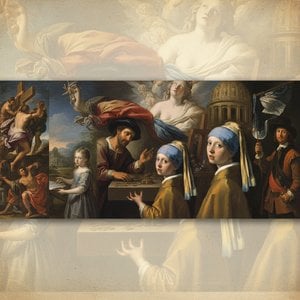
The Holy Trinity (1577) работы Эль Греко, репродукция маслом ручной работы от мастера
Предпросмотр Предпросмотр в AR Перейти к печатным копиям Перейти к цифровым изображениям Поделиться
Детали произведения Руководство Добавить в избранное Скачать Похожие предметы Рентгенография Слайд-шоу Вопросы и ответы Скачать презентацию Статистика просмотров

The Holy Trinity Репродукция картины маслом ручной работы

Размеры
300.0 x 179.0 cm

Experience the ethereal drama of El Greco’s ‘The Holy Trinity,’ a monumental 1577 masterpiece showcasing his signature elongated figures and radiant halos against a turbulent cloudscape – immerse yourself in this iconic Spanish Baroque painting.

Погрузитесь в мир Э Греко! Драматичные картины, длинные фигуры и экспрессивное использование света – гений испанского маньеризма вдохновил художников XX века и продолжает восхищать зрителей.

Масляная репродукция ручной работы

Картина маслом на холсте в выбранном вами размере и раме, написанная на заказ нашими художниками. ( Перейти к печатным копиям Перейти к цифровым изображениям)

Corner sample of the P118B picture frame: формованный полистирол, 5 cm wide and 3 cm thick
P118B $10
Corner sample of the P118H picture frame: формованный полистирол, 5 cm wide and 3 cm thick
P118H $10
Corner sample of the P118W picture frame: формованный полистирол, 5 cm wide and 3 cm thick
P118W $10
Corner sample of the P438Z picture frame: формованный полистирол, 5.5 cm wide and 3.5 cm thick
P438Z $10
Corner sample of the P508JH picture frame: формованный полистирол, 7 cm wide and 3.5 cm thick
P508JH $12
Corner sample of the P508YH picture frame: формованный полистирол, 7 cm wide and 3.5 cm thick
P508YH $12
Corner sample of the P805H picture frame: формованный полистирол, 5 cm wide and 3.5 cm thick
P805H $10
Corner sample of the P805Z picture frame: формованный полистирол, 5 cm wide and 3.5 cm thick
P805Z $10
Corner sample of the P919BZ picture frame: формованный полистирол, 7 cm wide and 3.5 cm thick
P919BZ $10
Corner sample of the P919G picture frame: формованный полистирол, 7 cm wide and 3.5 cm thick
P919G $10
Corner sample of the P919XJ picture frame: формованный полистирол, 7 cm wide and 3.5 cm thick
P919XJ $10
Corner sample of the P959ZH picture frame: формованный полистирол, 5 cm wide and 3 cm thick
P959ZH $10
Corner sample of the P968JZ picture frame: формованный полистирол, 6 cm wide and 4 cm thick
P968JZ $12
Corner sample of the W106C picture frame: массив дерева, 5 cm wide and 3 cm thick
W106C $8
Corner sample of the W218G picture frame: массив дерева, 5 cm wide and 3 cm thick
W218G $10
Corner sample of the W218JH picture frame: массив дерева, 5 cm wide and 3 cm thick
W218JH $8
Corner sample of the W218Y picture frame: массив дерева, 5 cm wide and 3 cm thick
W218Y $10
Corner sample of the W307PJ picture frame: массив дерева, 6 cm wide and 3 cm thick
W307PJ $10
Corner sample of the W316G picture frame: массив дерева, 6 cm wide and 3 cm thick
W316G $10
Corner sample of the W316PJ picture frame: массив дерева, 6 cm wide and 3 cm thick
W316PJ $8
Corner sample of the W316Y picture frame: массив дерева, 6 cm wide and 3 cm thick
W316Y $10
Corner sample of the W398PJ picture frame: массив дерева, 5 cm wide and 3 cm thick
W398PJ $8
Corner sample of the W4111J picture frame: массив дерева, 6.5 cm wide and 3.5 cm thick
W4111J $10
Corner sample of the W500HY picture frame: массив дерева, 7 cm wide and 5 cm thick
W500HY $15
Corner sample of the W500JH picture frame: массив дерева, 7 cm wide and 5 cm thick
W500JH $15
Corner sample of the W692G picture frame: массив дерева, 8 cm wide and 4 cm thick
W692G $12
Corner sample of the W849H picture frame: массив дерева, 5 cm wide and 3 cm thick
W849H $8
Corner sample of the W940BG picture frame: массив дерева, 7.5 cm wide and 4.5 cm thick
W940BG $15
Corner sample of the W953PJ picture frame: массив дерева, 6 cm wide and 3.5 cm thick
W953PJ $8

Стандартный размер
на заказ
CM
INCH

Выберите один из наших стандартных размеров, соответствующих оригинальным пропорциям произведения искусства.

ширина
высота

Введите необходимую ширину и высоту, чтобы репродукция подошла к вашей раме или стене. Поскольку работа выполняется вручную, при изменении пропорций художник может немного увеличить область вокруг картины или, наоборот, обрезать края — выбор за вами. Перед началом работы мы пришлем вам цифровой макет на утверждение. Изображение на этой странице не является точным результатом — увидеть реальный вид можно только на макете.

Примеры возможных изменений: замена лица на фото клиента; добавление домашнего животного (например, замена кошки на собаку); добавление скрытого послания на фоне; изменение пейзажа или элементов фона.
После оформления заказа команда WahooArt.com свяжется с клиентом по электронной почте для уточнения деталей и предоставит предварительный макет

Доставка по всему миру () за 3–4 недели вместо стандартных 5 недель. (8 Ноябрь). Без компромиссов в качестве.

Бесплатная экспресс-доставка по всему миру
Высококачественный льняной холст
Полное страхование при доставке
Гарантия возмещения таможенных пошлин
Гарантия точного цветового соответствия
100-дневная гарантия возврата (только при обнаружении дефектов)
Гарантия возврата 100% средств
Скидка при оптовом заказе

Итоговая стоимость

$ 272

The Holy Trinity

Техника репродукции

Размер репродукции

-

Итоговая стоимость

$ 272

Основные сведения

  • Dimensions: 300 x 179 cm
  • Title: The Holy Trinity
  • Influences: Byzantine art
  • Subject or theme: Religious iconography
  • Year: 1577
  • Notable elements or techniques: Dramatic lighting; elongated figures

Тест на знание искусства

В каждом вопросе только один правильный ответ.

Вопрос 1:
In which year was El Greco's 'The Holy Trinity' completed?
Вопрос 2:
Where did El Greco move in 1577?
Вопрос 3:
Which artistic style is 'The Holy Trinity' considered a cornerstone of?
Вопрос 4:
How many individuals surround Jesus in the painting to represent humanity's yearning for salvation?
Вопрос 5:
Which artist's use of color palette is noted as an influence on El Greco's work in this painting?

A Vision of Divine Grace

El Greco's "The Holy Trinity," completed in 1577, stands as an arresting testament to the artist’s singular vision and a cornerstone of Mannerist painting. More than just a depiction of religious iconography—though undeniably rooted in Byzantine tradition—the canvas pulsates with palpable emotion and anticipates movements that would define artistic expression centuries later. Its dramatic composition and masterful use of color immediately captivate the viewer, drawing them into a realm of spiritual contemplation. The painting portrays Jesus Christ lying on the ground, his arms outstretched in a gesture of profound humility and acceptance. Above him hover three angels—a central triad symbolizing divine unity—their luminous halos casting ethereal light upon the scene. Twelve individuals surround Jesus, representing humanity's yearning for salvation and mirroring the biblical depiction of the Magi witnessing Christ’s birth. This carefully constructed tableau isn’t simply illustrating scripture; it’s conveying an experience of transcendent beauty and spiritual revelation.

The artist's technique is characterized by elongated figures, distorted proportions, and a flattened perspective—elements that deliberately challenge Renaissance conventions. He achieved this expressive distortion through meticulous layering of paint, employing glazing techniques to build up translucent surfaces that shimmer with color and luminosity. The artist's masterful manipulation of light, particularly the dramatic chiaroscuro, intensifies the emotional impact of the scene, highlighting Jesus’ vulnerability and emphasizing the angels’ radiant presence. This deliberate departure from realism wasn’t a rejection of beauty; rather, it was an attempt to capture the inner spiritual reality—the divine essence—that transcends physical form.

Historical Resonance and Symbolic Depth

Painted in Toledo, Spain, during El Greco's exile from Venice, "The Holy Trinity" reflects the anxieties and aspirations of its time. The Spanish Habsburg court commissioned numerous religious artworks to bolster papal legitimacy and solidify royal authority. However, El Greco’s work transcends political concerns, delving into profound theological themes. Venetian artistic influences—particularly the use of color palettes reminiscent of Tintoretto—can be discerned in the painting's vibrant hues, contributing to its overall grandeur and conveying a sense of otherworldly splendor.

The symbolism within the piece is as profound as its visual impact. The Holy Trinity itself embodies fundamental Christian beliefs—Father, Son, and Holy Spirit—representing God as creator, redeemer, and sanctifier. The outstretched arms of Jesus symbolize humility and submission to divine will, while the angels represent heavenly grace and protection. The twelve figures surrounding Christ embody humanity's collective desire for salvation and underscore the universality of faith. El Greco’s deliberate distortions serve not merely aesthetic purposes but also convey a deeper spiritual truth: that God transcends earthly limitations and offers solace to all who seek Him.

Ultimately, "The Holy Trinity" compels viewers to confront questions of faith, mortality, and divine compassion. The painting's luminous colors and dramatic lighting evoke feelings of awe and reverence, transporting the observer into a realm beyond the everyday. It’s a work that speaks to the human yearning for spiritual connection—a reminder that beauty can reside in imperfection and that true understanding requires embracing perspectives that challenge conventional notions of reality. Its enduring power lies in its ability to inspire contemplation and reaffirm the profound significance of faith.

Вопросы и ответы

Какой основной тон у работы «The Holy Trinity»?

В работе «The Holy Trinity», Эль Греко преобладает Amber to Saffron-й оттенок.

Как в «The Holy Trinity», Эль Греко переплетаются художественное направление и эпоха?

В работе «The Holy Trinity», Эль Греко эстетика Baroque Dramatic Lighting встречается с эпохой — Эпоха Возрождения.

Как сочетаются техника и стиль в работе "The Holy Trinity"?

«The Holy Trinity» выполнено в технике Oil On Canvas в стиле Baroque Dramatic Lighting.


Биография художника

Doménikos Theotokópoulos, Known As El Greco – A Pioneer Of Expressionism And Cubism

Doménikos Theotokópoulos, universally recognized as El Greco – “the Greek” – stands apart in the annals of Western art history. Born in Crete, Greece, around 1541, his artistic journey traversed Venice and Rome before finding its definitive expression in the spiritual crucible of Toledo, Spain. He wasn’t merely a product of these locations; he synthesized their diverse influences into an unparalleled style that foreshadowed the emotional fervor of Expressionism and the fragmented forms of Cubism centuries ahead of time. His formative years within the Byzantine tradition instilled in him meticulous attention to detail and a profound understanding of religious iconography – principles that would permeate his entire oeuvre.

Early Training And Venetian Influence

El Greco’s artistic education began in Crete, where he absorbed the stylistic conventions of Byzantium—characterized by serene compositions, stylized figures, and luminous colors. However, his relocation to Venice around 1567 irrevocably altered his trajectory. Immersed in the bustling artistic milieu of the Serenissima Republic, he encountered titans of Venetian painting – Titian, Tintoretto, Veronese – absorbing their mastery of color palettes, compositional strategies, and dramatic lighting techniques. He deliberately loosened his brushwork, embracing the sensual qualities of oil paint and experimenting with dynamic poses that departed from traditional Byzantine conventions. This Venetian influence is palpable in early masterpieces like *St. Sebastian* (1600), where anatomical accuracy harmoniously blends with theatrical illumination—a testament to El Greco’s ability to synthesize disparate artistic traditions.

Roman Exposure And Mannerist Style

A subsequent pilgrimage to Rome exposed him to Mannerism, a stylistic movement that prioritized elongated figures, distorted perspectives, and sophisticated compositional arrangements. While he demonstrated considerable talent within the Roman art world – attracting commissions from prominent patrons – El Greco struggled to gain widespread acclaim amidst the competitive landscape of Florentine artistic circles. Despite facing challenges in establishing himself as a celebrated artist during his formative years, his unwavering dedication to experimentation and innovation would ultimately propel him toward his singular artistic vision.

Toledo And Spiritual Expression

El Greco’s final artistic home was Toledo, Spain—a city steeped in religious fervor during the Counter-Reformation. This environment fostered both patronage and an atmosphere conducive to exploring themes of spirituality and transcendence. It was here that he achieved his most profound artistic breakthroughs, producing works imbued with a palpable sense of emotional intensity and visionary grandeur. His distinctive style – characterized by elongated figures bathed in ethereal light—became synonymous with the expressive power of Mannerism and foreshadowed the stylistic innovations of Expressionism and Cubism. Consider *The Burial of the Count of Orgaz* (1586-1588), a monumental painting that exemplifies El Greco’s masterful blending of Byzantine tradition and Venetian realism. The depiction of a miraculous event—the descent of saints to bury a nobleman—captures the sublime beauty of religious devotion while simultaneously conveying an overwhelming sense of spiritual awe.

Legacy And Recognition

El Greco's artistic legacy extends far beyond his lifetime, resonating powerfully with artists across subsequent eras. His pioneering use of elongated figures and dramatic lighting captivated contemporaries like Picasso and Braque, who recognized him as a precursor to modern art—particularly Cubism—admiring his unconventional perspectives and stylistic boldness. Furthermore, El Greco’s emotive style found kinship with Expressionist painters who sought to convey profound psychological states through vibrant colors and forceful brushstrokes. Today, El Greco is revered as one of the most influential figures in Western art history—a visionary painter whose oeuvre continues to inspire awe and contemplation, securing his place among the titans of artistic innovation and spiritual expression. His paintings remain enduring symbols of faith, emotion, and the boundless capacity of human imagination.
Эль Греко

Эль Греко

1541 - 1614 , Греция

Об авторе

  • Artistic Movement Or Style: Маньеризм, Барокко
  • Artists Or Movements Influenced By This Artist:
    • Экспрессионизм
    • Кубизм
  • Artists Who Influenced This Artist:
    • Тициан
    • Тинторетто
  • Date Of Birth: 1541 г.
  • Date Of Death: 1614 г.
  • Full Name: Доминикс Феотокóпулос
  • Nationality: Греко-Испанский
  • Notable Artworks:
    • Положение Графа Оргаза
    • Вид Толедо
    • Одевание Христа
  • Place Of Birth: Крета, Греция
Откройте для себя произведения искусства, распределенные по темам, стилям и характеристикам.