Картина маслом на холсте в выбранном вами размере и раме, написанная на заказ нашими художниками. ( Купить принт Купить изображение)





























Выберите один из наших стандартных размеров, соответствующих оригинальным пропорциям произведения искусства.

Вы можете указать собственные размеры, чтобы картина идеально вписалась в выбранную раму или пространство. Если выбранный вами размер не соответствует пропорциям оригинала, мы либо обрежем полотно, либо расширим его за счет дополнительных элементов, написанных вручную. Цифровой макет будет отправлен вам на утверждение перед началом производства.
Обратите внимание, что предварительный просмотр на экране не отражает фактическую обрезку или расширение. Только макет точно покажет окончательную композицию.
Хотя доступны индивидуальные размеры, мы рекомендуем выбирать вариант из предопределенного списка, чтобы сохранить исходные пропорции.
Доставка по всему миру () за 3–4 недели вместо стандартных 5 недель. (6 Сентябрь). Без компромиссов в качестве.


MIrage
Размер репродукции
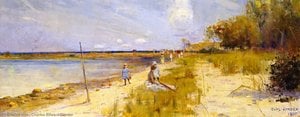
Charles Edward Conder's "Mirage," painted in 1889, isn’t merely a depiction of a landscape; it’s an invitation into a realm where reality subtly bends, inviting contemplation on the ephemeral nature of perception and the allure of the Australian outback. Born in Tottenham, London, Conder’s journey led him to Australia, where he became a pivotal figure within the Heidelberg School – a movement that championed a distinctly Australian artistic voice, rejecting European academic traditions in favor of capturing the light, color, and spirit of the continent.
The painting immediately draws the eye with its vibrant palette. Warm ochres dominate the foreground, punctuated by the cool blues and greens of distant trees and sky. Conder masterfully employs an Impressionistic technique, utilizing loose brushstrokes and broken colors to capture the shimmering heat haze that defines the Australian landscape. This isn’t a photographic representation; rather, it's a subjective experience translated onto canvas – a distillation of light, color, and atmosphere. The composition itself is deceptively simple: a woman holding a ball in her hand, positioned beside a solitary tree against a backdrop of rolling hills. Yet, within this apparent stillness lies a subtle dynamism, a sense of movement created by the play of light and shadow.
While superficially appearing as a charming pastoral scene, “Mirage” is rich in symbolic meaning. The woman holding the ball evokes a sense of carefree leisure – a quintessential image of Australian summer. It speaks to a time of relaxation, social gatherings, and the simple pleasures of life. However, the presence of the ball itself introduces an element of illusion. Balls are often associated with games, entertainment, and even fleeting moments of joy. In this context, it suggests that these experiences, like the mirage itself, can be deceptive – beautiful but ultimately transient.
The solitary tree further amplifies this theme. Trees represent resilience, strength, and connection to the earth. Yet, its isolation within the vast landscape hints at a sense of loneliness or detachment. The woman’s position beside it suggests a moment of quiet contemplation, perhaps questioning the nature of her own place in this world.
"Mirage" exemplifies the core tenets of the Heidelberg School – a group of Australian artists who sought to capture the unique character of their homeland. Unlike their European counterparts, they were deeply interested in portraying the light and color of the Australian landscape, often focusing on scenes of rural life and leisure. Conder’s work is characterized by its vibrant colors, loose brushstrokes, and emphasis on capturing the fleeting effects of light and atmosphere. His use of local pigments and his rejection of academic conventions firmly established him as a key figure in shaping Australian art.
Conder’s skill lies not just in depicting a scene, but in conveying its *feeling*. The painting isn't about literal accuracy; it’s about capturing the subjective experience of being immersed in the heat haze of the Australian outback. The shimmering quality of the landscape, the sense of distance and ambiguity, all contribute to a powerful emotional impact. “Mirage” invites us to question our perceptions, to appreciate the beauty of illusion, and to contemplate the transient nature of life itself. It remains a captivating testament to Conder’s artistic vision and his profound connection to the Australian landscape.

Charles Edward Conder (1868–1909) был британским художником, литографом и дизайнером, который оставил неизгладимый след в мире искусства. Родился он в Топпинге, Мэньшэ́рсхир, Англия 24 октября 1868 года. Его ранние годы были отмечены трагическим событием – смертью матери от инфлюэнцы при возрасте всего четырех лет. Этот опыт оказал глубокое влияние на формирование его мировоззрения и художественного стиля.
В 1884 году Conder переехал в Сидней, Австралия, где работал вместе со своим дядей как геодезист и ландшафтный инженер. Однако вскоре он обнаружил истинную страсть к рисованию пейзажей и отказывался от более практичной работы ради творчества. Уже к 1886 году он стал художником для иллюстрированного Сиднея Ньюс, работая рядом с такими выдающимися художниками как Альберт Генри Фулвуд и Франк Махони. Эти коллеги оказали значительное влияние на его художественное развитие и формирование эстетических взглядов.
Conder стал одним из ключевых представителей немецкой школы в Сиднеи, объединившись с другими талантливыми художниками для создания уникального направления в австралийской живописи. Его наиболее известным произведением является картина «Отправление Востока – Круговая бухта» (1888), которая демонстрирует мастерство использования формы и мазка и была приобретена художественной галереей Нового Южного Уэльса, что стало первым его работами в общедоступной коллекции. Также стоит отметить работу «Отпуск в Ментоне» (1888) – яркий образ жизни и отдыха на берегу моря.
Влияние итальянской живописи эпохи Возрождения и французского импрессионизма особенно заметно в его творчестве. Conder изучал искусство в Париже и работал под руководством таких известных художников как Жюль Юбер и Альфред Сислей, что позволило ему освоить новые техники и привить любовь к красоте природы.
В последующие годы жизнь Condera была омрачена серьезными заболеваниями, включая паралич и эпизод психомоторного расстройства. Несмотря на это он продолжал заниматься живописью и оставил после себя наследие как одного из самых важных художников немецкой школы в Австралии. Его работы были более высоко оценены в Англии, чем во Франции, где его портрет был написан Генри Де Тулуз-Лотреком в 1892 году.

1868 - 1909 , Великобритания

Master the nuances of Impressionism vs. Post-Impressionism with our expert guide. Explore the revolutionary shift from Monet’s fleeting light to Van Gogh’s emotional depth. Discover how these iconic movements continue to inspire fine art collectors and modern interiors today.

 Предпросмотр
 Поделиться
 Поделиться
 Детали произведения

 Скачать
 Похожие работы
 Рентгенография
 Слайд-шоу


 Читать далее







 Вариант со стеклом доступен только для размеров менее 110 см