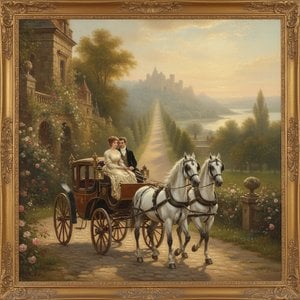
Albert Pinkham Ryder (1847–1917): A Visionary of American Romanticism
Albert Pinkham Ryder, born March 19, 1847, in New Bedford, Massachusetts, remains a somewhat enigmatic figure in American art history. Details of his childhood are scarce, shrouded in the mists that would later become so characteristic of his paintings. However, it is known that he began to explore his artistic inclinations early on, capturing the landscapes of his native New Bedford with nascent skill. This coastal upbringing, steeped in the atmosphere of a bustling whaling port, undoubtedly left an indelible mark on his imagination and would resurface throughout his career as a recurring source of inspiration.
In the late 1860s, Ryder’s family relocated to New York City, where his brother managed the renowned Hotel Albert in Greenwich Village. This move placed young Albert within a vibrant cultural milieu, offering opportunities for artistic development and exposure to new ideas. While assisting with family responsibilities, he continued to pursue his passion for painting, laying the groundwork for his future artistic journey.
Formal Training and European Influences
Ryder’s formal art education began with studies under William Edgar Marshall in New York City. He then enrolled at the National Academy of Design, attending between 1870 and 1875, where he exhibited his first work in 1873 and forged a lifelong friendship with fellow artist Julian Alden Weir. These formative years provided him with a solid foundation in traditional techniques and introduced him to the established art world.
However, Ryder’s artistic vision extended beyond conventional academic training. Between 1877 and 1903, he embarked on four journeys to Europe, immersing himself in the artistic currents of the Old World. He was particularly drawn to the French Barbizon school, with its emphasis on naturalism and plein air painting, and the Dutch Hague School, known for its atmospheric landscapes and muted color palettes. These influences profoundly shaped his aesthetic sensibilities, contributing to the development of his unique style.
A Painter's Soul: Ryder’s Distinctive Style
Ryder’s artistic signature is instantly recognizable—a captivating blend of Symbolism, Tonalism, and a deeply personal vision. His paintings are not mere representations of reality but rather evocative interpretations of nature infused with mood, mystery, and spiritual resonance. He favored broad, often ill-defined shapes and stylized figures set within dreamlike landscapes or seascapes, creating an atmosphere that is both ethereal and haunting.
Light plays a crucial role in Ryder’s work. His scenes are frequently illuminated by dim sunlight filtering through eerie clouds or the soft glow of moonlight, casting long shadows and enhancing the sense of drama and introspection. He masterfully manipulated color to create subtle variations and atmospheric effects, often employing a limited palette to achieve maximum emotional impact.
Notable Works and Legacy
Ryder’s most celebrated paintings include Misty Moonlight (ca. 1893), which captures the sublime beauty of coastal New Bedford under an overcast sky—a testament to his ability to distill nature's essence into a single, unforgettable image. Also noteworthy are The Race Track (1894) and Siegfried & Rhine Maidens (1896), where Ryder explored mythological themes with symbolic imagery and expressive brushwork.
Ryder’s influence extends far beyond his immediate contemporaries. His emphasis on form, color, and emotional expression paved the way for later generations of artists, including Jackson Pollock, who acknowledged Ryder as a significant precursor to Abstract Expressionism. He remains celebrated as a pioneer of American Tonalism and Symbolism, an artist whose mystical paintings continue to inspire awe and wonder.
Lloyd Goodrich says that Ryder is “one of the few authentic religious painters of his period” in whom religion was not mere conformity, but deep personal emotion. The life of Christ moved him to some of his most tender and impressive works.



 Предпросмотр
 Купить картину ручной работы
 Поделиться
 Поделиться
 Детали произведения

 Скачать
 Похожие работы
 Рентгенография
 Слайд-шоу
 Stats
Stats


 Читать далее






































 Вариант со стеклом доступен только для размеров менее 110 см